

Full disclosure: We built Pascal, an AI coaching platform. We don't have rigorous independent research yet—AI coaching is too new. What we have is vendor data (including ours), customer reports, and usage metrics. That's not enough to declare victory, but it's enough to see patterns.
The question: can AI coaching deliver real management improvement, or is it expensive software that managers ignore?
Here's what we know after two years: AI coaching costs $100–$300 per employee annually. Human coaching costs $15,000–$25,000 per person. AI reaches your entire workforce. Human coaches serve 2–5% of managers. But cost means nothing if the tool doesn't work.
Most managers never get coaching. Not because companies don't care. Because human coaching costs $20,000 per person and scales to maybe 50 people in a 1,000-person company.
What happens to everyone else? They struggle through difficult conversations alone. They give vague feedback because they don't know how to be specific. They avoid delegating because the conversation feels awkward. They prepare for performance reviews the night before.
A manager who can't delegate wastes hours weekly on work someone else should do. A manager who gives poor feedback loses good employees. A manager who avoids difficult conversations lets problems fester until they require HR intervention.
Traditional training doesn't fix this. Managers attend a workshop, learn a framework, then forget 74% of it within weeks (SafetyCulture research on training retention). The gap between learning and application kills retention.
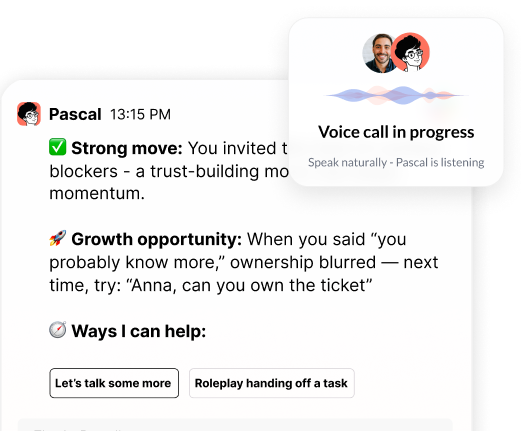
AI coaching lives in Slack or Teams. A manager types "I need to give difficult feedback to Sarah about missing deadlines." The system responds in 30 seconds with a framework: how to open the conversation, what questions to ask, how to listen for defensive responses.
Here's what that looks like:
Manager: "I need to give difficult feedback to Sarah about missing deadlines."
AI Coach: "Start with a specific example. Try: 'Sarah, the client report was due Tuesday at 9am. It arrived Thursday at 2pm. This is the third time this month a deadline was missed. Help me understand what's happening.'
Then pause. Let her explain before you problem-solve. If she gets defensive, acknowledge her feelings: 'I hear that you're frustrated. Let's focus on what we can control going forward.'
What's one deadline she's missed recently? Let's practice the opening."
The manager practices the conversation, gets feedback on her approach, then has the real discussion an hour later. She applies the framework while it's fresh, not three weeks after a workshop.
This works for routine management challenges: preparing for 1:1s, delegating tasks, giving feedback, running meetings, coaching on communication style. The AI provides structure for conversations managers have weekly.
Three situations require human coaches: executive transitions with high business impact, crisis interventions with legal exposure, complex organizational politics.
A first-time CEO learning board management needs someone who's held that role. The business impact (decisions affecting $10M+ in revenue, 200+ employees) justifies $25,000 annually. An algorithm can't share war stories from similar transitions.
Performance improvement plans, team conflicts with legal exposure, leadership failures requiring termination need human judgment. When lawyers might get involved, you need confidentiality and advice that accounts for context an AI can't see.
A VP navigating a merger where two departments compete for resources needs a coach who understands power dynamics, reads between lines in executive conversations, and helps plan multi-month influence campaigns. This requires relationship depth built over months of scheduled calls, not transactional exchanges in Slack.
Human coaching works through trust. Scheduled video calls every two weeks. The manager describes a situation, the coach asks questions, they explore patterns over months. The relationship enables harder conversations about leadership gaps or career doubts that managers won't type into a chatbot.
AI coaching handles skill development. Human coaching navigates politics and crisis.
Data Breakdown:
• Metric: Cost per employee annually | AI Coaching: $100–$300 | Human Coaching: $15,000–$25,000
• Metric: Who it reaches | AI Coaching: 100% of workforce | Human Coaching: 2–5% of managers
• Metric: Response time | AI Coaching: Immediate (30 seconds) | Human Coaching: Scheduled (bi-weekly sessions)
• Metric: Best for | AI Coaching: Routine skill development: feedback preparation, delegation, 1:1 meetings | Human Coaching: Executive transitions, crisis intervention, organizational politics, high-stakes decisions
• Metric: Scalability | AI Coaching: Unlimited | Human Coaching: Limited by coach availability
• Metric: Relationship depth | AI Coaching: Transactional, framework-based | Human Coaching: Deep, trust-based over months
The comparison isn't which is better overall, but which tool fits which situation. AI coaching reaches 100% of your managers for everyday challenges. Human coaching serves your top 5% facing high-stakes decisions with significant business impact.
Pascal's internal metrics show managers use the platform 60–80% of weeks. Other AI coaching vendors report similar patterns. This is 3–4x higher than traditional learning platforms (which see 15–30% usage).
Usage doesn't prove effectiveness, but it's a prerequisite. A tool managers ignore can't change behavior.
Here's what we don't know: long-term effectiveness compared to human coaching, failure rates and common mistakes, which situations AI handles poorly, what happens in companies that stop using the platform.
We're collecting this data but haven't published it. That's a credibility gap we need to close.
The conservative claim: AI coaching solves a real problem (most managers who need support can't access it under traditional models). The economics work. The usage data suggests managers find it valuable. But we're making effectiveness claims based on vendor data and customer reports, not independent research.
AI coaching platforms flag sensitive topics for human intervention: harassment complaints, discrimination concerns, mental health crises, legal issues. These get routed to HR or appropriate resources.
The risk: generic chatbots without workplace-specific guardrails can give inappropriate advice. A manager asks about terminating an underperformer, the AI suggests documenting performance issues, but the employee is on protected medical leave. Bad advice creates legal exposure.
Pascal includes safety systems designed for workplace contexts. SOC2 compliance means your data meets enterprise security standards (encrypted in transit and at rest, access controls, regular security audits). The platform doesn't train on customer data, so your conversations stay private.
But we don't have good failure mode data yet. When does AI coaching give bad advice? What mistakes do managers make? We're collecting this information but can't publish patterns yet.
Deploy AI coaching to frontline and mid-level managers (team leads with 3–10 reports, department heads with 10–50 reports). Reserve human coaching for C-suite executives and high-stakes situations.
This increases total coaching coverage from 5% of managers to 100% while maintaining human support where it matters most.
For a 500-person company with 100 managers: human coaching for everyone costs $1.5M–$2.5M annually. AI coaching costs $30K–$50K for the same group. The savings fund human coaching for your top 10 executives.
Start with one department. Measure adoption and behavior change over 90 days. Expand based on results.
Track four metrics: weekly active usage (target 60–80%), direct report feedback on manager improvement (ask reports "Has your manager's feedback quality improved in the past 90 days?", target 70%+ yes), manager satisfaction with the tool (target Net Promoter Score of +30 or higher), time saved in HR support (track how many "how do I handle this conversation?" requests HR receives, target 30% reduction).
These metrics prove whether your investment changes behavior or becomes expensive shelfware.
Early versions of Pascal gave generic advice that didn't account for company culture. A framework that works at a startup doesn't work at a bank. We now integrate company values and role competencies, but customization remains hard.
AI coaching works poorly for managers who process verbally. Some people need a human conversation to think through problems. We're building voice interfaces, but text-based coaching excludes some learning styles.
We don't have good data on what happens when companies stop using the platform. Do the skills stick? Do managers revert to old habits? We need longitudinal studies we don't have yet.
AI coaching solves a real problem: most managers who need support can't access it under traditional models. The economics work. The usage data suggests managers find it valuable.
But we're making effectiveness claims based on vendor data and customer reports, not independent research. That's not enough evidence to declare AI coaching equivalent to human coaching across all situations.
The conservative approach: deploy AI coaching for routine skill development where the downside risk is low. Reserve human coaching for high-stakes situations where bad advice creates real damage.
The aggressive approach: deploy AI coaching broadly, measure results rigorously, and adjust based on what you learn. This requires tracking behavior change, not just usage metrics.
Most companies will end up somewhere in between. AI coaching for frontline managers handling routine challenges. Human coaching for executives navigating complex politics and crisis situations.
The question is whether partial coverage for everyone beats deep coverage for 5% of managers. We think it does, but we're still collecting the evidence to prove it.
• AI coaching costs $100–$300 per employee annually versus $15,000–$25,000 for human coaching
• AI handles routine skill development; human coaches navigate complex politics and crisis situations
• Usage data shows 60–80% weekly adoption, but independent effectiveness research is limited
• Deploy AI coaching for frontline managers, reserve human coaching for executives and high-stakes situations
• Most effectiveness data comes from vendors reporting their own metrics (including ours)
See how Pascal works at https://heypinnacle.com
Header photo by Christina @ wocintechchat.com M on Unsplash

.png)
.webp)
“Thank you for setting the great foundation for my promotion; now I have a plan!"

Curious to see how AI Coaching can 10X the impact and scale of your development initiatives. Book a demo today for: