
Blog article
AI in HR: What CHROs told us at the November roundtable
Key insights from Pinnacle's November CHRO roundtable on what's working in AI enablement and adoption across leading organizations.


Performance reviews are entering a new phase. Citi and JP Morgan are experimenting with AI tools that draft evaluations and consolidate inputs. Analysts at Forrester are encouraging leaders to use AI to check reviews for tone and fairness. Legal experts are already warning that improper use could create bias, compliance issues, and privacy concerns.
The momentum is real. Companies want consistency, less administrative work, and reviews that feel more objective. Yet a key insight often gets lost in the excitement.
Performance reviews only drive growth when they contain concrete, observable examples.
Examples shape behavior change. They help employees understand what to repeat or adjust. They build trust in the fairness of the process. When examples are missing, reviews drift toward generalities that neither motivate nor clarify.
Many teams use AI as a ghost writer. A manager inputs a prompt and receives a polished paragraph. The tone is confident. The content is often disconnected from an employee’s actual work. Forrester notes that this creates feedback that sounds thorough yet lacks the detail employees need to improve.
Another risk sits beneath the surface. Models trained on historical reviews may replicate the same biases those reviews contained. Legal experts caution that this exposes organizations to Title VII, ADA, and state-level algorithmic bias obligations. Even when a tool comes from a vendor, liability remains with the employer.
Both challenges point to the same problem.
AI cannot write a meaningful review without meaningful inputs.
Managers often struggle to recall the moments that matter. A year of meetings compresses into a handful of impressions. The missing examples become the missing foundation.
Three elements consistently strengthen performance reviews:
Tools that produce generic summaries solve for speed. They do not solve for quality. The value of AI comes from helping managers capture and organize the right inputs, not replacing human judgment.
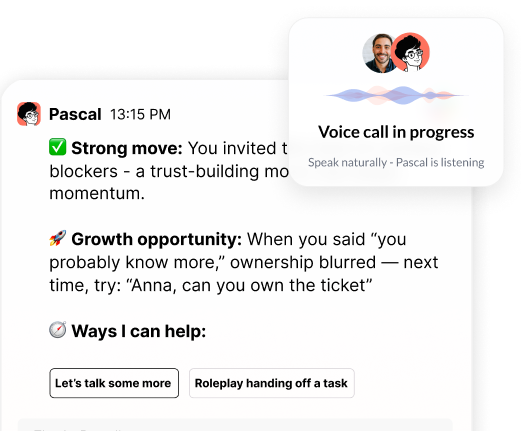
At Pinnacle, we developed Pascal, our AI Coach, because reviews break down at the source of information, not at the end of the process. Managers forget key moments. Employees receive feedback without context. Calibration becomes harder because the underlying material is thin.
Pascal joins meetings with managers, captures meaningful examples in real time, and organizes them so the review cycle starts with stronger inputs. When employees see specific moments connected to their work, the conversation becomes fairer, clearer, and more actionable. Managers write better evaluations because they are working from real substance rather than memory.
AI will continue entering performance management. The leaders who see the full picture will focus less on automated writing and more on building a system that supports clarity year-round. Strong reviews come from strong examples. Strong examples come from capturing them as they happen.
This is the shift that improves fairness, strengthens manager capability, and reduces compliance risk. It is also the shift that makes AI coaching genuinely valuable.
Performance reviews should help people grow. The right inputs make that possible.

.png)
.webp)
“Thank you for setting the great foundation for my promotion; now I have a plan!"

Curious to see how AI Coaching can 10X the impact and scale of your development initiatives. Book a demo today for: