

AI coaching personalizes to company values by ingesting your leadership frameworks, competency models, and cultural documentation, then applying these standards in every coaching interaction. When a manager asks for feedback advice, the system recommends your specific model (not generic best practices), cites your leadership competencies, and aligns with your cultural values.
This requires three things: documented competency frameworks, integration with daily workflows (Slack, Teams, meetings), and 60–90 days of iteration to tune the system to your culture.
Personalization means the AI references your frameworks first, not generic leadership theory. Your competency models, values documentation, and leadership principles become the primary reference layer.
The system ingests your organizational content through document upload (PDFs, Google Docs, internal wikis). You provide culture decks, competency frameworks by level, feedback models, performance management guidelines, and approved templates. The platform parses this content and prioritizes it above baseline knowledge.
Different teams can receive function-specific coaching. Engineering managers get guidance aligned with technical leadership competencies. Sales managers get coaching reflecting customer-facing skills. The system identifies team membership through org chart data or role tags.
If you're driving a cultural shift (consensus-driven to "disagree and commit"), you document the new behavior with specific examples. The AI then reinforces this change when managers face relevant situations. A manager deliberating in Slack for three days on a reversible decision gets prompted: "Your 'disagree and commit' value suggests making this call today. Here's your framework for one-way versus two-way door decisions."
Generic tools like ChatGPT provide leadership advice based on broad principles. They can't tell a manager at your life sciences company how to navigate a performance conversation using your specific feedback framework. They don't know your competency definitions, your escalation procedures, or your cultural values.
Traditional coaching offers deep personalization but costs $2,000–5,000 per engagement and reaches only senior leaders. According to Gartner research, only 12% of employees have access to professional coaching. In most organizations, that's 50–100 leaders. Personalized AI reaches all 2,000 managers at $20–50 per person per month.
Data Breakdown:
• Approach: Generic AI | Knows Your Values: No | Available 24/7: Yes | Cost per Manager: $20/month | Reaches All Levels: Yes
• Approach: Traditional Coaching | Knows Your Values: Sometimes | Available 24/7: No | Cost per Manager: $2,000–5,000/engagement | Reaches All Levels: No
• Approach: Personalized AI | Knows Your Values: Yes | Available 24/7: Yes | Cost per Manager: $20–50/month | Reaches All Levels: Yes
The scalability difference: traditional coaching reaches 5% of your managers; personalized AI reaches 100% at 1% of the cost while maintaining alignment with your frameworks.
Four content layers drive effective personalization:
Culture and values documentation: mission statements, culture decks, behavioral expectations, transformation initiatives you're driving.
Competency frameworks: leadership competencies by level, technical skill matrices, role-specific behavioral standards.
Training materials: internal training content, your chosen frameworks (Situational Leadership, Radical Candor, SBI feedback model), approved templates.
Policies and processes: performance management guidelines, escalation procedures, legal guardrails.
The richer this foundation, the more precisely the AI coaches to your standards. Companies without documented competencies should create them first. AI can't personalize to frameworks that don't exist.
Pascal customizes at company and department levels. You upload content once, then configure which frameworks apply to which teams. Engineering teams see technical leadership competencies. Sales teams see customer-facing skills. This ensures relevance without separate systems.
The system identifies moments in real work where your values apply, then provides feedback aligned with those values. This happens through integration with communication platforms.
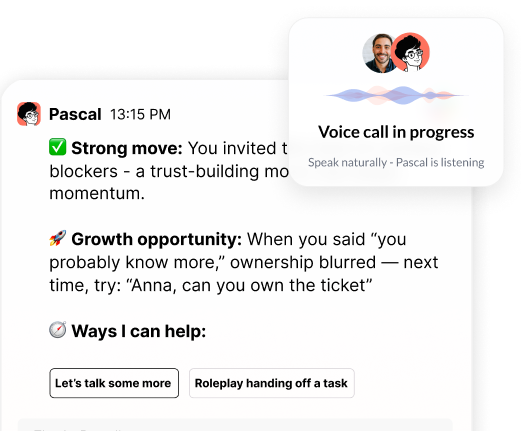
When a manager asks for help with a difficult conversation, the system coaches to your "Constructive Feedback" competency definition with your specific language and examples. It links to your templates and training materials, not generic internet advice.
Every manager receives coaching aligned with the same competency definitions. This eliminates the inconsistency of 50 different human coaches interpreting frameworks differently.
A tech company with 500 employees (NDA prevents naming) wanted to shift from consensus-driven to "disagree and commit" culture. They uploaded their new cultural framework to Pascal with specific behavioral examples: "When you face a two-way door decision, gather input for 48 hours maximum, then decide. Document your reasoning and move forward."
Pascal began recognizing decision-making moments in manager communications. When a manager posted "Still thinking through this vendor choice, want to make sure everyone's comfortable" on day three of discussion, the system prompted: "This appears to be a reversible decision. Your 'disagree and commit' framework suggests deciding today. Here's how to document your reasoning and move forward."
Within 90 days, the company measured decision velocity through Jira ticket cycle time and meeting notes analysis. Average time from discussion start to decision dropped from 8.2 days to 4.1 days for reversible decisions.
Yes, if you have 200–4,000 employees and documented competency models. The ROI calculation: traditional coaching reaches 5% of your managers at $3,000 per person ($150,000 for 50 managers). Personalized AI coaching reaches 100% of managers at $20–50 per person per month ($48,000–120,000 annually for 200 managers).
You need three things: documented competency frameworks or leadership principles, commitment to embedding coaching in daily workflows, and willingness to iterate on customization over 60–90 days.
Mid-sized companies face the steepest challenge. You're too large for everyone to know the culture intuitively, too small to afford coaching for all managers. Without personalized AI coaching, you're left with generic tools that contradict your culture or expensive human coaching that reaches only executives.
Measurement requires three data streams:
Manager relevance feedback: Weekly pulse questions: "Did this coaching reflect how we do things here?" and "Would you apply this advice?" If scores drop below 80%, your customization needs work.
Behavioral change tracking: Compare manager actions before and after coaching moments against your competency definitions. Did they use your feedback model? Did they escalate appropriately? Track adoption rates for specific frameworks.
Aggregated interaction analysis: Review patterns across all coaching conversations (anonymized). If your value is "transparency" but the AI consistently recommends withholding information, you have a misalignment. Pascal provides dashboards showing which competencies are being coached most frequently and whether behaviors shift in the desired direction.
Combine quantitative metrics with qualitative review. Have your L&D team spot-check coaching conversations monthly. Do managers get advice that sounds like your culture? Would your best leaders give similar guidance?
Conflicts reveal gaps in your customization or documentation. When the AI recommends an approach that contradicts your values, your organizational content wasn't specific enough or the system's baseline knowledge is overriding your frameworks.
Immediate fixes: Update your values documentation with specific behavioral examples. If your value is "candor" but the AI suggests softening critical feedback, add examples of what candid feedback looks like in your culture: "At our company, candid feedback means naming the specific behavior, explaining the impact, and proposing a path forward—all in the same conversation, not spread across weeks."
Adjust the system's prioritization settings to weight your content more heavily. Most platforms allow you to set organizational content as the primary reference layer.
Pascal includes moderation systems that flag potential conflicts. When coaching touches legal, ethical, or cultural boundaries, the system either provides guardrailed guidance or directs the manager to human support.
Treat AI coaching as a living system. Your culture evolves. Your competencies shift. Quarterly reviews of coaching patterns help you spot drift before it becomes problematic. The goal is continuous improvement toward your cultural standards, not perfect alignment from day one.
Organizations that succeed treat conflicts as learning opportunities. Each misalignment reveals something about how clearly you've documented your culture or how well the system understands your priorities.
• Personalized AI coaching embeds your specific competencies, values, and leadership frameworks into coaching logic through document ingestion and prioritization settings
• The system reaches 100% of managers at $20–50 per person per month (1% the cost of traditional coaching) while maintaining cultural alignment that generic chatbots can't provide
• Effective personalization requires four content layers: culture documents, competency frameworks, training materials, and policies—with departmental customization for function-specific needs
• Measurement combines manager relevance scores (target: 80%+), behavioral change tracking against your competencies, and aggregated interaction analysis to ensure the AI reinforces your values
• Implementation requires documented frameworks, integration with daily workflows, and 60–90 days of iteration to tune the system to your culture
Pascal delivers AI coaching personalized to your company's values, competencies, and culture. The platform integrates with Slack, Teams, and meetings to provide context-aware coaching that scales to every manager. Learn more about Pascal or schedule a demo to see how we customize coaching to your organization.
Header photo by Campaign Creators on Unsplash

.png)
.webp)
“Thank you for setting the great foundation for my promotion; now I have a plan!"

Curious to see how AI Coaching can 10X the impact and scale of your development initiatives. Book a demo today for: