

AI coaching personalizes to company values by ingesting your leadership frameworks, cultural documentation, and behavioral standards, then applying these definitions in every coaching interaction. Your managers get recommendations aligned with how your company defines success, not generic management theory.
Personalization means embedding your values statements, competency models, and leadership principles directly into the AI coaching system's knowledge base. When a manager asks Pascal by Pinnacle for feedback guidance, the system recommends your specific feedback model (like SBI if that's your standard), references your leadership competencies by name, and aligns suggestions with your cultural values.
This requires three components: documented competency frameworks uploaded to the platform, values statements tagged by department and function level, and leadership principles integrated into the AI's decision-making logic.
Generic AI gives universal advice. Personalized AI coaching applies your organizational standards—the specific language, frameworks, and expectations that define success in your culture.
Generic AI vs. Values-Aligned AI Coaching
Data Breakdown:
• Scenario: Manager needs to give critical feedback | Generic AI Response: Recommends SBI model | Values-Aligned Response: Recommends your feedback model, cites your "Growth Mindset" value, links to internal feedback guide
• Scenario: Delegation challenge | Generic AI Response: Suggests general delegation frameworks | Values-Aligned Response: References your delegation competency definition, suggests development actions from your framework
• Scenario: Conflict resolution | Generic AI Response: Provides universal de-escalation tactics | Values-Aligned Response: Applies your "Respectful Directness" cultural principle, aligns with your escalation pathways
Values-aligned AI coaching transforms development from generic capability-building into cultural reinforcement that scales your leadership philosophy to every manager. Traditional training programs teach universal frameworks, then hope managers adapt them to your culture. Values-aligned AI coaching starts with your culture.
Cultural consistency at scale eliminates variance between what headquarters teaches and what satellite offices practice. A first-time manager in Singapore receives the same development as one in San Francisco—both grounded in your approach to leadership.
New managers learn your approach from day one, not generic management theory they'll need to unlearn. When Pascal customers embed their competency frameworks, new managers reference organizational standards in real situations.
"If we can democratize coaching—make it specific, timely, and integrated into real workflows—we solve one of the most chronic issues in the modern workplace," notes Melinda Wolfe, former CHRO at Bloomberg, Pearson, and GLG.
Configuration requires uploading your competency frameworks, skill definitions, and development guidance through the platform's admin portal, then tagging these materials by role, department, and seniority level. Pascal allows HR teams to embed competencies, training materials, policies, programs, and culture documentation at both company and department levels.
Configuration process:
• Audit existing competency documentation — Gather leadership frameworks, skill matrices, performance rubrics, and development guides
• Upload materials through admin portal — Add documents with metadata tags (department, function, level) so the AI knows when to apply each framework
• Define priority competencies — Flag which competencies the AI should emphasize based on organizational priorities
• Test with pilot group — Validate alignment with a small group of managers before organization-wide rollout
The system creates links back to your documented resources during coaching conversations. When a manager asks about delegation, the AI references your delegation competency, links to your internal delegation guide, your delegation skill matrix, and relevant training modules.
Customization extends to individual-level personalization. Beyond company frameworks, the system can incorporate performance reviews, 360 feedback results, and personality assessments (DISC, Myers-Briggs) to tailor guidance to each manager's development needs within your organizational context.
Values-aligned AI coaching delivers recommendations grounded in your organization's documented standards and cultural expectations. Generic approaches provide universal best practices that may conflict with how your company operates. A generic AI might recommend "radical candor" for difficult conversations, while your values-aligned system recommends your "respectful directness" framework that balances transparency with your collaborative culture.
Terminology consistency matters. If your company uses "Ownership" as a core value instead of "Accountability," values-aligned coaching uses your language. This is how managers internalize and apply your cultural expectations.
Policy compliance becomes automatic. Values-aligned systems know your escalation pathways, your HR policies, your legal guardrails. When a manager faces a sensitive situation, the AI references your policies and escalation procedures.
Cultural reinforcement happens in every interaction. Generic AI might suggest five different feedback models across five conversations. Values-aligned AI consistently reinforces your feedback model, building muscle memory around your approach.
"Real learning and value come from in-context coaching—solving problems in the moment, not in a classroom," explains Jeff Diana, former CHRO at Calendly, Atlassian, and SuccessFactors.
Personalized AI coaching scales your organizational frameworks to every manager at a fraction of traditional coaching costs. Human coaching remains valuable for complex, high-stakes situations requiring nuanced judgment. Pascal delivers 24/7 in-the-flow coaching customized to both company context (competencies, values, culture) and individual context (performance reviews, personality tests, career aspirations).
Cost comparison:
• Traditional executive coaching: $10,000–$25,000 per person annually
• AI coaching: $100–$250 per person annually
Availability creates the real advantage. Human coaches book weeks out for scheduled sessions. AI coaches respond in seconds when managers face actual decisions. That timing difference transforms development from a scheduled event into continuous learning.
Consistency eliminates quality variance. Human coaches vary in expertise, approach, and quality. AI coaches apply identical frameworks across the organization.
Scalability changes who gets coaching. Traditional coaching reaches 5–10% of leaders—typically senior executives. AI coaching reaches 100% of managers.
The complementary model works best. AI handles daily guidance—feedback preparation, delegation decisions, communication challenges. Human coaches tackle career transitions, executive presence development, political navigation, and other situations requiring human judgment.
An effective AI coach needs three layers of data: organizational context (values, competencies, policies), individual context (performance data, goals, personality assessments), and interaction context (meeting observations, communication patterns, relationship dynamics). Pascal combines these layers to deliver guidance aligned with your company's standards and personalized to each manager's situation.
Organizational context includes:
• Leadership competency frameworks and skill definitions
• Company values statements and culture documentation
• Training materials, playbooks, and internal guides
• Policies, escalation pathways, and compliance requirements
Individual context incorporates:
• Performance review data and 360 feedback results
• Career goals and development priorities
• Personality assessments (DISC, Myers-Briggs)
• Role-specific responsibilities and team dynamics
Interaction context comes from:
• Meeting participation and communication patterns
• Observed team interactions and relationship dynamics
• Real-time coaching requests and questions
• Behavioral patterns over time
Pascal is SOC2 compliant and never uses customer data to train models. All data remains within your organization's control, with appropriate access restrictions and security measures.
When a manager asks for feedback guidance, the system knows your feedback framework, understands this manager's development areas from performance reviews, recognizes patterns from their team interactions, and delivers guidance that addresses their situation using your organizational standards.
ChatGPT has no organizational context, no individual context, and no interaction history. It provides universal advice. Purpose-built AI coaching platforms use your data to deliver guidance that's both organizationally aligned and individually relevant.
Measure values reinforcement through three mechanisms: behavioral observation data showing managers applying your frameworks, sentiment analysis of coaching interactions revealing terminology alignment, and outcome metrics demonstrating improvement in your defined competencies. Pascal provides analytics dashboards showing which organizational frameworks managers reference most, how frequently they apply your models, and whether their team interactions reflect your cultural values.
Quantitative metrics include:
• Framework application rates (how often managers use your models)
• Competency improvement scores aligned to your definitions
• Policy compliance rates in sensitive situations
• Cultural terminology usage in coaching interactions
Qualitative indicators reveal:
• Manager testimonials referencing your values
• Team feedback mentioning organizational frameworks
• Coaching conversation analysis showing cultural alignment
• Escalation patterns matching your defined pathways
Outcome measurements track:
• Direct report improvement rates
• Manager effectiveness scores
• Time-to-competency for new managers
• Cultural consistency across locations
The analytics should measure whether coaching is changing behavior in ways that align with your organizational standards. Generic engagement metrics (logins, session length) don't tell you if managers are internalizing your approach to leadership.
Pascal's aggregated, anonymized insights protect individual privacy while giving HR leaders visibility into cultural adoption patterns. You can see which competencies need more reinforcement, which frameworks resonate most, and where gaps exist between your stated values and actual management practices.
The most common pitfall is uploading documentation without integration—treating the AI as a document repository rather than a coaching system that actively applies your frameworks. Organizations dump their competency models into the platform, then wonder why coaching still feels generic. The AI needs explicit instruction on when and how to apply each framework, not just access to the documents.
Other mistakes include:
Over-customization that creates complexity. Some organizations try to encode every nuance of their culture, creating frameworks so complex the AI can't apply them consistently. Start with core values and primary competencies, then layer in complexity based on actual usage patterns.
Under-customization that wastes the opportunity. Other organizations barely customize at all, using expensive AI coaching as a generic chatbot. If your AI coach could work at any company, you're not getting the value of personalization.
Inconsistent documentation across departments. When different business units use different terminology for the same competencies, the AI can't deliver consistent coaching. Standardize your frameworks before embedding them, or explicitly map variations.
Neglecting the feedback loop. Personalization isn't one-time configuration—it's ongoing refinement based on how managers use the system. Organizations that set-and-forget their customization miss opportunities to improve alignment over time.
Ignoring the human coaching complement. AI coaching personalized to your values works best alongside human coaching for complex situations. Organizations that try to replace all human coaching miss the nuance that experienced coaches bring to career development and political navigation.
Treat AI coaching personalization as a strategic initiative, not a technical implementation. Involve your best coaches in defining how frameworks should be applied. Test with pilot groups. Iterate based on real usage. Measure whether coaching is changing behavior in ways that align with your culture.
• AI coaching personalizes to company values by ingesting your leadership frameworks, competency models, and cultural documentation, then applying these standards in every coaching interaction—transforming generic advice into guidance that reinforces your approach to leadership
• Configuration requires uploading competency frameworks through the admin portal, tagging materials by role and department, and defining priority competencies—ensuring the AI applies the right standards to the right people at the right time
• Values-aligned AI coaching delivers recommendations grounded in your documented standards and cultural expectations—using your terminology, referencing your frameworks, and aligning with your policies rather than providing universal best practices
• Personalized AI coaching scales organizational frameworks to every manager at a fraction of traditional coaching costs—making development accessible to 100% of managers while maintaining consistency with your leadership philosophy
• Measure values reinforcement through behavioral observation data, sentiment analysis of coaching interactions, and outcome metrics—tracking whether managers apply your frameworks and whether their behavior reflects your cultural values
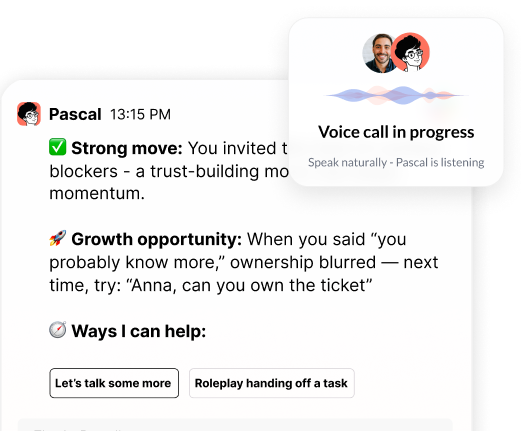
Ready to see how AI coaching can reinforce your values and competencies? See how Pascal works inside Slack to deliver values-aligned coaching at scale.
Header photo by Christina @ wocintechchat.com M on Unsplash

.png)
.webp)
“Thank you for setting the great foundation for my promotion; now I have a plan!"

Curious to see how AI Coaching can 10X the impact and scale of your development initiatives. Book a demo today for: