

Responsible AI coaching requires purpose-built AI coaches with contextual awareness, clear governance frameworks, human escalation protocols, and privacy-first architecture. Without these guardrails, organizations expose themselves to compliance risks, cultural misalignment, and failed adoption.
Responsible scaling means deploying AI coaching with intentional guardrails that protect employee privacy, maintain coaching quality, and align with organizational values.
The foundation is privacy architecture. AI coaches must maintain SOC2 compliance, never train on customer data, and keep individual coaching conversations confidential. Without this trust foundation, employees turn off the tool and the investment fails.
Governance frameworks include moderation flags for inappropriate content, sensitive topic escalation to human experts, and organization-specific controls that reflect your legal and cultural boundaries. These features decide whether a coaching system becomes a trusted daily resource or a source of legal exposure.
Purpose-built AI coaches integrate your company's values, competencies, and culture. Generic AI tools lack organizational context, creating compliance risks and inconsistent guidance. The difference shows up immediately in manager trust and adoption rates.
Responsible AI coaches include built-in guardrails, contextual awareness, and human escalation protocols that generic tools lack entirely.
Generic AI tools provide no organizational context. Every response is divorced from your company's values and leadership principles. Conversations may train future models, exposing sensitive business information. There's no human backup for complex situations and no moderation or content filtering.
Purpose-built AI coaches integrate into Slack, Teams, Zoom, and Meet, so coaching happens in the flow of work inside the tools managers already use. They provide anonymous, aggregated insights for HR teams without exposing individual conversations.
Comparison: responsible and generic AI coaching
Data Breakdown:
• Dimension: Organizational Context | Generic AI Tools: Generic responses, no company knowledge | Responsible AI Coaches: Customized to your values, competencies, culture
• Dimension: Privacy Controls | Generic AI Tools: Conversations may train future models | Responsible AI Coaches: SOC2 compliant, zero training on customer data
• Dimension: Escalation Protocols | Generic AI Tools: No human backup for complex situations | Responsible AI Coaches: Flags potential harm for review and redirects terminations and harassment to HR or People teams
• Dimension: Governance | Generic AI Tools: No moderation or content filtering | Responsible AI Coaches: Moderation flags, organization-specific controls
• Dimension: Data Visibility | Generic AI Tools: No aggregate insights for HR | Responsible AI Coaches: Anonymous, aggregated insights without individual exposure
• Dimension: Integration | Generic AI Tools: Standalone tool, separate from workflow | Responsible AI Coaches: Plugged into Slack, Teams, Zoom, Meet, with coaching in the flow of work
Heavily regulated industries require zero-day data retention capabilities: AI coaches that can delete transcripts while still capturing behavioral insights. If employees feel monitored, they'll turn off the tool and the value disappears.
CHROs should establish a four-layer governance framework before scaling: ethical guidelines defining appropriate use cases, technical controls limiting data access and retention, escalation protocols routing complex situations to human experts, and measurement systems tracking both adoption and coaching quality.
The ethical guidelines layer defines which coaching scenarios suit AI, such as routine feedback, skill development and goal-setting, and which ones need a human. Potential harm is flagged for review, and topics like terminations, harassment, medical issues and employee grievances are redirected to the HR or People team, or to EAP. This clarity protects both employees and the organization.
Technical controls implement data residency requirements, custom retention windows, and the ability to blacklist specific sensitive meetings or teams so the AI coach never joins them. For the most conservative security environments, AI coaches can provide coaching insights without saving transcripts, using zero-day retention to address regulatory concerns while maintaining coaching value.
Escalation protocols send people to the right human partner when a conversation goes past what an AI coach should handle. For terminations, harassment, medical issues or grievances, the coach redirects the person to their HR or People team, or to EAP, and any sign of potential harm is flagged for review. This safety net is non-negotiable for responsible deployment.
Measurement systems track adoption rates alongside coaching quality indicators: manager confidence, direct report improvement, time saved, and behavior change aligned with organizational competencies.
Organizations protect employee privacy by implementing architecture where individual coaching conversations remain confidential, never shared with HR or administrators, while providing only anonymized, aggregated insights at the organizational level. This trust foundation is non-negotiable, because adoption collapses when employees feel monitored.
The confidentiality principle means all individual coaching conversations stay personal. HR teams receive aggregate insights (skill gaps across the organization, cultural trends, adoption patterns) without access to individual chat data. This separation builds the trust necessary for authentic coaching conversations.
Data retention flexibility addresses the most conservative security environments. AI coaches can provide coaching insights without saving transcripts, using zero-day retention to satisfy regulatory concerns while maintaining coaching value. For companies already using approved note-taking tools like Zoom Companion or Teams recording, integration with existing systems reduces privacy friction.
Transparency about data collection, usage, and access builds employee trust. When employees understand exactly what data is collected, how it's used, and who has access, they engage more authentically with the coaching system.
Integration with approved tools reduces privacy concerns, because it adds no new recording technology. AI coaches that plug into Slack, Teams, Zoom, and Meet (tools companies already trust and employees already use) eliminate the "another surveillance tool" perception that kills adoption.
Mid-sized companies face three primary scaling challenges: limited HR bandwidth to support rollout and ongoing engagement, diverse manager populations with varying needs and tech comfort levels, and proving ROI quickly enough to justify continued investment.
Limited HR bandwidth is the most common barrier. Small L&D teams can't provide individual onboarding and support to 200 to 4,000 employees. Successful deployments tie AI coaching to existing programs (management training, promotion pathways, performance review cycles), so it reinforces current initiatives.
Diverse manager populations require flexible engagement models. First-time managers need different support than senior leaders. Technical teams have different communication patterns than sales teams. Purpose-built AI coaches adapt to these differences, providing personalized coaching based on role, experience level, and organizational context.
Proving ROI quickly requires clear success metrics from day one. Track adoption rates, engagement depth, behavior change, and manager effectiveness improvements. These concrete outcomes justify continued investment and expansion.
Some companies use AI coaching without meeting recording capabilities due to regulatory constraints, which shows that responsible scaling adapts to each organization's requirements. The AI coach integrates into leadership development programs, goal-setting rituals, and performance reviews with organizational hooks that enable effectiveness without requiring full feature adoption.
Organizations should measure AI coaching success through behavior change indicators, manager confidence improvements, direct report feedback, time savings for HR teams, and alignment with organizational competencies. The most effective measurement systems track whether managers actually apply coaching guidance in real situations.
Behavior change indicators show whether managers are implementing feedback, conducting more effective 1:1s, and handling difficult conversations with greater skill. These outcomes show whether coaching is changing how managers lead. Track specific behavioral competencies that align with organizational values.
Manager confidence improvements measure whether leaders feel more prepared for challenging situations. Surveys before and after implementation reveal whether managers trust the guidance enough to change their approach.
Direct report feedback provides the ultimate validation. When direct reports report improvement in their managers, the coaching is working. This metric cuts through vanity measurements to reveal actual impact on team effectiveness and employee experience.
Time savings for HR teams demonstrate operational efficiency. If AI coaching reduces routine guidance requests, HR business partners can cover broader scope and focus on complex issues.
Alignment with organizational competencies ensures coaching reinforces company values. AI coaches customized to your specific leadership principles drive behavior in the direction you want to go.
Human coaches handle complex situations requiring emotional intelligence, nuanced judgment, and deep relationship context. AI coaches provide 24/7 support for routine guidance, skill development, and immediate feedback. The most effective models combine both, with clear escalation protocols determining when human expertise is required.
AI excels at providing consistent, immediate feedback on routine situations. A manager preparing for a difficult conversation gets instant guidance on framing, tone, and approach. Someone working through a performance issue receives structured frameworks and example language. These interactions happen in the flow of work, eliminating the scheduling friction of traditional coaching.
Human coaches bring irreplaceable value for complex situations. Mental health concerns, harassment allegations, accommodation requests, and termination discussions require human judgment, empathy, and relationship context that AI cannot replicate. A well-built AI coach redirects these situations to the HR or People team from the first message.
The hybrid model scales coaching access while maintaining quality. Organizations can provide every manager with daily coaching support, reserving expensive human coaching hours for situations that truly require it. This approach extends development to every manager.
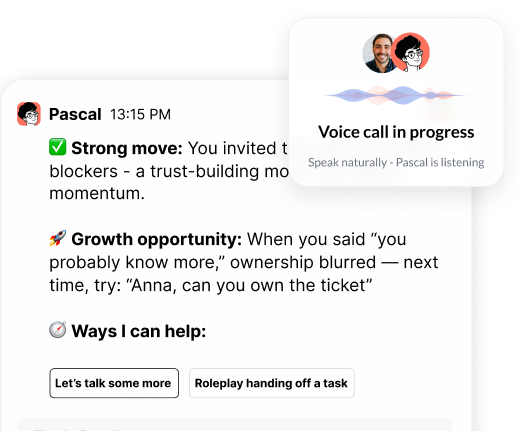
Pascal, Pinnacle's AI coach, is customized to each company's competencies, values and training materials, so his guidance reflects the leadership principles the organization already teaches.
• Responsible AI coaching scaling requires purpose-built AI coaches with organizational context, which protects against compliance risks and cultural misalignment.
• Privacy architecture where individual conversations remain confidential is non-negotiable, and HR teams receive only anonymized, aggregated insights.
• Four-layer governance frameworks (ethical guidelines, technical controls, escalation protocols, measurement systems) protect organizations from legal exposure and failed adoption.
• Mid-sized companies succeed by tying AI coaching to existing programs, adapting to diverse manager populations, and proving ROI through behavior change alongside adoption metrics.
• The most effective models combine AI for routine guidance with human coaches for complex situations, using clear escalation protocols to determine when human expertise is required.
Ready to scale coaching responsibly across your organization? See how Pascal works inside Slack, Teams, and your existing workflow to deliver contextual, privacy-first coaching that managers actually use.
Header photo by Vitaly Gariev on Unsplash



“Thank you for setting the great foundation for my promotion; now I have a plan!"

Curious to see how AI Coaching can 10X the impact and scale of your development initiatives. Book a demo today for: