

Responsible AI coaching scaling requires purpose-built platforms with contextual awareness, clear governance, human escalation protocols, and integration into daily workflows. Organizations that prioritize these elements see 83% of direct reports report improvement in their managers while avoiding the governance gaps that plague unrestricted AI adoption.
Quick Takeaway: Scaling AI coaching responsibly means extending access to every manager without sacrificing quality, privacy, or safety. It requires systems designed specifically for workplace coaching, combined with clear boundaries around sensitive topics and human oversight. The organizations succeeding treat AI as augmentation that makes human expertise more strategic, not replacement that threatens jobs.
The coaching industry reached $6.25 billion in 2024 and is projected to hit $7.3 billion in 2025, yet 95% of AI projects fail to deliver expected results, according to MIT research. For CHROs evaluating how to scale AI coaching, the challenge isn't finding vendors. It's understanding which capabilities actually drive manager effectiveness while protecting your organization from governance risk.
Responsible scaling means extending coaching access to every manager without sacrificing quality, privacy, or safety. It requires systems designed specifically for workplace coaching, not generic AI repurposed for leadership, combined with clear boundaries around sensitive topics and human oversight.
Purpose-built platforms grounded in people science deliver guidance managers trust and apply. Contextual awareness eliminates friction and drives adoption by understanding each manager's team dynamics, organizational values, and actual work patterns. Governance frameworks address data privacy, bias mitigation, and escalation for sensitive topics. Integration into existing workflows removes adoption barriers that kill ROI.
The governance gap reveals the core challenge. Only 1% of organizations report mature AI integration despite 78% using AI, according to recent research. This disconnect creates substantial risk for people leaders deploying AI coaching without proper safeguards.
The governance gap emerges when adoption outpaces oversight. Prevent it by establishing clear policies, training managers on appropriate use, selecting platforms with built-in guardrails, and maintaining human expertise for sensitive situations.
34% of organizations lack clear generative AI policies; 70% provide no training on responsible use. Meanwhile, 57% of employees hide their AI use, uploading sensitive data to unapproved tools. This shadow AI phenomenon creates exactly the compliance exposure that makes CHROs hesitate on deployment.
Purpose-built systems like Pascal include moderation systems that flag harassment, mental health concerns, and escalate terminations to HR. Organizations can define what the AI coach will and won't respond to, creating a walled garden aligned with company risk tolerance. SOC 2 compliance and data isolation prevent cross-user information leakage that generic tools can't guarantee.
The difference is intentional design. Scaling chaos means deploying generic tools without context or controls. Scaling responsibly means selecting platforms that know your people, proactively deliver relevant guidance, and include human oversight for complex situations.
95% of AI projects fail to deliver results due to adoption challenges, not technology limitations. Platforms with proactive engagement maintain 94% monthly retention with 2.3 sessions per week. Contextual awareness eliminates the friction that kills adoption; managers don't repeat situations or waste time explaining context.
Organizations like HubSpot, Zapier, and Marriott succeed by embedding AI into daily workflows and treating it as augmentation, not replacement. Hybrid models deliver 83% of direct reports reporting measurable manager improvement. This approach combines AI for routine coaching with humans for complex situations, delivering both scale and quality.
Move beyond training metrics to behavioral outcomes. Track adoption leading indicators alongside business impact measures that prove AI coaching drives real change.
Leading indicators include weekly active users, session frequency, feature adoption, and coaching engagement patterns. Behavioral indicators measure 360 feedback improvements, manager effectiveness scores, and team engagement metrics. Business outcomes track time-to-productivity for new managers, retention improvements, and feedback conversation quality.
Purpose-built platforms provide analytics across all levels, enabling CHROs to demonstrate ROI through both leading and lagging indicators. Organizations see an average 20% lift in Manager Net Promoter Score among highly engaged users. These aren't engagement metrics—they're behavior change indicators that predict retention and organizational health.
Robust guardrails include moderation systems that detect sensitive topics, escalation protocols that route to HR, and customizable boundaries that align with organizational policy. These protections enable scaling without exposing the organization to compliance violations or harmful guidance.
Moderation flags toxic behavior, harassment indicators, and mental health concerns; escalates appropriately. When terminations, medical issues, or employee grievances surface, the system escalates to HR while helping managers prepare for those conversations. Data architecture prevents cross-user leakage; user-level isolation ensures one manager's conversations remain confidential from their direct reports.
Organizations can customize what the AI coach will and won't address, creating controls that match their risk profile. Escalation protocols ensure human expertise handles situations requiring judgment, legal consideration, or emotional complexity. Pinnacle's SOC 2 examination validates our commitment to security, availability, and confidentiality, with user-level data isolation preventing information leakage across accounts.
Adoption dies when coaching requires context-switching to another platform. Integration into Slack, Teams, and meeting tools eliminates friction and makes coaching part of daily routines rather than another task competing for attention.
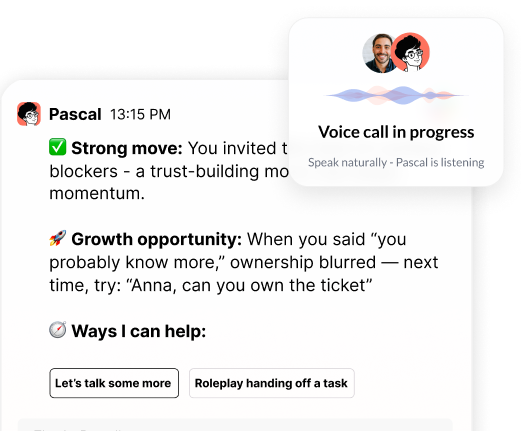
Platforms meeting managers in existing workflow tools see dramatically higher engagement than standalone applications. Pascal's integration into Slack and Teams enables coaching in the flow of work, with managers accessing guidance without opening separate apps. Proactive engagement surfaces feedback after meetings, not waiting to be asked, creating consistent habits that drive long-term behavior change.
Workflow integration also enables organizational insights; HR teams gain visibility into where managers struggle most without exposing individual conversations. This intelligence helps People teams allocate resources strategically and identify emerging challenges before they escalate.
Start small with specific high-value tasks, involve both HR and IT in governance design, measure both adoption and outcomes, and frame AI as augmentation that makes human expertise more strategic, not replacement that threatens jobs.
Begin with one to two month focused pilots targeting specific manager challenges like feedback preparation, delegation, or one-on-one structure. Establish governance frameworks before scaling; define data access, escalation protocols, and customizable guardrails. Communicate clearly that AI handles routine guidance while humans remain essential for complex situations.
Partner with IT on data integration and security; with HR on policy alignment and change management. Use early wins to build momentum and address skepticism before enterprise rollout. This approach respects both the urgency of AI adoption and the organizational learning needed for sustainable implementation.
Pascal combines purpose-built coaching expertise, contextual awareness from your HR systems, proactive engagement that surfaces guidance in real time, and sophisticated guardrails that escalate sensitive topics to humans. The result: coaching at scale that managers trust and apply, without creating governance risk. Book a demo to see how Pascal delivers responsible scaling with measurable impact on manager effectiveness and team performance.

.png)
.webp)
“Thank you for setting the great foundation for my promotion; now I have a plan!"

Curious to see how AI Coaching can 10X the impact and scale of your development initiatives. Book a demo today for: