

AI coaching systems learn safely by isolating user data, encrypting interactions, and using human oversight for sensitive topics. The key distinction: these systems personalize guidance within a session but never retrain their foundation models on customer conversations.
Safe learning means improving personalization without exposing individual data, training on confidential conversations, or creating surveillance risks.
The International Coaching Federation's 2025 AI Coaching Framework defines safe learning through the CIA triad: confidentiality, integrity, and availability. Security isn't just technical infrastructure—it's an ethical commitment to protecting the coaching relationship.
Three technical requirements enable safe learning:
Data isolation ensures each employee has a separate coaching instance. One manager's session cannot be accessed by another user or their supervisor.
Session-based learning means systems remember user preferences and context during a conversation but don't retrain foundation models on proprietary data. The system adapts to you in real time, then forgets the specifics.
Transparency requires users to know what data the system accesses, how it's used, and who can see aggregated insights.
Purpose-built platforms achieve this through encryption at rest and in transit, user-level access controls, and explicit policies against using customer data for model training. Consumer AI tools like ChatGPT train on all inputs by default—a manager asking for performance advice might inadvertently expose confidential employee information to a system that improves by learning from every conversation.
The most effective systems use a "minimum viable context" model. They access role, goals, performance signals, and interaction history rather than deep personal data.
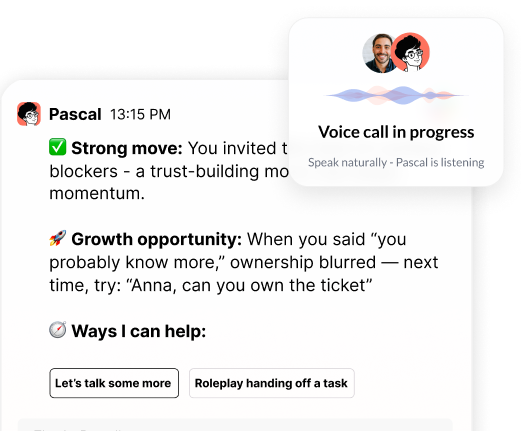
Pascal by Pinnacle joins Zoom, Teams, or Google Meet calls to understand team dynamics and communication patterns. After a meeting, it might say: "I noticed you interrupted your direct report three times in today's 1:1. Want to work on active listening?" The observation creates value. The transcript isn't stored.
This approach delivers results without surveillance. In a six-month study of 847 managers using Pascal, 83% of their direct reports reported improvement in manager effectiveness. The system maintains SOC2 compliance (the security standard used by enterprise HR systems) and never trains on customer data.
Three design principles enable this balance:
Contextual awareness without recording means observing meeting participation and communication style without storing verbatim conversations.
Opt-in data sharing gives employees control over which meetings the AI joins. They can remove access at any time.
Anonymized aggregation means HR teams receive trend data (40% of managers need help with difficult conversations) without individual-level visibility.
Research from MIT's Sloan School of Management shows that 95% of AI projects fail not because of technical limitations but because of deployment approach. Privacy violations destroy trust. Without trust, adoption collapses.
Purpose-built platforms implement three security layers: technical (encryption, data isolation), operational (access controls, monitoring), and ethical (transparency, escalation protocols).
Encryption standards include AES-256 at rest and TLS 1.3 in transit. These determine whether AI coaching becomes a trusted resource or an organizational liability.
Access control through role-based permissions ensures only the individual user sees their coaching history. Managers don't gain visibility into personal conversations by default, though individuals can choose to share their own transcripts.
Audit trails log all data access for compliance and security review.
Third-party verification through SOC2 Type II certification provides independent validation of security controls. This certification requires demonstrating that security measures are designed properly and operating effectively over time.
Pascal maintains strict confidentiality and never shares individual-level data with HR. The platform sends a notification at the beginning of calls explaining how users can opt out. This transparency builds the trust necessary for effective coaching—employees won't use a coach they believe reports to management.
Advanced platforms use moderation flags and sensitive topic detection to escalate conversations beyond the system's scope.
When Pascal detects discussions involving mental health crises, legal issues, harassment, or discrimination, it redirects users to appropriate human resources (EAP, HR, legal counsel) rather than attempting to provide AI-generated guidance. This human-in-the-loop approach protects both employees and organizations while maintaining the coaching relationship for appropriate topics.
Automated detection uses natural language processing to identify keywords and conversation patterns indicating sensitive topics.
Escalation protocols include pre-defined workflows that route users to qualified human support.
Organizational controls allow companies to customize which topics trigger escalation based on their policies.
Data Breakdown:
• Topic Category: Mental Health Crisis | AI Coach Response: Immediate escalation | Human Resource: Employee Assistance Program
• Topic Category: Legal Issues | AI Coach Response: Redirect to legal counsel | Human Resource: Legal department
• Topic Category: Performance Termination | AI Coach Response: Escalate to HR | Human Resource: HR Business Partner
• Topic Category: Career Development | AI Coach Response: AI coaching appropriate | Human Resource: Optional human coach for complex cases
• Topic Category: Team Conflict | AI Coach Response: AI coaching with escalation option | Human Resource: Manager or HR if unresolved
This approach recognizes that AI coaching excels at skill development, communication improvement, and day-to-day management challenges—but has clear boundaries around clinical, legal, and high-stakes HR decisions.
HR leaders need visibility into engagement, skill development, behavioral outcomes, and ROI—not individual conversations.
Anonymized aggregation means HR receives trend data showing organizational patterns without individual-level visibility. For example: "40% of managers need help with difficult conversations" or "Active listening skills improved 25% over the past quarter across the sales organization."
Engagement metrics include usage frequency, coaching session length, and which competencies managers work on most.
Behavioral outcomes track whether managers apply coaching guidance in subsequent meetings.
ROI measurement connects coaching engagement to business results. In a study of 847 managers using Pascal over six months, 83% of direct reports reported improvement in manager effectiveness. Managers saved an average of 150 hours annually (time previously spent searching for coaching resources or waiting for scheduled sessions with human coaches). Manager NPS increased 20% on average.
The visibility balance is critical: enough data for HR to demonstrate impact and identify organizational skill gaps, but never so much that individual privacy is compromised. Purpose-built platforms achieve this through technical architecture (user-level data isolation) and governance (clear policies on what data is aggregated and who can access it).
• Safe learning requires technical, operational, and ethical safeguards: encryption, data isolation, transparency, and human escalation protocols protect privacy while enabling personalization.
• Minimum viable context delivers better outcomes than deep surveillance: AI coaches need role, goals, performance signals, and interaction history—not biographical profiles or stored transcripts.
• Proactive coaching drives higher adoption than on-demand models: systems embedded in daily workflows (Slack, Teams, Zoom) create habits; separate portals get abandoned.
• Governance matters more than technology: unrestricted AI coaching (employees using ChatGPT) creates greater risk than purpose-built platforms with explicit privacy controls.
• HR needs anonymized aggregation, not individual visibility: trend data shows skill gaps and coaching impact without compromising individual trust or confidentiality.
AI coaching at scale requires architecture designed for privacy, governance that earns trust, and integration into the tools managers already use. See how Pascal works inside Slack to deliver real-time coaching without compromising confidentiality.
Header photo by Vitaly Gariev on Unsplash

.png)
.webp)
“Thank you for setting the great foundation for my promotion; now I have a plan!"

Curious to see how AI Coaching can 10X the impact and scale of your development initiatives. Book a demo today for: