

A good AI coach demonstrates three qualities: it's built on proven coaching frameworks (not generic chatbot responses), it understands your organization's context (people, culture, goals), and it integrates into workflows where managers already work. Look for 40%+ daily usage within 30 days and documented behavior change by day 90.
The AI coaching market is growing fast. For CHROs evaluating vendors, the challenge isn't finding an AI coaching tool—it's identifying which platforms will transform manager effectiveness versus which will become another underutilized license in your tech stack.
The difference comes down to five factors that predict real adoption and behavior change.
Effective AI coaches are built on established coaching methodologies by certified professionals. The difference shows up in response quality: purpose-built coaches provide structured, actionable guidance grounded in behavioral science. Chatbots offer surface-level suggestions that sound helpful but lack developmental depth.
Managers need more than conversational AI—they need systematic approaches that drive behavior change.
Look for these signals when evaluating platforms:
• Coaching methodology transparency: Vendors should articulate which coaching frameworks inform their AI's responses (GROW model, situational leadership, emotional intelligence frameworks)
• Professional credentials: Platforms trained by ICF-certified coaches (International Coaching Federation) demonstrate commitment to coaching standards, not just natural language processing
• Response structure: Quality coaches guide managers through structured thinking rather than simply answering questions
• Developmental progression: Effective platforms track skill development over time and adjust coaching intensity as managers grow
Generic AI tools like ChatGPT can discuss coaching concepts, but they lack the systematic approach that drives behavior change.
The gap becomes obvious in complex scenarios. When a manager asks about handling a difficult performance conversation, a chatbot might suggest "be direct and empathetic." A purpose-built coach walks them through situation analysis, identifies their development area (perhaps difficulty with directness), references their past feedback patterns, and provides a structured framework for the conversation.
AI coaches that understand your company's culture, values, competencies, and individual employee goals eliminate the friction of repeatedly explaining situations. This context operates across four layers:
Individual data: Role, goals, performance history, personality assessments, and career aspirations create a foundation for personalized coaching. Without this layer, every interaction starts from zero.
Organizational knowledge: Values, leadership competencies, cultural norms, and strategic priorities ensure coaching aligns with how your company operates. A platform coaching managers at a fast-moving startup should sound different from one serving a regulated financial services firm.
Real-time work patterns: Meeting dynamics, communication style, collaboration frequency, and interaction quality provide behavioral data that self-reported challenges miss. Managers often don't recognize their own blind spots.
Temporal context: Performance cycles, goal-setting seasons, organizational priorities, and team changes mean coaching must adapt to what matters now, not generic development advice.
The "cold start" problem (when systems lack initial data to provide personalized recommendations) kills adoption for generic coaches. Managers won't engage with tools that require them to explain context every interaction.
Best platforms connect to HRIS, performance management systems, and communication platforms (Slack, Teams, Zoom) to build this context automatically. They aggregate anonymized data to provide enterprise-level cultural insights while protecting individual privacy through SOC2 compliance (a security certification for handling sensitive data) and strict data governance.
Understanding what makes a coach effective and why context matters is only half the battle. Even the best coaching methodology fails if managers never use it.
AI coaching must live in the tools managers already use daily—Slack, Teams, Zoom, or email—not in a separate portal they'll forget to open. Platforms requiring managers to switch to a dedicated app see significant drop-off after the first month.
Workflow integration breaks down into five requirements:
Meeting companion functionality: AI that joins meetings and observes real interactions provides coaching grounded in actual behavior, not self-reported challenges. Post-meeting feedback becomes specific: "In today's 1:1, you interrupted Sarah three times when she raised concerns about the timeline. Consider asking a follow-up question before offering solutions."
Proactive engagement: Best platforms surface coaching moments (post-meeting feedback, pre-1:1 preparation, recognition opportunities) rather than waiting for managers to remember to ask. Proactive nudges create habits that drive long-term development.
Communication platform integration: Coaching delivered in Slack or Teams meets managers where they already work. A manager can ask "How should I handle this situation?" directly in their workflow without opening another app.
Calendar awareness: Platforms that connect to calendars can prepare managers before important meetings, follow up afterward, and identify patterns across recurring interactions.
Mobile accessibility: Coaching should be available on any device, any time, without requiring app downloads. Managers need guidance in the moment, not when they return to their desk.
Traditional coaching requires scheduling, travel, and dedicated time blocks. AI coaching in workflow provides guidance in 30-second moments between meetings. This shift from scheduled development to continuous learning changes how managers grow.
Once you've deployed AI coaching in the right places, you need to know if it's working. Effective AI coaching shows measurable impact across three levels: adoption indicators, behavioral change metrics, and business outcomes.
Adoption indicators predict long-term success:
• Daily usage rate above 40% in first 30 days signals that managers find genuine value
• Average session length of 3-5 minutes indicates engaged interaction, not just quick check-ins
• Return usage patterns showing managers coming back multiple times per week demonstrate habit formation
• Feature adoption breadth (using multiple coaching capabilities, not just one) proves the platform delivers value across scenarios
Behavioral change metrics show real development:
• Direct report feedback on manager improvement through 360 data provides the ultimate validation
• Application of coaching frameworks in real situations (observable in meeting recordings or self-reports)
• Quality of feedback conversations measured through sentiment analysis or spot checks
• Reduction in HR escalations or manager-related issues indicates improved capability
Business outcomes justify continued investment:
• New manager time-to-productivity reduction (measured in weeks to full effectiveness)
• Manager retention rates and promotion readiness (are coached managers staying and advancing?)
• Team engagement and performance scores correlated with manager coaching usage
• Quantified time savings (hours per manager per month freed up by faster decision-making)
Beware vanity metrics like "total messages sent" or "accounts created." These don't predict behavior change or business impact. A platform with 90% account creation but 15% active usage is failing, regardless of how impressive the initial rollout looked.
The 90-day benchmark matters because behavior change takes time. Expect 40%+ daily usage by day 30, visible behavior changes reported by direct reports by day 60, and measurable business outcomes by day 90. Platforms that can't demonstrate this progression aren't delivering real coaching—they're delivering conversation.
Even with strong adoption and measurable impact, AI coaching creates risk if it attempts to handle every scenario. Effective AI coaches recognize when situations require human expertise and escalate appropriately.
The best platforms build guardrails that protect both employees and organizations: content moderation flags inappropriate requests, sensitive topic detection routes issues like harassment or mental health to HR, and organization-specific controls align with company policies.
Four layers of protection distinguish responsible platforms:
Content moderation: Real-time filtering prevents inappropriate uses while allowing legitimate coaching conversations. This isn't about censorship—it's about ensuring the tool stays within its designed purpose.
Sensitive topic detection: Natural language processing identifies conversations that need human judgment: mental health concerns, harassment allegations, legal risks, or ethical violations.
Escalation protocols: Clear pathways route flagged conversations to appropriate human experts (HR, legal, EAP) with proper documentation and follow-up.
Privacy protection: SOC2 compliance, encryption, and strict data governance ensure sensitive conversations remain confidential. Customer data is never used to train models.
The risk of unrestricted AI coaching is real. Platforms without proper guardrails can provide harmful advice on sensitive topics, create legal exposure through inappropriate guidance, or damage trust when employees realize the AI lacks judgment on complex human situations.
Organizations in regulated industries—healthcare, life sciences, financial services—are cautious about AI adoption. These companies need vendors who understand compliance requirements and build appropriate controls from the ground up, not as afterthoughts.
• Purpose-built expertise matters: AI coaches trained by ICF-certified professionals on proven frameworks deliver structured guidance that drives behavior change, not generic chatbot responses
• Context is non-negotiable: Platforms that understand your people, culture, and organizational goals eliminate the friction of repeated context-setting and deliver coaching managers trust
• Workflow integration predicts adoption: Coaching must live in Slack, Teams, or Zoom—not a separate portal managers forget to open
• Three-level metrics prove impact: Track adoption indicators (40%+ daily usage), behavioral change (direct report feedback), and business outcomes (time savings, retention) to validate ROI
• Guardrails protect everyone: Responsible platforms escalate sensitive topics to human experts rather than coaching through harassment, mental health, or legal issues
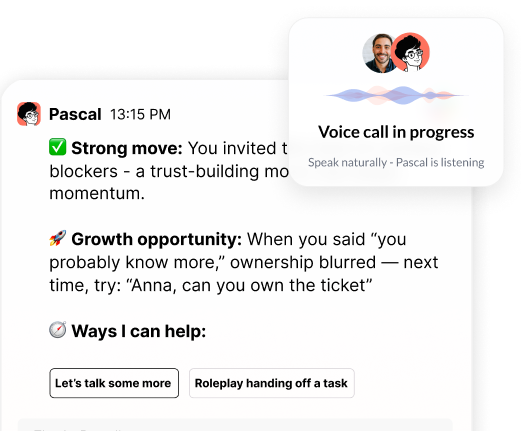
Pascal delivers professional coaching at scale by meeting managers where they already work. Built by ICF-certified coaches, trained on your organization's context, and protected by enterprise-grade security, Pascal transforms manager effectiveness through daily micro-coaching moments. See how Pascal works or schedule a demo to evaluate whether AI coaching fits your talent development strategy.
Header photo by Vitaly Gariev on Unsplash

.png)
.webp)
“Thank you for setting the great foundation for my promotion; now I have a plan!"

Curious to see how AI Coaching can 10X the impact and scale of your development initiatives. Book a demo today for: