

AI coaching works when managers change their behavior, direct reports notice improvement, and business metrics shift—measured through adoption patterns, behavioral indicators, and outcomes like retention, not satisfaction scores.
AI coaching works when managers handle difficult conversations better, direct reports see consistent improvement, and metrics like retention move. This requires three proof levels: adoption signals (repeat usage, conversation depth), behavioral change (direct report assessments, 360 feedback improvements), and business outcomes (manager effectiveness scores, retention rates).
Melinda Wolfe, former CHRO at Bloomberg and Pearson, frames the practical test: "It makes it easier not to make mistakes. And it gives you frameworks to think through problems before you act."
Context matters. Generic AI tools provide generic advice. Platforms built for coaching integrate into Slack and Teams to deliver guidance based on actual team interactions. You should see behavioral shifts within 60-90 days through direct report feedback.
CHROs face pressure to justify every technology investment with concrete ROI. AI coaching platforms generate real-time data that proves value or exposes waste within 90 days.
Jeff Diana, former CHRO at Calendly and Atlassian, notes: "HR leaders face a choice: shape how AI transforms work or watch other functions make those decisions for you."
AI coaching competes with traditional coaching ($300-500/hour), underutilized LMS platforms, and HRBP headcount. The measurement trap: 80% weekly active users means nothing if managers don't apply what they learn. Focus on behavior change, not logins.
AI coaching delivers measurable manager improvement at a fraction of traditional executive coaching costs while reaching all managers instead of just senior leaders. Annual workshops, self-paced LMS modules, and quarterly coaching sessions fail because they disconnect from the moments managers need support.
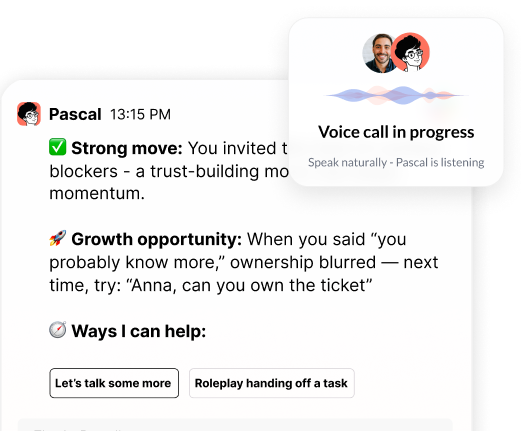
Platforms built for coaching succeed by embedding guidance into daily workflows: joining meetings, observing Slack conversations, providing real-time feedback when managers face actual challenges.
Data Breakdown:
• Approach: Executive Coaching | Cost per Manager: $15,000-30,000/year | Reach: Top 5-10% | Time to Impact: 6-12 months | Behavior Change Measurement: Subjective self-assessment
• Approach: Leadership Workshops | Cost per Manager: $2,000-5,000/year | Reach: 20-30% | Time to Impact: 3-6 months | Behavior Change Measurement: Post-training surveys
• Approach: LMS Platforms | Cost per Manager: $500-1,500/year | Reach: 100% (5-15% active) | Time to Impact: Unclear | Behavior Change Measurement: Completion rates
• Approach: AI Coaching Platforms | Cost per Manager: $150-300/year | Reach: 100% | Time to Impact: 60-90 days | Behavior Change Measurement: Direct report improvement
Traditional coaching reserves personalized guidance for executives. AI democratizes it across all management levels. Scheduled coaching sessions miss critical moments. AI coaches provide support during actual meetings and conversations. Human coaches vary in quality and approach. AI coaching delivers consistent frameworks aligned with company values.
Track three measurement levels: adoption leading indicators, behavioral change metrics, and business outcomes.
Repeat usage rate: 60%+ managers returning weekly signals the platform solves real problems, not curiosity-driven exploration.
Conversation depth: Average 8+ message exchanges per session indicates real problem-solving, not quick lookups.
Proactive engagement: 40%+ of interactions initiated by the AI coach based on observed meetings or communications shows the platform understands context and provides timely guidance.
Feature breadth: Managers using 3+ capabilities (meeting prep, feedback drafting, conflict navigation, career conversations) indicates comprehensive value.
Direct report improvement scores: 70%+ direct reports reporting "my manager has improved" in pulse surveys is the clearest signal of real behavior change.
360 feedback shifts: Measurable increases in specific competencies (communication, delegation, feedback quality). Track before-and-after scores in targeted areas.
Skill application evidence: Managers applying learned frameworks in documented situations. Look for specific examples in follow-up conversations.
Self-reported confidence: Manager confidence scores increasing in specific scenarios (difficult conversations, performance management). Confidence predicts sustained application.
Manager Net Promoter Score (NPS): This measures whether direct reports would recommend their manager to others. A 15-20% lift among teams whose managers use AI coaching correlates with retention and engagement.
Retention impact: 5-10% improvement in retention rates for teams with engaged manager-users. Track voluntary turnover by manager cohort.
Time savings: Hours saved per manager on meeting prep, feedback drafting, and HR guidance requests. This frees capacity for strategic work.
HRBP efficiency: 30-40% reduction in routine manager support requests allows HR to increase span of control. Track ticket volume and response times.
Focus on leading indicators that predict long-term success rather than waiting for lagging business outcomes.
In the first 30 days, track adoption velocity: what percentage of managers engage within their first week, and how many return for a second session within 72 hours.
By day 60, measure conversation quality: average session length, topics addressed, and whether managers use the platform proactively or only when prompted.
By day 90, run a pulse survey asking direct reports: "In the past 60 days, how would you rate your manager's communication, feedback, and development support compared to before?" Use a 5-point scale from "significantly worse" to "significantly better." If 60%+ answer "better" or "significantly better," you have proof of behavior change.
Calculate cost avoidance. If AI coaching saves each manager time on meeting prep and feedback drafting, and your average manager's fully-loaded cost is $150,000/year, calculate the value of time saved. For a company with 200 managers, even modest time savings create measurable value.
Compare against alternatives. Traditional coaching at $15,000 per executive reaches 20 leaders. AI coaching at $300 per manager reaches all 200 managers for $60,000—delivering 10x the reach at lower total cost.
Present three data layers that connect investment to business outcomes.
Start with adoption metrics that prove managers find value: weekly active users, repeat usage rates, and average session depth. These numbers demonstrate the platform isn't shelfware.
Next, show behavioral change evidence. Include direct report improvement scores, specific examples of managers applying new frameworks, and 360 feedback improvements in targeted competencies. Pair quantitative data with qualitative stories: "After using the platform to prepare for a difficult conversation, Manager X addressed a performance issue that had lingered for six months."
Connect to business outcomes. Show retention improvements for teams whose managers use the platform. Calculate time savings and cost avoidance. Demonstrate HRBP efficiency gains through reduced support ticket volume.
Frame the investment comparison clearly. Traditional coaching: $300,000 for 20 executives. AI coaching: $60,000 for 200 managers. Same budget reaches 10x more people with measurable behavior change in 90 days instead of 12 months.
Address the CFO's likely questions about methodology. Explain how you measure time savings (manager self-reports validated against calendar analysis and HRBP ticket reduction). Show how you isolate AI coaching impact from other variables (compare retention rates between manager cohorts with similar team sizes, tenure, and departments). Acknowledge confounding factors (market conditions, compensation changes) and explain your controls.
Vanity metrics look impressive but don't connect to business outcomes. Weekly active users, total sessions logged, and completion rates tell you nothing about whether managers improve.
Track metrics that predict sustained behavior change. Repeat usage within 72 hours signals the platform solved a real problem. Conversation depth (8+ message exchanges) indicates genuine problem-solving, not quick lookups. Proactive engagement initiated by the AI coach shows contextual awareness and timely guidance.
The critical test: direct report improvement scores. If managers use the platform weekly but their direct reports don't notice improvement, the platform isn't working. Track this metric monthly through pulse surveys.
High usage numbers mean nothing if managers don't apply what they learn. Focus on application evidence: managers using specific frameworks in documented situations, 360 feedback improvements in targeted competencies, and measurable shifts in team outcomes.
At 6 months, you should see sustained adoption (60%+ managers using weekly), measurable behavioral change (70%+ direct reports reporting improvement), and early business impact (5-10% retention improvement for engaged manager cohorts). HRBP teams should report 30-40% reduction in routine manager support requests.
By 12 months, the platform should be embedded in your leadership operating system. Manager NPS should show 15-20% lift for teams with engaged managers. Retention improvements should be statistically significant and attributable to specific manager cohorts.
Long-term success means AI coaching becomes how managers develop, not a program they complete. Usage should remain consistent, not spike during onboarding then decline. New managers should engage within their first week. The platform should surface organizational insights that inform talent strategy.
• Track three measurement levels: adoption leading indicators (repeat usage, conversation depth, proactive engagement), behavioral change metrics (direct report improvement, 360 feedback shifts, skill application), and business outcomes (manager NPS, retention, time savings).
• Direct report improvement is the critical metric. If direct reports don't notice improvement, the platform isn't working—regardless of usage statistics.
• Prove ROI within 90 days by focusing on leading indicators (adoption velocity, conversation quality, early behavioral signals) rather than waiting for lagging business outcomes.
• Avoid vanity metrics. Weekly active users and completion rates don't prove value. Track metrics that predict sustained behavior change and connect to business outcomes.
• AI coaching delivers 10x reach at lower cost than traditional coaching, with measurable results in 60-90 days instead of 6-12 months.
Ready to prove AI coaching ROI in your organization? See how Pascal works inside Slack to deliver measurable manager improvement in 90 days.
Header photo by Austin Distel on Unsplash

.png)
.webp)
“Thank you for setting the great foundation for my promotion; now I have a plan!"

Curious to see how AI Coaching can 10X the impact and scale of your development initiatives. Book a demo today for: