

AI coaching accelerates AI fluency by delivering contextual, proactive guidance in the flow of work—where managers actually make decisions—rather than in training rooms or separate platforms. When integrated into daily tools like Slack and Teams, AI coaching transforms managers from uncertain experimenters into confident, skilled collaborators with AI. The difference between managers who develop genuine fluency and those who remain hesitant comes down to three factors: whether they receive guidance at the moment they need it, whether that guidance reflects their specific situation and organizational context, and whether the coaching becomes a consistent habit rather than a crisis-only resource.
Quick Takeaway: AI coaching accelerates AI fluency by embedding learning into daily workflows at moments when guidance creates maximum impact. Managers who receive proactive, contextual coaching develop skills 2-3 times faster than those relying on episodic training, with 94% monthly retention and sustained behavior change that proves training ROI.
AI fluency is the ability to recognize when and how to use AI effectively, interpret its outputs critically, and make sound decisions based on AI-generated insights. For managers, fluency means moving from fear or passive adoption to active, strategic use of AI in team leadership, feedback, and decision-making. This capability determines whether managers see AI as a threat to be avoided or an opportunity to amplify their impact on teams.
Managers set the tone for team AI adoption; their fluency directly influences whether employees see AI as a threat or opportunity. Only 7% of CEOs view their CHROs as AI-savvy, creating a credibility gap at the exact moment when workforce transformation depends on human-AI collaboration. Organizations like HubSpot, Zapier, and Marriott have discovered that manager AI fluency directly predicts team adoption rates and business outcomes.
AI fluency isn't just technical knowledge; it's confidence born from repeated, successful use in real situations. When managers practice giving feedback with AI coaching, roleplay difficult conversations, and receive real-time guidance after meetings, they develop intuition about when and how AI adds value. This experiential learning creates the muscle memory that transforms AI from a curiosity into a trusted tool.
Traditional training delivers knowledge in batches, disconnected from the moment managers need it. Learning in the flow of work means coaching arrives during or immediately after the triggering event—when context is fresh, motivation is highest, and application is immediate. This distinction determines whether managers actually change behavior or simply gain theoretical knowledge that fades within weeks.
BCG found that 79% of employees receiving more than five hours of AI training become regular users, compared to 67% with less exposure. Yet this statistic masks a deeper truth: the quality and timing of training matter far more than the quantity. The 70-20-10 learning model shows 70% of learning comes from hands-on challenges, 20% from peer relationships, and 10% from formal coursework; most companies invert this ratio and wonder why adoption stalls.
Managers don't learn to use AI by studying it; they learn by using it in low-stakes, supported moments with feedback. When a manager prepares for a one-on-one conversation and receives specific coaching from Pascal on how to invite psychological safety, then gets real-time feedback after the actual conversation, the learning sticks. Proactive AI coaches that meet managers in Slack, Teams, and meeting tools achieve 75%+ regular usage versus 51% for on-demand tools, according to recent adoption research.
Proactive AI coaching observes real work moments—meetings, emails, team interactions—and surfaces guidance before managers realize they need it. Rather than waiting for a manager to ask "How do I delegate this?", the AI coach delivers specific feedback after a delegation attempt, while the learning moment is still fresh and the manager can immediately apply the insight.
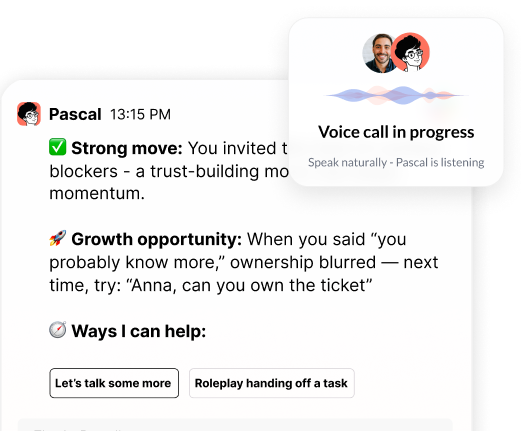
Pascal maintains 94% monthly retention with an average of 2.3 coaching sessions per week, indicating sustained habit formation rather than sporadic use. After a team meeting, proactive coaches deliver real-time feedback: "Strong move inviting input. Growth opportunity: when you said 'you probably know more,' ownership blurred. Next time, try explicitly assigning ownership." This feedback arrives in Slack within minutes, creating a tight feedback loop that drives behavior change.
Proactive engagement creates consistent practice loops that compress manager ramp time from 12-18 months to significantly faster effectiveness. 83% of direct reports see measurable improvement in their manager's effectiveness when using contextual AI coaching. The improvement comes not from a single training event but from consistent reinforcement across dozens of real management moments.
Contextual AI coaches that integrate with your HRIS, performance systems, and communication tools understand each manager's people, goals, and work patterns. This eliminates friction—managers don't need to repeatedly explain situations—and enables personalized guidance that feels immediately relevant. When Pascal knows a manager's direct report's communication style, recent feedback, and career goals, coaching becomes tailored to that specific relationship rather than generic.
Generic AI tools like ChatGPT provide lowest-common-denominator advice because they lack organizational context; contextual platforms integrate performance reviews, team dynamics, and company culture. Organizations using contextually aware AI coaching report significantly higher engagement because managers experience coaching as a trusted partner who already understands their situation, not another system requiring data entry.
58% of L&D professionals believe AI enhances leadership training when it provides adaptive, contextual content delivered on-demand, according to recent research on AI coaching effectiveness. The contextual foundation transforms generic advice into specific, actionable guidance that managers recognize as applicable to their exact situation.
AI coaching that lives in Slack, Teams, and meeting platforms eliminates the friction that kills adoption. Managers don't need to remember to open another app or context-switch away from their work. Coaching happens where they already spend their time. HubSpot's approach of introducing AI tools within first two days of employment and running weekly peer demos created 98% employee usage with 84% comfort level.
Platforms requiring separate logins see engagement drop to less than once per month; tools embedded in existing workflows achieve 2.3+ sessions per week. Voice-based coaching in Slack makes guidance feel like a conversation with a trusted colleague rather than interacting with software. Workflow integration enables proactive coaching: Pascal joins meetings, analyzes team dynamics, and delivers feedback in the same tool where managers coordinate work.
The integration advantage extends beyond convenience to learning science. When coaching arrives in the tool where work happens, the context switch disappears and managers engage immediately. This immediacy is critical for habit formation, which requires consistent repetition at predictable intervals. Proactive coaching delivered in existing workflows creates that consistency.
Culture determines whether managers view AI as a threat to be avoided or an opportunity to embrace. Organizations that explicitly frame AI as augmentation (making human work more strategic) and build AI expectations into performance frameworks see dramatically higher fluency development. Zapier embeds AI fluency into hiring, onboarding, and performance reviews, making coaching proficiency part of how the company defines effective leadership.
Marriott's approach of encouraging associates to "kill zombies" (automate outdated processes) creates curiosity rather than compliance. Brandon Sammut, CHRO of Zapier, captures the principle: "With AI you can delegate the work, you cannot delegate the accountability." Organizations that position AI coaching as a development resource rather than monitoring tool see significantly higher adoption and faster fluency development.
Culture shapes whether managers see AI as augmentation or replacement. When leadership explicitly positions AI as a tool that makes human judgment more valuable—not less—managers embrace it. When culture treats AI as surveillance, adoption stalls. The organizations winning with AI coaching invest in change management that builds confidence alongside capability.
Pascal combines purpose-built coaching expertise, contextual awareness of your people and workflows, proactive engagement after meetings, and workflow integration into Slack and Teams. This creates the conditions where managers develop genuine fluency through consistent practice with real-time feedback. Rather than waiting for managers to ask questions, Pascal surfaces guidance based on observed patterns in actual team interactions.
Purpose-built coaching grounded in 50+ leadership frameworks and people science, not generic AI repurposed for workplace use. Pascal is customizable to your organization's values and competency frameworks, ensuring guidance reinforces your culture rather than generic best practices. Escalation protocols for sensitive topics (harassment, terminations) protect organizations while ensuring appropriate human expertise is involved.
Managers can roleplay difficult conversations, practice feedback delivery, and receive specific behavioral feedback on their actual meetings. Pascal's contextual approach delivers coaching that feels like working with a coach who already understands your organization, your people, and your specific challenges. The result is AI fluency that develops through doing, not studying—exactly how adults learn most effectively.
The business case for AI coaching becomes clear when you examine outcomes that matter to CHROs: faster manager ramp time, higher quality feedback conversations, improved performance review consistency, and sustained behavior change. Organizations implementing contextual AI coaching report measurable improvements across these dimensions that traditional training rarely achieves.
| Outcome | Traditional Training | Proactive AI Coaching |
|---|---|---|
| Manager adoption rate | 20-30% engagement | 75%+ regular usage |
| Monthly retention | Drops after 2-3 months | 94% sustained engagement |
| Colleague-reported improvement | Varies widely by manager | 83% report measurable improvement |
| Manager NPS lift | Minimal change | 20% average increase |
| Time to effectiveness | 12-18 months | 40% faster ramp |
One technology company estimated saving 150 hours across 50 employees in their initial Pascal rollout. These time savings stem from eliminated redundant coaching questions, reduced need for managers to search for relevant resources, and decreased escalations to HR for routine management questions. As adoption scales across hundreds of managers, the productivity impact compounds significantly.
"This was the first time I've done any leadership/management training. I thought it was helpful and the personalized touch was great." — Jason H., Sr. Manager, Growth Engineering & Operations
The outcomes extend beyond efficiency to strategic impact. When managers develop AI fluency through consistent coaching, they make better decisions about when to use AI and when to rely on human judgment. They become more strategic about task automation and more thoughtful about team member development. This judgment—knowing when to delegate to AI and when to invest in human growth—defines true AI fluency.
Organizations using contextually aware AI coaching report that managers experience coaching as support rather than surveillance, which drives adoption and creates psychological safety for experimentation. This trust is essential for building fluency, because managers won't practice new approaches if they fear the coaching data will be used against them.
The managers who develop genuine AI fluency aren't those who attend training workshops. They're the ones who practice with real-time, contextual coaching integrated into their daily work. Pascal delivers exactly that—proactive guidance in Slack, personalized to your people and culture, with escalation protocols that keep sensitive issues human-centered.

.png)
.webp)
“Thank you for setting the great foundation for my promotion; now I have a plan!"

Curious to see how AI Coaching can 10X the impact and scale of your development initiatives. Book a demo today for: