

Performance reviews fail because managers lack time, training, and real-time context. AI coaching addresses this by synthesizing behavioral data from meetings throughout the year, then helping managers prepare for difficult conversations before they happen.
This isn't theoretical. At a 500-person tech company, review completion jumped from 73% to 96% after managers started using AI to practice conversations and draft reviews based on meeting observations. Employee satisfaction with review quality rose 34 percentage points.
But AI coaching only works with proper guardrails. Without SOC2 compliance, escalation protocols for sensitive topics, and integration with existing systems, you risk privacy violations and manager distrust.
AI coaching provides continuous, context-aware guidance using real-time behavioral data and your organization's competency frameworks. The AI attends meetings (with participant notification), observes team dynamics, and builds a record of performance patterns as they happen.
When review season arrives, managers don't start from scratch. The AI has already documented months of meeting observations, communication patterns, and project outcomes. A manager preparing a review spends 30 minutes refining an AI-drafted narrative instead of 3-5 hours hunting for examples in email and memory.
Between formal reviews, the AI identifies performance issues early. A manager struggling with a difficult conversation can rehearse with the AI before the actual meeting, reducing anxiety and improving delivery.
Traditional performance management operates in quarterly or annual cycles. AI coaching provides daily touchpoints. According to Betterworks' State of Performance Enablement research, organizations need continuous feedback mechanisms because annual reviews catch issues too late.
The difference between generic chatbots and purpose-built platforms: integration with your specific competency frameworks. Generic tools offer boilerplate advice. Purpose-built platforms like Pascal reflect what matters in your culture.
Traditional coaching has three problems: cost, frequency, and lack of context. External coaches charge $200-500 per session, meet managers monthly at best, and don't observe daily work. Learning platforms see completion rates below 15%. HRIS performance modules document reviews but don't coach managers through conversations.
AI coaching costs $20-150 per manager annually (1-10% of traditional coaching) while providing daily guidance. For a 500-person company with 50 managers, that's $100,000-750,000 in annual savings.
Time savings: Managers spend 3-5 hours preparing each review manually. With AI synthesis, preparation drops to 30 minutes. For a manager with 8 direct reports conducting biannual reviews, that's 56 hours saved annually.
Quality improvements: AI-drafted reviews are more specific and evidence-based than manager-written drafts. The AI ties examples to your competency framework instead of relying on manager recall. This reduces recency bias, halo effects, and demographic disparities in ratings.
Manager confidence: New managers struggle with performance conversations. AI provides guided practice before live conversations. Pascal customers report 20% increases in Manager Net Promoter Scores.
Former Bloomberg, Pearson, and GLG CHRO Melinda Wolfe: "If we can democratize coaching—make it specific, timely, and integrated into real workflows—we solve one of the most chronic issues in the modern workplace."
Invest if your organization struggles with inconsistent review quality, manager confidence gaps, or limited coaching resources. The ROI case is strongest for companies with 200-4,000 employees where traditional coaching doesn't scale economically.
Strong fit scenarios:
• New managers lack confidence in performance conversations (traditional training takes 6-12 months to show impact)
• Inconsistent review quality across departments (AI provides standardized guidance)
• Limited HR bandwidth for manager support (AI scales to hundreds of managers simultaneously)
Weak fit scenarios:
• Small companies under 50 employees (direct CHRO coaching more cost-effective)
• Performance reviews already excellent with high manager capability (invest elsewhere)
• Highly regulated industries without SOC2-compliant options (compliance risk too high)
The platform must integrate with your existing HRIS and performance management systems. It must be trained on your specific competencies, not generic leadership advice. It needs escalation protocols for sensitive topics. And it must be proactive—joining meetings and providing real-time feedback, not waiting for managers to remember to use it.
Former Calendly, Atlassian, and SuccessFactors CHRO Jeff Diana: "Real learning comes from in-context coaching—solving problems in the moment, not in a classroom."
Three common failures: treating AI coaching as a standalone tool, underestimating change management, and choosing platforms that lack organizational context.
Integration failures happen when AI coaching sits outside your performance management workflow. Managers won't adopt a separate tool that duplicates effort. The solution must pull data from your HRIS, integrate with calendar and meeting platforms, and feed outputs back into your system of record.
Change management requires more than an announcement email. Managers need to understand what the AI observes, how it protects privacy, and why it's not surveillance. Address the fear directly: "Is AI listening to my 1-on-1s? Can my manager see everything I say?"
Transparency builds trust. Publish clear guidelines on AI capabilities, data retention, and privacy protections. Managers should know the AI joins meetings (with appropriate notifications), analyzes communication patterns, and synthesizes performance data—but doesn't surveil or judge.
Platform selection mistakes happen when CHROs choose based on demos rather than technical architecture. The platform must be trained on your competencies, values, and culture documentation. It needs memory of previous conversations and behavioral patterns to provide relevant guidance.
Privacy concerns are legitimate. Choose SOC2-compliant platforms that never use customer data to train models. Ensure the platform has moderation flags for inappropriate content and escalation protocols for sensitive topics like harassment or mental health.
Track four metrics: manager effectiveness improvement, time savings, review quality scores, and HR team capacity gains. Organizations following best practices see positive ROI within 90 days.
Manager effectiveness: Survey direct reports on specific behaviors before and after implementation. "My manager provides timely, specific feedback." "My manager helps me develop my skills." Track Manager Net Promoter Score changes.
Time savings: Calculate hours saved per review multiplied by manager count. A manager with 8 direct reports conducting biannual reviews saves 56 hours annually (from 5 hours per review to 30 minutes). For 50 managers, that's 2,800 hours.
Review quality: Have HR rate a sample of reviews on specificity, competency alignment, and evidence quality before implementation. Repeat the assessment after 90 days. Look for improvements in concrete examples tied to competencies.
HR capacity gains: Track support tickets related to performance review questions, documentation help, and coaching requests. Measure the reduction in these requests and calculate the value of redirected HR time.
A financial services company with 300 managers calculated $2.1M in annual value: $900K in manager time savings (valued at average manager hourly rate), $800K in avoided external coaching costs, and $400K in HR capacity redirected to strategic talent initiatives.
Four layers: technical safeguards, escalation protocols, transparency standards, and ongoing monitoring.
Technical safeguards: SOC2 compliance and data isolation. Customer data must never train underlying models. Content moderation to flag inappropriate requests or responses. Organization-specific controls that align AI guidance with your policies.
Escalation protocols: Define when AI hands off to humans. Mental health concerns, harassment allegations, legal issues, and termination discussions require human HR involvement. The AI should recognize these situations and provide immediate escalation paths.
Transparency standards: Managers understand what the AI observes and how it uses that information. Clear documentation of AI capabilities, data retention, and privacy protections. No surprises.
Ongoing monitoring: Quarterly reviews of AI guidance quality, bias audits, and user feedback analysis. Track which topics generate the most escalations. Review flagged content for patterns. Survey managers on AI guidance relevance. Adjust training data and guardrails based on these insights.
Former HP and Royal Caribbean CHRO Tracy Keogh (a Pinnacle advisor): "The technology is powerful, but governance determines whether it builds trust or erodes it. Get the guardrails right from day one."
• AI coaching transforms performance reviews from annual events into continuous development cycles by synthesizing behavioral data from meetings throughout the year
• Purpose-built platforms cost $20-150 per manager annually (1-10% of traditional coaching) while providing daily guidance instead of monthly sessions
• Successful implementation requires integration with existing HRIS and performance management systems, not standalone tools
• Measure ROI through manager effectiveness scores, time savings (56 hours per manager annually), review quality improvements, and HR capacity gains
• Governance is non-negotiable: SOC2 compliance, escalation protocols for sensitive topics, transparency about AI capabilities, and ongoing monitoring
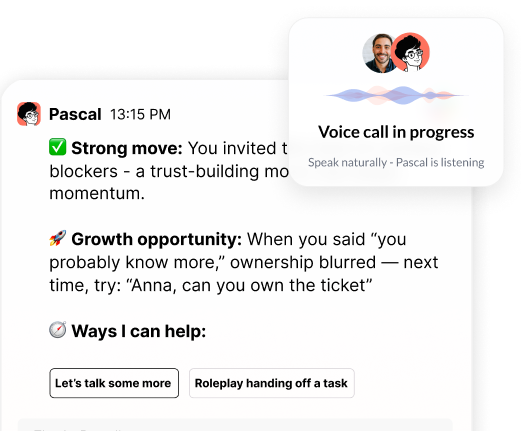
Pascal integrates with existing performance management systems to provide real-time coaching, automated review synthesis, and continuous manager development. See how Pascal works inside Slack and Teams or book a demo to discuss your specific performance review challenges.
Header photo by Amy Hirschi on Unsplash

.png)
.webp)
“Thank you for setting the great foundation for my promotion; now I have a plan!"

Curious to see how AI Coaching can 10X the impact and scale of your development initiatives. Book a demo today for: