
AI coaching transforms performance reviews from annual compliance rituals into continuous development cycles. The technology embeds real-time feedback, contextual guidance, and behavioral insights directly into managers' workflows. Instead of replacing human judgment, AI coaching platforms synthesize meeting observations, competency data, and organizational values to help managers prepare better reviews, deliver specific feedback, and turn performance conversations into actionable development plans.
AI coaching provides managers with real-time, personalized guidance before, during, and after evaluation conversations. The technology synthesizes behavioral observations, competency frameworks, and organizational values. Unlike traditional performance management software that stores ratings, AI coaching supports managers' preparation, conversation quality, and follow-through by observing actual work patterns and suggesting development approaches aligned with company culture.
The technology operates differently than conventional review systems. According to DILAN Consulting, AI coaching platforms interview managers about direct reports aligned with specific competencies, then draft reviews incorporating context from past conversations. This shifts reviews from memory-dependent exercises to data-informed development discussions.
Traditional reviews provide quarterly snapshots. AI coaching delivers continuous performance insights by analyzing behavioral patterns across meetings and communications. Pascal joins meetings as a silent listener (a bot that records and transcribes Zoom, Teams, or Google Meet sessions), capturing specific examples of behaviors that managers can reference weeks or months later when formal reviews occur.
The integration point matters. AI coaching doesn't replace performance management systems like Workday or SuccessFactors. It embeds into existing workflows through Slack, Teams, and Zoom to provide continuous development between formal review cycles, making the annual or semi-annual review a summary of ongoing conversations rather than a high-stakes event.
Organizations are integrating AI coaching with performance reviews because managers lack support. They're asked to be player-coaches who deliver results, develop people, and lead through volatility, yet 60% of new managers report feeling unprepared and most receive zero training before their first leadership role.
"We're asking more of managers with fewer resources," notes Melinda Wolfe, former CHRO at Bloomberg, Pearson, and GLG. "That's not sustainable without better support." The economic reality makes traditional solutions impossible to scale. Executive coaching costs $200-$600 per hour. AI coaching platforms deliver 24/7 guidance at approximately 1% of traditional coaching costs, making personalized development support economically viable for every manager, not just executives.
The coaching industry reached $6.25 billion in 2024 and is projected to hit $7.3 billion in 2025, according to Forbes. Yet most organizations can't provide coaching to frontline managers where the need is greatest. AI coaching solves this access problem while addressing the quality and consistency challenges that plague traditional performance reviews.
AI coaching improves review quality by eliminating recency bias, providing consistent competency-based frameworks across all managers, and surfacing specific behavioral examples from actual work interactions that managers might forget. The technology ensures every manager delivers feedback grounded in observable behaviors rather than vague impressions, while maintaining human judgment for final decisions.
Recency bias plagues traditional reviews. Managers remember the last few weeks vividly but struggle to recall performance from six or nine months earlier. AI synthesizes behavioral data across entire review periods, creating a more complete performance picture.
Consistency at scale becomes possible when organizations embed their competency frameworks and values into AI coaching systems. Every manager evaluates against the same criteria, reducing the variability that creates perceptions of unfairness. A manager in marketing and a manager in engineering both reference the same leadership competencies when assessing their teams.
Specificity through observation transforms feedback quality. Pascal joins meetings as a silent listener, capturing specific examples of behaviors aligned with company values. Instead of writing "needs to improve communication skills," a manager can reference three specific meetings where the employee interrupted colleagues or failed to summarize action items.
"It makes it easier not to make mistakes. And it gives you frameworks to think through problems before you act," says Wolfe. This guardrail function prevents common review errors like comparing employees to each other rather than to role standards, or letting one negative incident overshadow consistent strong performance.
SOC2-compliant platforms include moderation flags, sensitive topic escalation, and organization-specific controls to prevent inappropriate use. If a manager attempts to document protected characteristics or uses language that could create legal exposure, the system flags the content for HR review before it becomes part of the official record.
Performance Review Process Comparison
Data Breakdown:
• Aspect: Preparation Time | Traditional Process: 3-5 hours per review cycle | AI-Enhanced Process: 30-60 minutes per review cycle
• Aspect: Feedback Specificity | Traditional Process: Vague impressions, recent examples | AI-Enhanced Process: Specific behaviors across full period
• Aspect: Bias Mitigation | Traditional Process: Manager-dependent | AI-Enhanced Process: Consistent frameworks, recency bias eliminated
• Aspect: Follow-Through | Traditional Process: Manual tracking, often forgotten | AI-Enhanced Process: Automated goal tracking, progress updates
• Aspect: Documentation Quality | Traditional Process: Varies widely by manager skill | AI-Enhanced Process: Standardized structure, behavioral evidence
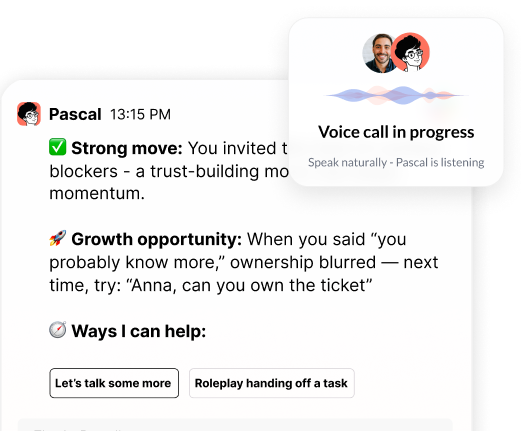
AI coaching integrates with performance reviews through four touchpoints: pre-review preparation, live conversation support, post-review documentation, and continuous check-ins between formal cycles. Pascal embeds into Slack, Teams, and Zoom to make this support available in the flow of work, not as a separate system managers must remember to use.
Pre-review synthesis transforms preparation from a dreaded task into a guided conversation. The AI interviews managers about direct reports aligned with competencies (through a chatbot interface in Slack or Teams that asks structured questions about each employee's performance), then drafts reviews incorporating context from past conversations. This reduces preparation time from 3-5 hours to 30-60 minutes while improving feedback quality.
Real-time meeting support provides guidance during performance conversations. Pascal can suggest clarifying questions when a manager's feedback is too vague, or recommend development resources when an employee asks about growth opportunities (through notifications that appear on the manager's phone or computer during the meeting). The support happens without interrupting the conversation flow.
Post-review documentation captures action items, development goals, and follow-up commitments automatically. This eliminates the administrative burden that causes many performance conversations to end without clear next steps. Managers save an estimated 150+ hours annually on documentation alone.
Continuous reinforcement between formal reviews keeps development momentum alive. AI provides weekly rollups and post-meeting insights that help managers track progress on development goals. Instead of waiting six months for the next formal review, managers receive prompts to check in on specific commitments or celebrate progress.
System integration matters for adoption. "We can connect with various HR systems. We're not trying to replace systems of record like performance management platforms, but rather embed into your existing workflow," according to internal Pinnacle documentation. This approach means managers don't choose between their existing tools and AI coaching—they get both working together.
AI coaching introduces three categories of risk: technical failures that produce bad advice, over-reliance that atrophies manager judgment, and privacy concerns that erode employee trust. Organizations that acknowledge these risks and build safeguards outperform those that treat AI coaching as a solved problem.
Technical failures happen when AI misinterprets context or suggests inappropriate feedback. A manager discussing an employee's medical leave might receive AI prompts about "attendance issues" if the system lacks context. False positives in moderation systems can flag legitimate feedback as problematic, creating friction. Organizations need clear escalation paths when AI suggestions don't match the situation.
Over-reliance becomes a risk when managers stop thinking critically about their team members. If a manager simply accepts every AI-generated review without adding personal insight, the feedback becomes generic. The technology should augment manager judgment, not replace it. Training managers to use AI as a starting point rather than a final answer prevents this failure mode.
Privacy concerns matter because employees may not know AI is observing their meetings and analyzing their behavior. One in six employees has considered quitting because of workplace monitoring they considered invasive, according to a 2025 ExpressVPN survey cited by Forbes. Organizations must be transparent about what AI observes, how data is used, and who can access information. Employees should know when they're in AI-monitored meetings and have the ability to opt out of observation in certain contexts (like one-on-ones about personal issues).
Bias amplification poses a risk if AI systems encode existing organizational biases into their frameworks. If an organization historically undervalues certain communication styles or work approaches, AI trained on that organization's data may perpetuate those biases. Regular audits of AI suggestions across demographic groups can surface these patterns before they cause harm.
Legal exposure increases if managers rely on AI-generated language that creates documentation problems. While moderation systems flag obvious issues, they may miss subtle problems. HR should review AI-assisted performance improvement plans and termination documentation before they become official.
Performance reviews contain sensitive employee data that requires enterprise-grade security and privacy protections. AI coaching platforms must maintain SOC2 compliance, never use customer data to train models, provide granular access controls, and offer anonymized aggregated insights to HR leaders while protecting individual privacy.
SOC2 compliance establishes baseline security standards. This certification means the platform has undergone independent audits of its security controls, data handling practices, and privacy protections. Pascal maintains SOC2 compliance as a foundational requirement.
Training data separation prevents customer information from leaking into model improvements. Many AI platforms train their models on customer data, which creates risks that one company's performance review language could appear in another company's AI suggestions. Enterprise-grade platforms commit to never using customer data for model training.
Access controls ensure only appropriate people see sensitive information. Managers access their own team's data. HR leaders see anonymized aggregated insights. Executives view organizational trends without individual employee details. These permission layers prevent unauthorized access to performance information.
Anonymized insights provide organizational value without compromising privacy. HR leaders can see that 40% of managers struggle with delegation conversations or that engineering teams need more support with cross-functional communication. These insights drive training investments without exposing individual performance data.
Transparency about observation matters for employee trust. Employees should know when AI is recording meetings, what data is captured, how long it's retained, and who can access it. Organizations that treat AI observation as a secret create the exact surveillance culture that drives turnover.
Moderation and escalation protocols protect against misuse. If a manager attempts to document protected characteristics, uses discriminatory language, or discusses topics that should involve HR, the system flags the content for review. These guardrails prevent AI coaching from enabling poor management practices.
Organizations measure AI coaching ROI through five metrics: manager time savings, feedback quality improvements, employee development velocity, retention impact, and organizational culture shifts. The most successful implementations track both efficiency gains and effectiveness improvements, recognizing that faster reviews only create value if they also improve outcomes.
Manager time savings provide immediate, quantifiable ROI. Organizations measure hours saved on review preparation, documentation, and follow-up conversations. Pascal customers report saving 150+ hours annually per manager. At an average manager salary of $120,000, that's roughly $8,600 in recaptured time value per manager per year. (This calculation assumes all saved time creates equal value, which may not hold true if managers use recaptured time for low-value activities.)
Feedback quality improvements show up in employee survey responses. Organizations track whether employees report receiving more specific, actionable feedback after AI coaching implementation. A 20% increase in manager NPS indicates employees notice meaningful differences in how their managers lead and develop them.
Employee development velocity measures how quickly people progress on development goals. Organizations compare time-to-competency before and after AI coaching integration. If employees previously took 18 months to develop a critical skill and now take 12 months, that acceleration creates competitive advantage.
Retention impact connects AI coaching to business outcomes. Organizations track whether teams with AI-coached managers show lower turnover than teams without. Pascal reports an 83% direct report improvement rate (measured by manager assessments of employee performance over a six-month period following AI coaching implementation, though this metric comes from Pascal's internal data and lacks independent verification).
Organizational culture shifts become visible through behavioral changes. HR leaders using AI coaching platforms can track adoption of specific leadership behaviors across the organization. If the company prioritizes "transparent communication," the AI can measure how many managers practice that value in their team interactions.
ROI Measurement Framework
Data Breakdown:
• Metric Category: Efficiency | What to Measure: Hours saved on review prep and documentation | Typical Impact: 150+ hours per manager annually
• Metric Category: Quality | What to Measure: Employee feedback scores, manager NPS | Typical Impact: 20% improvement in manager effectiveness
• Metric Category: Development | What to Measure: Time to competency, skill progression rates | Typical Impact: 83% direct report improvement rate
• Metric Category: Retention | What to Measure: Turnover rates for coached vs. non-coached managers | Typical Impact: 15-25% reduction in regrettable attrition
• Metric Category: Culture | What to Measure: Adoption of desired leadership behaviors | Typical Impact: Measurable behavior change in 60-90 days
CHROs face four primary implementation challenges: manager resistance to AI observation, integration complexity with existing HR systems, change management across diverse manager populations, and maintaining the human element in performance conversations. Success requires addressing each challenge proactively rather than treating them as technical problems to solve later.
Manager resistance often stems from fear of surveillance rather than opposition to better tools. Managers worry that AI will judge their performance or report their mistakes to executives. Transparency about what the AI observes, how data is used, and who can access information reduces this anxiety. Emphasizing that AI coaching helps managers succeed rather than catches them failing shifts the narrative.
Integration complexity varies by organization. Companies with modern HR tech stacks find integration straightforward. Organizations running legacy systems or highly customized platforms face more technical challenges. Starting with pilot programs that don't require full integration, proving value, then expanding systematically reduces risk.
Change management across diverse manager populations requires different approaches for different groups. New managers often embrace AI coaching because they lack established habits to change. Experienced managers may resist, viewing AI coaching as implicit criticism of their current approach. Tailoring messaging and support to each group improves adoption.
Maintaining the human element matters for sensitive conversations. AI coaching should enhance human judgment, not replace it. Performance reviews involving potential terminations, serious performance issues, or personal circumstances require human empathy and discretion. Clear guidelines about when to rely on AI support versus when to involve HR or senior leaders prevent over-reliance on technology.
Technical adoption doesn't equal behavioral change. Managers might use AI coaching tools without changing how they conduct performance reviews. Measuring adoption rates separately from outcome improvements helps organizations identify where additional support or training is needed.
• AI coaching transforms performance reviews from annual events into continuous development cycles by providing managers with real-time guidance, behavioral observations, and competency-aligned frameworks that improve feedback quality and fairness.
• Organizations achieve measurable ROI through manager time savings (150+ hours annually), improved feedback quality (20% manager NPS increase), and accelerated employee development (83% direct report improvement rate, though this metric comes from vendor data and lacks independent verification).
• Integration requires four touchpoints: pre-review preparation that synthesizes behavioral data, live conversation support, automated documentation, and continuous check-ins between formal review cycles.
• Risks include technical failures that produce bad advice, over-reliance that atrophies manager judgment, and privacy concerns that erode employee trust. Organizations must be transparent about what AI observes and give employees visibility into how their data is used.
• Enterprise-grade platforms maintain SOC2 compliance, never train models on customer data, and provide anonymized aggregated insights to HR leaders while protecting individual employee privacy.
See how Pascal delivers AI coaching that helps every manager prepare better reviews, deliver more specific feedback, and turn performance conversations into development momentum. Discover how Pascal works inside Slack, Teams, and your existing workflows.
Header photo by Vitaly Gariev on Unsplash

.png)
.webp)
“Thank you for setting the great foundation for my promotion; now I have a plan!"

Curious to see how AI Coaching can 10X the impact and scale of your development initiatives. Book a demo today for: