

AI coaching fills the gap between learning and doing by handling routine coaching moments with consistency and just-in-time support, freeing human coaches and L&D teams to focus on the complex, emotionally charged work where human judgment matters most. The result is a hybrid model that democratizes coaching access while protecting what only humans can deliver. This complementary approach addresses the knowing-doing gap that traditional training programs have struggled with for decades, transforming development from scheduled events into continuous, contextual experiences.
Quick Takeaway: AI coaching can deliver up to 90% of day-to-day coaching functions, including feedback preparation, delegation practice, and goal tracking, while human coaches remain essential for psychological safety, ethical judgment, and transformational growth. The hybrid model that combines both approaches extends coaching access to 20-100x more employees while preserving the human expertise that drives real behavior change.
AI can deliver up to 90% of day-to-day coaching functions, including feedback preparation, delegation practice, performance review drafting, and goal tracking, with consistency and 24/7 availability that humans can't match at scale. Organizations using purpose-built AI coaching platforms report 94% monthly retention with an average of 2.3 coaching sessions per week, compared to traditional platforms that see engagement drop to once per month or less.
The strength of AI coaching lies in specific, high-frequency support. When a manager prepares for a difficult conversation, AI can roleplay the scenario, provide real-time feedback on communication clarity, and surface specific talking points based on that employee's performance history and communication style. When a team lead struggles with delegation, AI offers frameworks and practice opportunities immediately, not weeks later in a training workshop. This just-in-time delivery is where AI excels because the coaching arrives when context is fresh and motivation is highest.
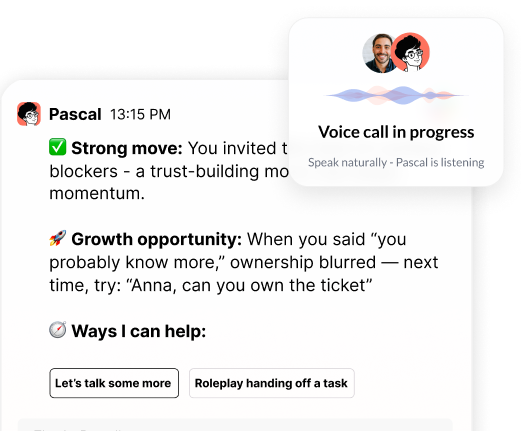
Pascal demonstrates this capability through proactive engagement, joining meetings and delivering real-time feedback after team interactions. A manager might finish a standup and receive specific observations: "Strong move inviting the team to surface blockers. Growth opportunity: When you said 'you probably know more,' ownership blurred. Next time, try: 'Anna, can you own this ticket?'" This immediate, contextual feedback creates learning moments that stick because they're grounded in actual work.
Human coaches excel at psychological safety, reading between the lines, ethical judgment, complex transformational work, and situations requiring legal expertise or emotional nuance that AI cannot replicate. Research from The Conference Board shows that while clients develop similarly high working alliance with both AI and human coaches in structured, goal-focused sessions, human coaches significantly outperform AI on commitment and relational depth for complex challenges.
The limitations of AI become clear in emotionally charged situations. When an employee experiences burnout, navigates a major career transition, or faces harassment, they need the empathy, lived experience, and nuanced judgment that only humans provide. Strategic career planning that involves understanding organizational politics, navigating senior relationships, and making decisions with long-term identity implications also requires human expertise. Melinda Wolfe, former CHRO at Bloomberg and Pearson, notes that managers need help preparing for these conversations, but human expertise remains essential for the actual intervention.
This distinction matters for organizational risk. When a manager describes potential harassment, discrimination, or termination scenarios, AI coaching should escalate to HR rather than provide step-by-step guidance that could create legal exposure. Pascal includes guardrails that recognize these boundaries and route sensitive topics to appropriate human resources.
Purpose-built AI handles routine coaching at scale; human coaches focus on complex, sensitive, and transformational work. This division of labor extends coaching access to 20-100x more employees while preserving human expertise where it creates disproportionate value. Organizations report 83% of direct reports see measurable improvement in their managers, with 20% lift in Manager Net Promoter Score among highly engaged users.
The economics of hybrid models make them compelling for CHROs. Traditional executive coaching costs $200 to $600 per hour and typically serves only senior leaders. AI coaching delivers similar guidance at 1/20th to 1/100th the cost, making it feasible to provide coaching to every manager in the organization. Human coaches then focus their time on the 10% of situations where their expertise creates disproportionate value: helping senior leaders navigate complex organizational dynamics, supporting people through major life transitions, and addressing situations requiring judgment that data alone cannot provide.
The practical division looks like this: AI coaches deliver daily preparation for difficult conversations, meeting feedback, and performance review support. Human coaches intervene for psychological safety concerns, career inflection points, and situations requiring judgment. Companies like HubSpot and Zapier demonstrate that this division of labor works: AI handles the volume; humans focus on complexity.
AI coaching increases ROI on existing training by reinforcing concepts in daily workflows, addressing the knowing-doing gap that traditional programs struggle with. Programs that integrate learning with daily work demands see measurably higher application rates than standalone training events. AI coaching embeds that integration by living inside Slack, Teams, and Zoom rather than requiring separate logins.
When your organization trains managers on radical candor principles, Pascal reinforces those concepts in real situations. If a manager avoids a difficult conversation, Pascal might prompt: "I noticed you didn't address the missed deadline in your 1:1 with Sarah. Want to talk through how to bring it up using the radical candor framework from last week's training?" This continuous reinforcement transforms training from isolated events into sustained behavior change.
The time savings compound quickly. One tech company using Pascal estimated saving 150 hours across just 50 employees in their initial rollout. Those hours represent time managers would have spent searching for resources, preparing for difficult conversations, or asking their own managers for guidance. When AI handles routine coaching, your L&D team and human coaches focus on strategic initiatives and high-impact interventions.
AI coaches that integrate with your HRIS, performance data, and communication tools deliver personalized guidance managers trust and apply. Generic AI tools without organizational context see adoption collapse after initial curiosity. Managers engaging with contextually aware AI coaching average 2.3 sessions per week with 94% monthly retention. Those using generic AI tools see engagement drop dramatically as the advice becomes irrelevant to their specific situations.
Purpose-built platforms trained on people science deliver guidance grounded in proven frameworks. When a manager asks how to handle a struggling team member, contextual AI considers that person's communication style, recent performance feedback, career aspirations, and team dynamics observed in actual meetings. The guidance reflects reality, not textbook theory. Integration with company values, competency models, and culture documentation ensures alignment with how your organization defines effective leadership.
Proactive coaching surfaces opportunities before managers realize they need help. After a team meeting, Pascal might identify a moment where the manager missed an opportunity to recognize a contribution or could have delegated more effectively. This proactive approach creates consistent development habits rather than crisis-only support.
Start with clear task division: identify which coaching moments AI handles best, ensure human coaches focus on complexity, and establish escalation protocols before deployment. Pilot with high-impact use cases like performance review preparation or difficult conversation roleplay. Jeff Diana, four-time CHRO, recommends starting with specific tasks rather than trying to transform all management coaching at once.
Train managers on when to use AI coaching versus escalating to human expertise. Establish clear ownership for different escalation categories and response timeframes. Measure leading indicators like engagement frequency and behavioral change indicators. Use aggregated insights to inform broader L&D strategy and organizational interventions. Link AI coaching to your existing training programs rather than treating it as separate.
The organizations seeing strongest results treat AI coaching as augmentation, not replacement. They frame the initiative around what managers gain—time for meaningful 1:1s, immediate support—rather than what gets displaced. This reframing builds adoption momentum because managers experience AI as helpful rather than threatening.
| Coaching Need | AI Coach Handles | Human Coach Handles |
|---|---|---|
| Daily management tasks | 1:1 preparation, feedback practice, delegation frameworks | Available for escalation if needed |
| Skill development | Continuous practice, roleplay, real-time feedback | Quarterly check-ins on progress and goals |
| Complex situations | Initial analysis, preparation support | Direct coaching on resolution strategy |
| Sensitive HR issues | Escalation to appropriate resources | Primary handler with HR involvement |
"By automating routine follow-ups and analysis, AI frees human coaches to focus on empathy, intuition, and strategic reflection."
Pascal combines contextual awareness, proactive engagement, and appropriate guardrails to scale coaching access while preserving the human expertise that drives transformational growth. The hybrid model works because it respects what each brings: AI's consistency and availability, humans' wisdom and judgment. Book a demo to see how Pascal delivers continuous, contextual coaching alongside your existing programs and coaches—and where it frees your team to focus on the complex, transformational work only humans can do.

.png)
.webp)
“Thank you for setting the great foundation for my promotion; now I have a plan!"

Curious to see how AI Coaching can 10X the impact and scale of your development initiatives. Book a demo today for: