

AI coaching embeds leadership guidance into Slack, Teams, and Zoom—delivering feedback during meetings, support between decisions, and contextual help when behavior change sticks. Development shifts from scheduled events to continuous learning.
AI coaching embeds leadership development into platforms managers already use—Slack, Microsoft Teams, Zoom, Google Meet. Guidance arrives at decision moments instead of requiring managers to schedule separate sessions. The AI joins meetings, observes communication patterns, and delivers feedback immediately after critical conversations.
The system lives inside collaboration tools, not separate portals. It surfaces guidance based on observed behaviors (upcoming 1:1s, difficult conversations, performance reviews) without waiting for managers to ask. Feedback connects to actual work: the meeting that just ended, the email about to send, the conversation happening now.
According to Gartner research, leader and manager development has topped HR leaders' priorities for three consecutive years, yet most organizations struggle to demonstrate behavior change from their investments. The disconnect stems from traditional approaches that separate learning from doing. Development happens through daily micro-moments of reflection and practice, not quarterly training events.
Traditional Training vs. AI Coaching:
Data Breakdown:
• Dimension: Timing | Traditional Training: Scheduled quarterly/annually | AI Coaching: Continuous, moment-by-moment
• Dimension: Location | Traditional Training: Separate LMS or classroom | AI Coaching: Inside Slack, Teams, Zoom
• Dimension: Personalization | Traditional Training: Generic cohort-based content | AI Coaching: Individualized based on behavior
• Dimension: Feedback Loop | Traditional Training: Weeks/months after training | AI Coaching: Immediate post-interaction
A manager's day with embedded AI coaching begins when the system sends a morning message in Slack highlighting today's critical conversations—a performance discussion at 2pm, a team standup at 10am—with preparation prompts based on past interactions with those individuals.
Morning (7:30 AM): AI coach sends Slack message: "You have a 1:1 with Marcus at 2pm. Last meeting, you committed to discussing his promotion timeline. Here's a framework for that conversation based on your company's career progression model." Manager role-plays the conversation in Slack, receiving feedback on tone and clarity.
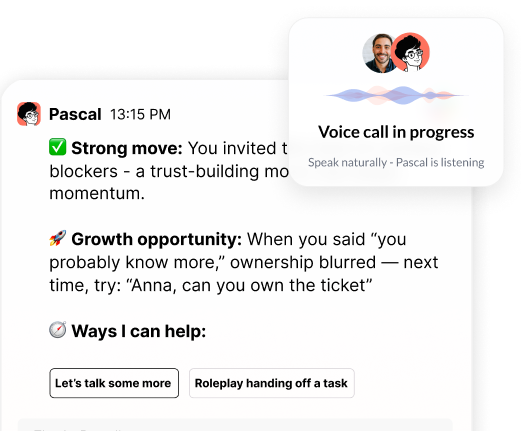
Mid-Morning (10:00 AM): AI joins team standup meeting via Zoom. Post-meeting analysis delivered in Slack within 5 minutes: "Strong: You acknowledged Jordan's concern about sprint capacity. Opportunity: When Alex raised the API issue, you moved to solutions before understanding the problem. Try asking three clarifying questions before suggesting fixes."
Afternoon (2:00 PM): Before Marcus 1:1, AI sends reminder with talking points and potential objection responses. Post-meeting: "You handled Marcus's frustration about timeline well by acknowledging emotion first. Consider: You promised to 'check with leadership'—set a specific follow-up date to maintain trust."
End of Day (5:00 PM): Weekly rollup delivered: "This week you held 12 1:1s and 8 team meetings. Your active listening improved 15% from last week. Focus area for next week: Delegation—you're solving problems your team should own."
This continuous feedback loop addresses what Jeff Diana, former CHRO at Calendly and Atlassian, identifies as the core challenge: "So much of the real learning and value comes from in-context coaching in the moment to drive performance and to solve problems in the moment."
AI coaching platforms integrate with workplace communication systems through calendar connections, meeting bots, and messaging app installations. The AI joins scheduled meetings via Zoom or Teams, monitors Slack or Teams conversations with appropriate permissions, and connects to calendar systems to understand context around upcoming leadership moments.
Meeting integration works through AI participants that join video conferences, transcribe conversations, analyze communication patterns, and deliver post-meeting feedback highlighting strengths and improvement opportunities. The system appears in messaging platforms as an always-available assistant for role-playing difficult conversations, preparing for 1:1s, or getting quick guidance on people challenges.
Calendar awareness means the AI understands upcoming performance reviews, team meetings, or skip-level conversations to provide proactive preparation support. Integration with HRIS, performance management platforms, and learning systems ensures coaching aligns with organizational competencies and values.
When HubSpot embedded AI tools into existing workflows, 98% of employees used AI on the job and 84% felt comfortable doing so, compared to typical enterprise software adoption rates of 30-40%. Integration depth determines adoption rates.
What the AI actually observes: The system measures speaking time distribution, interruption patterns, question-to-statement ratios, response times to team member concerns, and language indicating active listening versus problem-solving mode. It doesn't evaluate tone of voice or facial expressions—it focuses on observable communication behaviors that research links to management effectiveness.
Privacy and transparency: Teams know when the AI joins meetings (it appears as a participant). Managers control when the AI observes conversations and can disable it for sensitive discussions. Feedback goes only to the manager, not to their boss or HR, unless the manager chooses to share it.
AI coaching systems designed for workplace use include guardrails that flag sensitive topics, escalate concerning conversations to human HR professionals, and maintain organization-specific boundaries around what guidance the AI can provide. The system recognizes when a manager is dealing with situations requiring human judgment (potential legal issues, mental health concerns, serious performance problems) and routes those conversations appropriately.
Platforms like Pascal implement this through multiple protection layers: moderation flags that detect concerning language patterns, sensitive topic escalation that alerts HR when conversations enter protected territory, organization-specific controls that align with company policies, and anonymous aggregated insights that help HR understand trends without compromising individual privacy.
The AI never replaces human judgment in high-stakes situations. It acts as first-line support for the 80% of management challenges that benefit from structured frameworks and practice (delegation conversations, feedback delivery, meeting facilitation, career development discussions). For the 20% requiring human expertise, the system connects managers to appropriate resources.
This addresses the concern many HR leaders have about AI coaching: will it provide inappropriate guidance or miss critical warning signs? Purpose-built platforms trained by ICF-certified coaches (International Coaching Federation, the leading professional coaching credential) and designed for workplace contexts understand these boundaries. Generic chatbots do not.
Feedback works when it's attached to a specific meeting you just had rather than general guidance about a skill you need to develop. The brain processes concrete experiences differently than abstract concepts.
The effectiveness comes from three mechanisms. First, recency: feedback delivered within minutes of a conversation connects to fresh memory, allowing managers to replay the interaction mentally and identify specific moments where different approaches would have changed outcomes. Second, specificity: instead of "work on active listening," the AI says "when Jordan mentioned the API delay at 10:23am, you suggested a solution before asking clarifying questions—try asking three questions before offering fixes."
Third, privacy: managers receive feedback in private Slack messages or personal dashboards, creating psychological safety to acknowledge mistakes and experiment with new approaches.
The limitation: AI coaching works best for skill development (how to run effective 1:1s, how to delegate, how to give feedback). It doesn't replace human coaching for complex interpersonal dynamics, career transitions, or situations requiring deep emotional intelligence. Organizations should view AI coaching as a complement to human development resources, not a replacement.
Organizations implementing AI coaching embedded in daily workflows see measurable improvements in manager effectiveness within 90 days. Research from Perceptyx on AI leadership coaching shows managers report increased confidence in handling difficult conversations and direct reports note improved communication quality.
The results manifest across multiple dimensions. Managers save time because they prepare more efficiently for conversations, handle situations correctly the first time, and spend less time seeking guidance from HR or senior leaders. Teams perform better because managers provide clearer feedback, delegate more effectively, and create psychological safety through improved communication patterns.
Organizations gain visibility into management quality at scale. Instead of waiting for annual engagement surveys to reveal problems, AI coaching provides real-time signals about where managers struggle and what interventions work.
The economic case: AI coaching costs a fraction of traditional executive coaching (which runs $200-500 per hour) while maintaining 24/7 availability. For organizations with hundreds or thousands of managers, this means democratizing access to development support that previously only executives received.
What to watch for: Early adopters report that some managers initially perform for the AI rather than genuinely changing behavior. Effectiveness depends on creating a culture where the AI is positioned as a development tool, not a surveillance system. Organizations that frame AI coaching as "your private practice space" see better outcomes than those that emphasize monitoring.
• AI coaching embeds leadership development into Slack, Teams, and Zoom, delivering guidance at the moments when managers make decisions and have conversations, rather than requiring separate training sessions.
• Effective integration requires meeting bots that observe interactions, messaging platform presence for proactive support, and calendar awareness to provide contextual preparation.
• Feedback delivered within minutes of real conversations connects to concrete experiences, offers specific improvement suggestions, and creates psychological safety for experimentation.
• Purpose-built AI coaching platforms include guardrails for sensitive situations, escalation protocols to human HR professionals, and organization-specific boundaries that generic chatbots lack.
• Organizations implementing embedded AI coaching see measurable results within 90 days: improved direct report satisfaction, reduced HR escalations, and time saved through more efficient preparation.
Ready to see how AI coaching works inside your team's daily workflow? Discover how Pinnacle integrates with Slack, Teams, and Zoom to deliver leadership development at scale.
Header photo by Zulfugar Karimov on Unsplash

.png)
.webp)
“Thank you for setting the great foundation for my promotion; now I have a plan!"

Curious to see how AI Coaching can 10X the impact and scale of your development initiatives. Book a demo today for: