

Two architectures dominate AI coaching: purpose-built platforms designed exclusively for leadership development, and embedded features added to existing HR or productivity tools. The right choice depends on your organization's scale, existing tech stack, and whether you need coaching integrated into daily workflows or accessible through existing platforms.
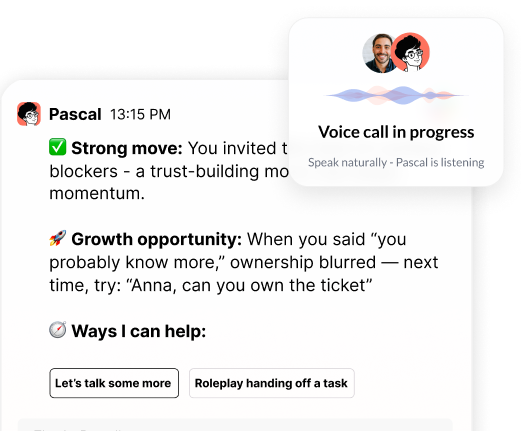
Purpose-built platforms architect everything around coaching. They train models on leadership conversations, integrate with communication tools (Slack, Teams, Zoom), and build knowledge graphs connecting performance data, meeting transcripts, and organizational context. Pascal by Pinnacle exemplifies this approach—it joins meetings, observes team interactions, and delivers guidance in the moment.
Embedded solutions add AI features to existing platforms. An LMS might add a coaching chatbot. Slack might build an AI assistant. These tools use general-purpose language models with coaching prompts layered on top. They access only data within their parent platform.
The architectural difference creates a proactive-versus-reactive split. Purpose-built coaches initiate conversations after observing a tense meeting or before a performance review. Embedded features wait for managers to remember they exist.
Choose purpose-built when:
• You need coaching integrated into daily workflows (Slack, Teams, meetings)
• You want the platform to observe interactions and provide timely guidance
• You require cross-platform context (meeting transcripts + performance data + chat history)
• You're scaling coaching beyond senior leaders to all managers
• You need coaching-specific safety mechanisms (sensitive topic detection, HR escalation)
Choose embedded when:
• Managers already use and trust the parent platform
• You want coaching as one feature among many (learning, performance management, productivity)
• Your budget prioritizes bundled solutions over specialized tools
• You have a small manager population (under 50)
• You're testing AI coaching before committing to a dedicated platform
Test both architectures with the same complex scenario: "My top performer just told me they're burned out and considering leaving." Purpose-built platforms provide structured, multi-step guidance grounded in coaching frameworks. Embedded tools offer surface-level suggestions.
Evaluation criteria:
Training data: Purpose-built platforms train on thousands of coaching conversations and leadership frameworks. Pascal uses ICF-certified coaches to develop its models. Embedded solutions use general-purpose LLMs (ChatGPT, Claude) with coaching prompts added.
Framework integration: Can the platform coach to your competency models and cultural values? Purpose-built systems ingest your frameworks and apply them. Embedded tools provide generic advice.
Response depth: Compare how each handles nuanced situations (conflict mediation, career development, performance conversations). Purpose-built coaches reference specific frameworks and multi-step processes. Embedded features rarely go beyond first-level advice.
Behavioral reinforcement: Does the platform track whether managers apply guidance? Purpose-built systems follow up. Embedded features don't close the loop.
Context separates a coach who knows you from a chatbot that doesn't. Purpose-built platforms build knowledge graphs from meeting transcripts, Slack conversations, performance reviews, 360 feedback, and goal documents. When you ask for feedback guidance, the coach references the actual conversation that just happened.
Embedded solutions access only data within their parent platform. An LMS AI knows what courses you've taken. A Slack assistant knows your message history. Neither knows your performance context, team dynamics, or development goals unless you explain them every time.
Managers abandon tools that require constant re-explanation. Purpose-built coaches remember your context and reach out at the right moment (after a tense meeting, before a performance review, when a team member seems disengaged). Embedded tools can't initiate because they lack the observational layer.
As Melinda Wolfe, former CHRO at Bloomberg, Pearson, and GLG, notes: "If we can finally democratize coaching—make it specific, timely, and integrated into real workflows—we solve one of the most chronic issues in the modern workplace."
The best coaching happens in the flow of work. Purpose-built coaches integrate into tools managers already use—Slack, Teams, Zoom—and deliver guidance at the moment of need. Embedded solutions live inside their parent platform, requiring managers to context-switch.
Workflow integration comparison:
Data Breakdown:
• Delivery Model: Where it lives | Purpose-Built: Slack, Teams, meetings, email | Embedded: Inside parent platform only
• Delivery Model: Activation | Purpose-Built: Proactive nudges, joins meetings | Embedded: Manager must visit platform
• Delivery Model: Context | Purpose-Built: Cross-platform knowledge graph | Embedded: Single-platform data
• Delivery Model: Adoption friction | Purpose-Built: Zero—already in workflow | Embedded: High—requires context switch
Platforms like Coachello and Risely live inside Slack and Microsoft Teams. Native delivery drives higher engagement because managers don't add another tool to their stack.
AI coaching touches sensitive topics: performance issues, conflict, career concerns, mental health signals. Purpose-built platforms include moderation systems, sensitive topic detection, and escalation pathways to HR. Embedded tools rarely have coaching-specific safety mechanisms.
Critical guardrails:
Sensitive topic detection: Does the platform recognize harassment, discrimination, mental health crisis, or legal risk? Purpose-built systems flag these for human review.
HR escalation: Can the platform route urgent situations to your HR team with context? Purpose-built platforms integrate with your escalation protocols.
Data privacy: Who sees what? Purpose-built platforms store data at the individual level with aggregated, anonymized insights for administrators. Embedded tools may expose individual conversations to platform admins.
Compliance: Is the vendor SOC2 compliant? Do they train models on your data? Pascal never uses customer data for model training. Embedded tools may not offer these guarantees.
Pascal's guardrails include moderation flags, sensitive topic escalation, organization-specific controls, and anonymous aggregated insights. No one in your organization sees individual coaching conversations—only the manager and Pascal.
Purpose-built platforms measure adoption rates, behavior change, and business outcomes. Embedded tools measure feature usage within their parent platform, which doesn't correlate with manager effectiveness.
ROI metrics:
Adoption rate: What percentage of managers use the coach weekly? Purpose-built platforms achieve higher weekly active usage. Embedded tools struggle because managers forget the feature exists.
Behavior change indicators: Does the platform track whether managers apply guidance? Purpose-built systems measure follow-through on feedback conversations, 1:1 quality, and delegation practices.
Leading indicators: Time to first feedback conversation, 1:1 frequency, team engagement scores. Purpose-built platforms correlate coaching usage with these metrics.
Business outcomes: Manager NPS, direct report satisfaction, retention rates. Purpose-built platforms demonstrate improvements in these areas when managers actively use the platform.
Purpose-built platforms cost more upfront but deliver higher ROI through adoption and behavior change. Embedded solutions appear cheaper because they're bundled with existing tools, but low adoption means you pay for unused features.
Cost framework:
Per-user pricing: Purpose-built platforms charge $50–200 per manager per year. Embedded features are often bundled with existing platform licenses but drive minimal usage.
Implementation costs: Purpose-built platforms require integration with Slack, Teams, and HRIS. Embedded tools plug into their parent platform but need change management to drive adoption.
Opportunity cost: What's the cost of managers not improving? Purpose-built platforms deliver measurable behavior change when adopted. Embedded tools with low adoption don't justify the investment.
Traditional executive coaching costs $15,000 per manager annually and serves only senior leaders. Purpose-built AI coaching costs 1% of that and scales to every manager.
Start with these questions:
• Do your managers already use and trust a platform that offers embedded coaching? If yes, test it first.
• Do you need coaching integrated into daily workflows (Slack, Teams, meetings)? If yes, evaluate purpose-built.
• Can you dedicate budget to a specialized coaching platform? If no, embedded may be your only option.
• Do you need cross-platform context (meeting transcripts + performance data + chat history)? If yes, purpose-built is required.
• Are you scaling coaching to 100+ managers? If yes, purpose-built delivers better ROI through higher adoption.
See how Pascal works inside Slack, Teams, and meetings. Pascal is an AI coach that lives where work happens, delivering guidance at the moment managers need it. Learn more about Pascal.
Header photo by ThisisEngineering on Unsplash

.png)
.webp)
“Thank you for setting the great foundation for my promotion; now I have a plan!"

Curious to see how AI Coaching can 10X the impact and scale of your development initiatives. Book a demo today for: