
AI coaching platforms need five core capabilities: coaching expertise from certified professionals, contextual awareness of your organization, proactive engagement in daily workflows, integration with existing systems, and guardrails for sensitive topics. Watch for vendors who won't discuss pricing, can't explain their coaching methodology, or lack measurable customer outcomes.
Effective platforms combine coaching expertise, organizational context, proactive engagement, system integration, and protective guardrails.
Data Breakdown:
• Capability: Coaching Expertise | What It Means: Training by ICF-certified coaches (International Coaching Federation—the industry's credentialing body) who understand behavioral change frameworks | Questions to Ask Vendors: "Who trained your coaching models? What credentials do they hold?"
• Capability: Contextual Awareness | What It Means: Three levels: individual (performance data, career goals), organizational (values, competencies, leadership frameworks), and situational (meeting context, team dynamics) | Questions to Ask Vendors: "How does your platform incorporate our organizational context? Show me an example."
• Capability: Proactive Engagement | What It Means: Delivers coaching when managers need it (before a difficult conversation, during performance reviews) through email, Slack, or calendar integration | Questions to Ask Vendors: "How does your platform reach managers at the moment of need? What triggers the outreach?"
• Capability: Integration Depth | What It Means: Connects to your HRIS (Human Resources Information System), performance management systems, 360 feedback results, org charts, and reporting relationships | Questions to Ask Vendors: "What systems do you integrate with? Can you access our performance review data?"
• Capability: Protective Guardrails | What It Means: Flags sensitive topics (terminations, harassment, legal issues) and escalates to HR instead of providing advice | Questions to Ask Vendors: "What happens when a manager asks about firing someone at 11 PM?"
Coaching expertise separates effective platforms from chatbots. Look for platforms trained by ICF-certified coaches who understand behavioral change frameworks and adult learning theory. Ask vendors: "Who trained your coaching models, and what credentials do they hold?" Vague answers about "machine learning" without coaching specifics mean you're buying a repurposed chatbot.
Contextual awareness operates at three levels. Individual context includes performance data and career goals. Organizational context includes your values, competencies, and leadership frameworks. Situational context includes meeting dynamics and team relationships. This depth means the difference between "give clear feedback" and "based on your company's Situation-Behavior-Impact framework and Alex's preference for direct communication, here's how to structure this conversation."
Proactive engagement solves the adoption problem. Effective platforms don't wait for managers to remember to use them. They reach out through email, Slack, or calendar integration when managers need guidance—before a difficult conversation, during performance reviews, after a team conflict. Jeff Diana, former CHRO at Calendly and Atlassian, notes that "real learning and value come from in-context coaching—solving problems in the moment, not in a classroom."
Integration depth goes beyond basic API (Application Programming Interface) connections. Can the platform access your HRIS data, performance management systems, and 360 feedback results? Does it understand your org chart and reporting relationships? Surface-level integrations miss the contextual richness that makes coaching relevant.
Protective guardrails include flags for sensitive topics and escalation protocols. Purpose-built platforms recognize when issues require HR involvement (terminations, harassment concerns, legal questions) and direct managers to appropriate resources. This matters when a frustrated manager asks about firing someone at 11 PM.
Six red flags indicate a vendor won't deliver value.
Pricing opacity. Vendors who won't discuss pricing until late in the sales cycle have complex, unpredictable cost structures. Ask for pricing ranges in your first conversation. Refusal signals deeper problems with their value proposition.
Missing coaching provenance. Ask directly: "Who trained your coaching models? What coaching methodologies do they follow?" If vendors can't explain their foundational coaching expertise, they've repurposed general-purpose language models without coaching specialization.
No outcome data. Vendors should provide metrics from existing customers: adoption rates, manager satisfaction scores, retention improvements, time savings. Vague claims like "increased engagement" without numbers mean they haven't measured results or the results aren't worth sharing.
Generic advice. Test company-specific scenarios during demos. Does the platform reference your values, competencies, and culture? Generic responses like "communicate clearly" or "set expectations" indicate shallow customization.
Missing guardrails. Ask: "What happens if a manager asks about terminating an employee or discusses a potential harassment situation?" Effective platforms escalate to HR. Generic tools provide advice that creates legal and ethical exposure.
Integration theater. Vendors claim "integration" but only offer basic API connections. Test whether the platform uses data from your systems to inform coaching. Can it reference performance review data? Does it understand reporting relationships? If not, you're getting surface-level connectivity without contextual depth.
Measure effectiveness through engagement indicators, behavioral outcomes, and business impact.
Data Breakdown:
• Metric Category: Engagement | What to Measure: Adoption rates, average sessions per user, feature usage patterns | Why It Matters: Low engagement means poor product-market fit or inadequate rollout
• Metric Category: Behavioral Outcomes | What to Measure: Direct report feedback (pulse surveys, 360 assessments), manager NPS (Net Promoter Score—measures satisfaction on -100 to 100 scale), observable changes in management practices | Why It Matters: Reveals whether coaching translates into observable behavior change
• Metric Category: Business Impact | What to Measure: Retention rates (high-engagement managers vs. low-engagement managers), team performance indicators, time savings (independent resolution vs. HR escalation) | Why It Matters: Connects coaching to organizational outcomes and ROI
• Metric Category: Qualitative Feedback | What to Measure: Manager interviews, specific coaching moment stories, difficult conversation outcomes | Why It Matters: Provides context that numbers miss
Engagement metrics reveal whether managers use the platform. Track adoption rates across different manager populations, average sessions per user, and which features drive engagement. Low engagement suggests poor product-market fit or inadequate rollout support.
Behavioral outcomes measure whether coaching translates into observable change. The gold standard is direct report feedback through pulse surveys or 360 assessments. Ask team members: "Has your manager's coaching improved in the past quarter?" Manager Net Promoter Scores provide another behavioral indicator.
Business impact metrics connect coaching to organizational outcomes. Track retention rates for teams with high-engagement managers versus low-engagement managers. Measure team performance indicators like velocity, quality metrics, or customer satisfaction. Calculate time savings when managers handle situations independently rather than escalating to HR.
Qualitative feedback provides context that numbers miss. Conduct manager interviews to understand which coaching moments proved valuable. Gather stories about situations where the platform helped managers navigate difficult conversations or make better decisions.
• Coaching expertise matters more than AI sophistication: platforms trained by ICF-certified coaches deliver better outcomes than repurposed language models
• Context drives relevance: organizational, individual, and situational awareness separates effective coaching from generic advice
• Proactive engagement solves the adoption problem: platforms that provide real-time feedback achieve higher adoption than reactive tools
• Transparent pricing and measurable outcomes separate serious vendors from vaporware: vendors who won't discuss pricing or provide customer metrics don't have compelling results
• Guardrails protect both managers and organizations: effective platforms escalate sensitive issues to HR
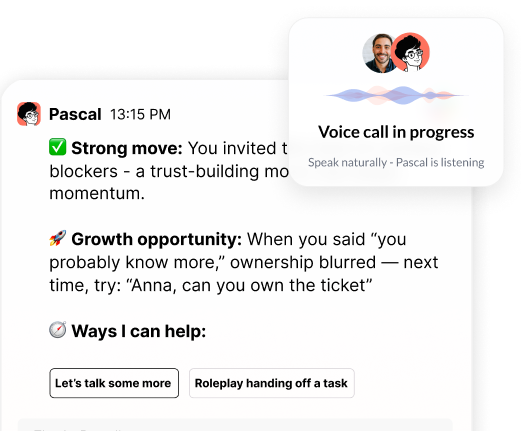
Pascal delivers proactive, personalized coaching that integrates into your managers' daily workflows—trained by ICF-certified coaches and customized to your culture. See how it works at heypinnacle.com.

.png)
.webp)
“Thank you for setting the great foundation for my promotion; now I have a plan!"

Curious to see how AI Coaching can 10X the impact and scale of your development initiatives. Book a demo today for: