

CHROs evaluating AI coaching platforms should prioritize five core capabilities: proactive engagement that meets managers in their workflow, contextual awareness of your organization, privacy-first architecture with SOC2 compliance, purpose-built coaching models, and measurable behavior change tracking. Red flags include vendors who can't demonstrate coaching expertise, refuse transparent pricing, lack enterprise security standards, or promise generic solutions without customization.
Platforms that consistently deliver manager effectiveness outcomes share five core capabilities. These aren't nice-to-have features—they're the minimum threshold for real behavior change.
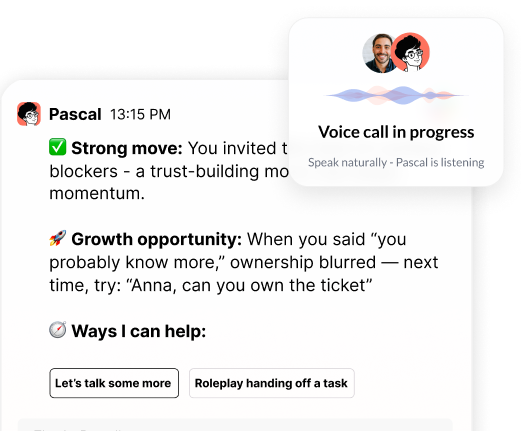
The AI coach initiates guidance at critical moments rather than waiting for managers to ask questions. It observes communication patterns and provides feedback when it matters most.
Reactive tools (chatbots you query) see 12-18% monthly active usage in enterprise deployments. Proactive systems that surface insights automatically achieve higher sustained engagement. Managers don't have to remember to use the tool—it becomes part of their existing workflow.
Red flag: Vendors who position their solution as "available 24/7" without explaining how it proactively engages managers.
The platform builds understanding of your people, their goals, team dynamics, and organizational culture—not just generic leadership principles.
Generic AI coaches trained only on public leadership content provide advice that could apply to any company. Context-aware platforms maintain memory of how specific individuals interact, what competencies your organization values, and which frameworks your culture reinforces.
Red flag: Vendors who can't explain how their platform learns about your organization beyond uploading documents.
SOC2 Type II compliance (an independent audit of security controls conducted over six months), clear data governance policies, and commitment to never training AI models on your company's data. This isn't optional for mid-market and enterprise organizations, especially in regulated industries.
The platform should offer aggregated insights for HR leaders without exposing individual conversations. Ask vendors where data is stored, how models are trained, and what happens to conversation logs.
Red flag: Vendors who are vague about data storage, model training, or conversation logs.
The AI is trained specifically for coaching conversations, not just a wrapper around ChatGPT or Claude with leadership prompts. The difference shows up in how the AI asks questions, challenges assumptions, and guides reflection.
Generic LLMs provide information. Coaching models guide thinking. Purpose-built systems understand coaching methodologies (GROW model, Socratic questioning, active listening techniques). They know when to ask questions versus when to provide direct guidance.
Red flag: Vendors who can't explain their coaching methodology or who describe their product as "powered by ChatGPT" without additional specialization.
The platform provides clear metrics on manager effectiveness improvements, not just usage statistics. You should see evidence of behavior change in direct report feedback, team performance, and manager confidence.
Usage metrics (logins, messages sent) don't predict outcomes. Behavior metrics (improvement in 1-on-1 quality, delegation effectiveness, feedback delivery) do. The platform should connect coaching interactions to observable workplace outcomes.
Red flag: Vendors who only report engagement metrics or who can't provide customer references with outcome data.
Most vendor evaluations prioritize surface-level features—user interface polish, integration lists, or impressive demos—while missing the capabilities that actually predict manager behavior change.
The demo trap catches even experienced buyers. Polished presentations showcase ideal scenarios, not the messy reality of daily management challenges. When every vendor claims "personalization" and "AI-powered insights," these terms become meaningless without specific definitions.
Small-scale pilots with hand-picked early adopters rarely predict organization-wide adoption patterns. Build your evaluation framework around the five capabilities above, then pressure-test each vendor's claims with specific use cases from your organization. Ask: "Show me exactly how your platform would coach one of our new engineering managers through their first difficult performance conversation."
The right questions expose whether vendors have built real coaching infrastructure or just wrapped ChatGPT in a nice interface.
"Show me how your platform would coach a manager through a specific scenario from our organization." Generic responses reveal generic platforms. Strong vendors will ask clarifying questions about your culture, then demonstrate how their system would adapt its guidance.
"What happens when a manager discusses a sensitive topic like mental health or discrimination?" Purpose-built platforms have guardrails: moderation flags, escalation protocols, and organization-specific controls. Generic chatbots don't.
"How does your platform learn about our company's leadership competencies and values?" The answer reveals whether the platform can customize or just uploads documents that sit unused.
"What behavior change metrics do your current customers track?" If vendors only cite usage statistics, they're measuring activity, not outcomes. Look for improvements in direct report feedback, team performance, and manager confidence.
"Can you show me your SOC2 compliance documentation and data governance policies?" Hesitation here is a deal-breaker for enterprise buyers.
Most AI coaching pilots fail because organizations test the wrong things with the wrong people. A well-designed pilot validates both the technology and your rollout strategy.
Start with 20-50 managers who represent your target population but aren't your most resistant skeptics. Include a mix of new managers (who need the most support) and experienced managers (who can evaluate quality). Avoid only selecting early adopters—they'll love anything new.
Run the pilot for 90 days minimum. Behavior change takes time. Measure three things: engagement (are managers using it?), satisfaction (do they find it valuable?), and outcomes (are direct reports seeing improvement?).
Create feedback loops. Weekly check-ins with pilot participants surface issues early. Monthly reviews with your implementation team allow course corrections. Don't wait until the end to discover problems.
Define success criteria before you start. What engagement rate would justify broader rollout? What satisfaction scores? What behavior change evidence? Without clear thresholds, every pilot becomes a negotiation.
Strong early indicators at 90 days include 60-75% of managers actively using the platform weekly, Net Promoter Scores above 40, directional improvement in manager effectiveness scores, expansion requests from other teams, and reduced HRBP load from repetitive manager questions.
Organizations that struggle with AI coaching adoption make predictable mistakes. Avoiding these patterns improves your success rate.
Treating AI coaching like software deployment instead of culture change. Technology adoption is easy. Behavior change is hard. Include change management, manager communications, and executive sponsorship. Don't just turn on the tool and hope managers use it.
Launching without clear use cases. "We're rolling out AI coaching" isn't compelling. "We're giving you 24/7 support for difficult conversations, delegation decisions, and feedback delivery" is. Managers need to know what problems this solves.
Ignoring the HRBP team. Your HR business partners are either your biggest advocates or your biggest obstacles. Involve them early. Show them how AI coaching reduces their repetitive questions and lets them focus on complex issues.
Measuring only usage, not outcomes. High engagement means nothing if managers aren't improving. Track behavior change through direct report feedback, team performance, and manager confidence surveys.
Skipping the customization. Generic AI coaching gets generic results. Invest time upfront to align the platform with your leadership competencies, values, and culture.
AI coaching vendors use different pricing structures, making comparisons difficult. Understanding what drives cost helps you negotiate and avoid surprises.
Most vendors price per user per month, ranging from $8-$40 depending on features and scale. Watch for hidden costs: implementation fees, customization charges, integration expenses, and annual price increases. Some vendors charge separately for premium features like meeting observation or advanced analytics.
Transparency matters as much as price. Vendors who refuse to share pricing guides or require lengthy sales cycles often have complex pricing that doesn't scale predictably.
Calculate total cost of ownership over three years, not just year one. Factor in implementation time (how long until managers see value?), ongoing customization needs, and potential expansion to additional user groups.
Red flag: Vendors who won't discuss pricing until after multiple meetings or who require custom quotes for standard features.
• Prioritize five core capabilities when evaluating AI coaching platforms: proactive engagement in workflow, contextual awareness, privacy-first architecture with SOC2 compliance, purpose-built coaching models, and measurable behavior change tracking.
• Red flags that predict implementation failure include vendors who can't demonstrate coaching expertise, refuse transparent pricing, lack enterprise security standards, or promise generic solutions without customization.
• Ask vendors to demonstrate how their platform would handle specific scenarios from your organization, not just polished demo scripts.
• Run 90-day pilots with 20-50 representative managers, measuring engagement, satisfaction, and outcomes—not just usage statistics.
• Success requires change management, clear use cases, HRBP involvement, and platform customization aligned with your leadership competencies and culture.
Ready to see how AI coaching can scale manager development across your organization? See how it works to transform leadership development from scheduled events into continuous, in-the-moment support.
Header photo by Christina @ wocintechchat.com M on Unsplash

.png)
.webp)
“Thank you for setting the great foundation for my promotion; now I have a plan!"

Curious to see how AI Coaching can 10X the impact and scale of your development initiatives. Book a demo today for: