

AI coaching delivers measurable behavior change by embedding personalized guidance into daily workflows. Traditional training suffers from 5–15% engagement rates and rapid knowledge decay. The difference: AI coaching meets managers when decisions happen, not weeks later in a classroom.
This analysis examines when AI coaching outperforms traditional approaches—and when it doesn't.
AI coaching transforms development from a scheduled event into a continuous experience. Traditional training delivers generic content to passive learners. AI coaching provides active, contextual guidance tied to real situations.
The core differences:
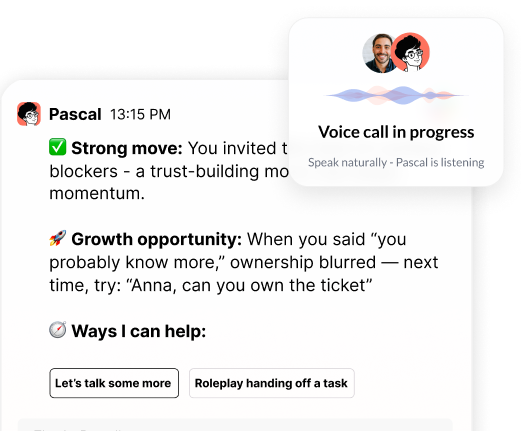
Real-time feedback loops. AI coaches observe interactions and provide immediate feedback customized to individual development goals. Instead of one-time training, managers receive continuous reinforcement through multiple touchpoints per week.
Contextual awareness. Purpose-built AI coaches integrate organizational competencies, individual performance data, and company culture to deliver relevant guidance. Rather than waiting for managers to remember training, AI coaching reaches out at critical moments—before a difficult conversation, after a team meeting, when patterns suggest intervention would help.
Behavioral tracking over time. AI coaches document progress, identify patterns, and adapt guidance based on what works for each individual.
Jeff Diana, former CHRO at Calendly, Atlassian, and SuccessFactors: "So much of the real learning and value comes from in-context coaching in the moment to drive performance and to solve problems in the moment."
Here's how the approaches compare:
Data Breakdown:
• Dimension: Cost per employee | Traditional Training: $800–$2,500/year | LMS Content: $200–$500/year | Human Coaching: $3,000–$10,000/year | AI Coaching: $50–$150/year
• Dimension: Engagement rate | Traditional Training: 20–30% completion | LMS Content: 5–15% active use | Human Coaching: 95%+ (when available) | AI Coaching: 85–95% sustained
• Dimension: Time to behavior change | Traditional Training: 6–12 months (if ever) | LMS Content: Rarely measurable | Human Coaching: 3–6 months | AI Coaching: 30–90 days
• Dimension: Scalability | Traditional Training: Limited by instructor capacity | LMS Content: High (but low utilization) | Human Coaching: Very limited | AI Coaching: Unlimited
• Dimension: Contextual relevance | Traditional Training: Generic scenarios | LMS Content: Self-selected topics | Human Coaching: Highly personalized | AI Coaching: Personalized + proactive
Your organization is ready when traditional training investments aren't delivering measurable behavior change, managers need support at scale, and leadership will embed development into daily workflows rather than treating it as a separate activity.
Diagnostic questions:
• What percentage of employees complete assigned training within 30 days of launch?
• Can you measure behavior change 90 days after a training program ends?
• How many managers have access to regular coaching today? (If less than 20%, you have a scale problem)
• Do managers report that training content connects to their actual work challenges?
• Are you spending on learning platforms that show low utilization in usage reports?
Readiness indicators:
• Leadership acknowledges that current training isn't changing behavior
• Your HR team will experiment with new delivery models
• The company has basic collaboration infrastructure (Slack, Teams, Zoom, or Google Meet)
• Privacy and security requirements are clearly defined (look for SOC2 compliance in vendors)
• Success metrics focus on behavior change and business outcomes, not completion rates
Red flags that suggest waiting:
• Leadership expects AI coaching to replace all human interaction (it shouldn't)
• You have no clear definition of what "good management" looks like in your culture
• Resistance to any AI tools exists across the organization
• Expectations center on immediate ROI without a 90-day adoption period
Melinda Wolfe, former CHRO at Bloomberg, Pearson, and GLG: "If we have an innovation right now, then it's incumbent upon us as HR leaders to show our companies an economic and effective way to help managers."
Calculate your current training cost per behavior change, not per completion. Most organizations spend $500–$2,000 per employee annually on training that produces minimal measurable impact. AI coaching delivers continuous development at $50–$150 per employee per year.
Step 1: Calculate your true training costs.
Add up annual spending on LMS licenses, content libraries (LinkedIn Learning, Udemy), instructor-led training, external workshops, and internal training team salaries allocated to manager development. Divide by number of managers in your organization. Typical range: $800–$2,500 per manager annually.
Step 2: Measure actual utilization and impact.
What percentage of assigned training gets completed? Industry average: 20–30%. Can you identify three specific behavior changes from last year's training investments? Survey managers: "How often do you apply what you learned in training?" The honest answer is usually "rarely."
Step 3: Calculate cost per behavior change.
If you spent $500K on manager training and can identify 50 managers who demonstrably changed behavior, your cost per behavior change is $10,000. Most organizations can't identify even 50 managers with measurable change.
Step 4: Model AI coaching economics.
AI coaching platforms typically charge $50–$150 per user annually. If you deploy to 500 managers at $100 per manager, your annual investment is $50,000. With 85% engagement and measurable behavior change in 60% of active users, you're achieving 255 behavior changes at $196 per outcome.
Step 5: Factor in secondary benefits.
AI coaching reduces HR business partner workload by handling routine manager questions, allowing HR to increase span of control. It provides real-time insights into leadership behaviors across the organization. It creates a continuous learning culture that compounds over time.
Leading indicators appear within 30 days: daily active usage above 40%, managers reporting that coaching feels relevant to their actual work, and specific examples of applied guidance in real situations. Lagging indicators emerge at 90 days: measurable behavior change in direct report feedback, reduced escalations to HR, and improved team performance metrics.
Track engagement metrics first:
• Daily and weekly active users
• Average coaching sessions per user per week
• Completion rates for suggested actions
Traditional training platforms see 5–15% monthly active usage. Effective AI coaching maintains 85–95%.
Measure behavior change through multiple lenses:
• Direct report feedback on specific leadership behaviors before and after AI coaching deployment
• Volume and nature of HR escalations (effective coaching should reduce routine manager questions)
• Team performance indicators (project completion rates, quality metrics, retention)
Calculate time savings and efficiency gains:
• Hours saved by HR business partners no longer handling basic manager queries
• Reduction in time-to-competency for new managers
• Elimination of low-value training programs that AI coaching replaces
Quantify business impact over time:
These outcomes emerge within 90 days and compound as the system learns individual patterns and organizational context.
A successful pilot runs 90 days with 30–50 managers across diverse teams, establishes clear before-and-after metrics, and includes both quantitative data and qualitative feedback from participants and their direct reports.
Define success criteria before launch:
Establish baseline measurements: current manager effectiveness scores from direct reports, HR business partner time spent on manager support, completion rates for existing training programs, and specific behavioral competencies you want to improve. Set realistic targets: 60% of pilot participants showing measurable improvement, 70%+ sustained engagement, and documented time savings for HR.
Select pilot participants strategically:
Include a mix of new managers who need foundational support and experienced managers facing new challenges. Represent different departments and team sizes. Avoid selecting only your strongest or weakest managers—you need a realistic cross-section to understand scalability.
Integrate AI coaching into existing workflows:
Purpose-built platforms join Slack, Teams, and meeting tools where managers already work. Avoid requiring managers to log into another platform. The less friction, the higher the adoption.
Collect data continuously throughout the pilot:
Track usage metrics weekly. Conduct brief pulse surveys at 30 and 60 days. Gather direct report feedback on observed manager behavior changes. Document specific examples of applied coaching in real situations.
Evaluate results at 90 days against your baseline:
Compare manager effectiveness scores, HR support time, and behavioral competency improvements. Calculate cost per behavior change versus traditional training. Collect qualitative feedback on what worked and what needs adjustment. Use these insights to refine your deployment strategy for broader rollout.
AI coaching doesn't replace human interaction in high-stakes situations. Senior executive coaching, crisis management, and complex organizational change still require human coaches who understand political dynamics and can navigate ambiguity.
AI coaching also struggles when:
• Your organization lacks clear competency frameworks (the AI needs something to coach toward)
• Privacy concerns prevent observation of real work interactions
• Managers resist any form of feedback or development
• The culture punishes vulnerability or experimentation
Blended approaches often work best: AI coaching for daily skill development, human coaching for strategic challenges, and peer learning communities for shared problem-solving.
• AI coaching delivers continuous, contextual guidance when managers need it, maintaining 85–95% engagement through proactive support and real-time feedback
• Calculate your true training cost per behavior change, not per completion—most organizations spend $500–$2,000 per employee annually on training that produces minimal measurable impact
• Leading indicators of AI coaching success appear within 30 days through daily active usage above 40% and specific examples of applied guidance in real situations
• Structure a 90-day pilot with 30–50 managers, clear before-and-after metrics, and integration into existing workflows to prove value before broader deployment
• AI coaching works best for daily skill development but doesn't replace human coaching for high-stakes situations or complex organizational change
Ready to see how AI coaching transforms manager development in your organization? See how Pinnacle's AI coach works inside Slack, Teams, and your daily tools to deliver real-time coaching at scale.
Header photo by Vitaly Gariev on Unsplash

.png)
.webp)
“Thank you for setting the great foundation for my promotion; now I have a plan!"

Curious to see how AI Coaching can 10X the impact and scale of your development initiatives. Book a demo today for: