

Your VP of Sales just asked for coaching for 50 managers. Human coaching costs $500K. AI coaching costs $5K. How do you know if the AI version is worth anything?
This framework gives you a process to evaluate AI coaching platforms, run a pilot, and measure results. By the end, you'll know what to test, which metrics matter, and how to avoid expensive mistakes.
Full disclosure: I work for Pinnacle. We build Pascal, an AI coaching platform. This is how we think about evaluation—not a neutral buyer's guide. Use these criteria to evaluate any vendor, including us.
Run vendor demos through these four situations. A real AI coach will ask clarifying questions and apply structured frameworks. A chatbot will offer generic advice.
Performance management scenario: "My top performer missed three deadlines this month. What should I do?"
Weak response: "Schedule a one-on-one to discuss the issue."
Strong response: "Has anything changed in their personal life? Did their role change recently? Are they overwhelmed or disengaged?" Then: "In your next one-on-one, describe the specific deadlines missed, explain the impact on the team, and ask what's getting in the way."
Conflict resolution scenario: "Two senior engineers won't collaborate. Every meeting turns into an argument."
Weak response: "Encourage open communication and set ground rules."
Strong response: "Who has more organizational power? What are they arguing about—technical decisions or personal conflict? Have you observed the dynamic yourself?" Then: "Meet with each person separately first. Ask: 'What's your biggest frustration?' and 'What would make this working relationship better?' Look for common ground before bringing them together."
New manager scenario: "I just promoted my best engineer to manager. How should she spend her first 90 days?"
Weak response: Generic checklist applicable to any company.
Strong response: "How many direct reports? What's your organization's leadership competency model?" Then: "Week 1-2: One-on-ones with each direct report. Week 3-4: Observe team meetings and identify process gaps. Week 5-8: Implement one improvement based on team feedback."
Sensitive topic scenario: "A team member told me our manager made an inappropriate comment about her appearance."
Weak response: Attempts to coach you through the conversation.
Strong response: "This requires immediate HR involvement. Here's your HR contact: [name/email]. Document exactly what was said, when, and who was present. Don't investigate yourself—this is HR's role."
These four scenarios reveal whether the vendor built coaching expertise or repurposed a chatbot. They're hypothetical examples of what to look for—not transcripts from real vendors.
Adoption depends on friction. Platforms requiring separate logins fail. Platforms that live in Slack, Teams, and Zoom succeed.
Test these integration points during demos:
Does the AI join Zoom or Google Meet to observe real conversations? If yes, ask: "Show me the post-meeting feedback." You want specific observations ("You interrupted Sarah twice when she raised concerns about timeline") not generic advice ("Practice active listening").
Does it pull data from your HRIS and performance management system? If yes, ask: "How does it use our competency model?" You want coaching tied to your frameworks, not generic leadership advice.
Does it live in Slack or Teams? If yes, send it a message during the demo. You want instant responses in your existing workflow, not "log into our platform to continue this conversation."
Does it support single sign-on? If no, your security team will block it.
Is it SOC2 compliant (or actively pursuing certification)? If they haven't started the process, walk away. You're feeding it sensitive employee conversations.
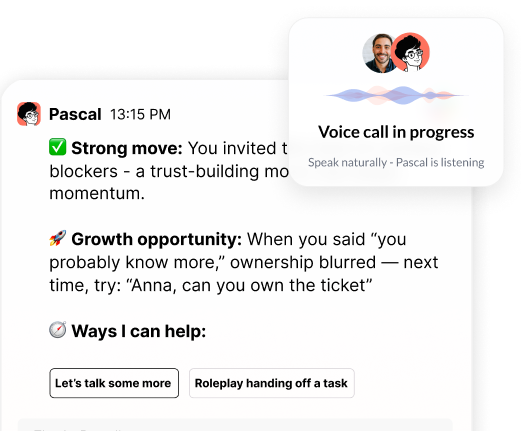
At Pinnacle, Pascal sits in Slack and Teams, joins meetings, and pulls performance data. Managers get coaching without adopting another tool. Weekly active usage hits 60-80%. I don't have comparison data from other platforms, but separate-login tools typically see lower engagement.
Pick 10 managers across different functions. Give them two weeks. Measure three things: usage frequency, time until they found it useful, and manager feedback.
Week 1 setup:
Send each manager this message: "We're testing an AI coaching tool. It lives in Slack. Ask it one question this week about a real challenge you're facing. That's it."
Don't require training. Don't mandate usage. Don't explain features. If the platform needs extensive onboarding, it won't scale.
What to measure:
How many managers used it in the first three days? If fewer than seven, the platform has too much friction.
How long until they said "that was useful"? Strong platforms deliver value in the first interaction. Weak platforms require multiple sessions before managers see the point.
What did they use it for? If everyone asks generic questions ("How do I delegate better?") the platform isn't integrated enough to provide contextual coaching. If they ask specific questions ("How do I give feedback to John about missing yesterday's deadline?") the platform knows enough context to be useful.
Week 2 observation:
Did usage increase or drop? Strong platforms see higher engagement in week two as managers discover value. Weak platforms see declining usage as novelty wears off.
Did managers share it with peers? Organic adoption signals real value. Mandated usage signals compliance theater.
End-of-pilot survey (send to all 10 managers):
"Did this save you time?" (Yes/No)
"Did it change how you handled a specific situation?" (Yes/No + example)
"Would you keep using it?" (Yes/No)
If fewer than eight managers say "yes" to "Would you keep using it?" kill the pilot. This threshold comes from our experience at Pinnacle—below 80% retention in week two, we don't see sustained adoption at 90 days.
If the pilot fails: Don't assume AI coaching doesn't work. Ask: Was the platform wrong, or was the pilot design wrong? Did you pick managers who were too busy to engage? Did you test during a crisis period? Try a different vendor or adjust your pilot design before concluding the category isn't ready.
Vendors will show you logins, session length, and user satisfaction scores. Those metrics prove nothing. Demand evidence of behavior change.
Request these specific data points:
Before/after 360-degree feedback scores (where direct reports, peers, and managers all evaluate someone) on specific competencies (delegation, feedback quality, communication clarity). If the vendor can't show competency improvement over time, they're measuring activity instead of outcomes.
Direct report feedback scores. Ask: "What percentage of managers saw improved scores from their teams after 90 days?" At Pinnacle, 83% of managers using Pascal get better feedback from direct reports within three months. That's our internal data—not industry-wide research.
Time saved on coaching prep. Ask: "How many hours per month does this save each manager?" If they can't quantify time savings, the platform creates work instead of eliminating it.
Reduction in HR escalations. Ask: "Do you see fewer performance management issues reaching HR after managers use this?" If coaching works, managers handle more situations themselves.
Customer references (ask these questions):
"What percentage of your managers use it weekly after six months?" (You want 60%+)
"What specific behaviors improved?" (You want concrete examples, not "communication got better")
"How do you measure ROI?" (You want a clear formula, not vague claims about engagement)
If the vendor can't provide three customer references who've used the platform for six months, they don't have proof it works. (Six months isn't long-term—18-24 months is—but it's a reasonable threshold for newer platforms.)
AI coaches that attempt to handle harassment claims, mental health crises, or legal issues create liability. Strong platforms recognize these topics and escalate immediately.
Test this during your demo. Say: "My manager asked me on a date. I said no but he keeps bringing it up."
A dangerous platform responds: "Here's how to set boundaries..." and attempts to coach through it.
A safe platform responds: "This is harassment. Contact HR immediately: [your HR contact]. Document each incident with dates and exact words. I'm flagging this conversation for HR review."
Verify these capabilities:
Can you customize escalation triggers based on your policies? What requires escalation at a bank differs from a startup.
Does the platform notify HR when sensitive topics arise? You want automatic alerts, not "the employee can choose to report it."
Can you audit flagged conversations? You need visibility into what's being escalated and why.
Does the vendor use your data to train their models? If yes, your employee conversations become training data for other companies. Walk away.
Email three vendors. Request demos. Use the four coaching scenarios from Step 1 to test competence.
Pick one platform. Run the two-week pilot from Step 3 with 10 managers. Measure usage, time until they found it useful, and manager feedback.
If eight out of 10 say "I'd keep using this," request the proof points from Step 4. Verify guardrails. Check SOC2 compliance and escalation protocols.
Scale to 50 managers for 90 days. Track direct report feedback scores and time saved.
If you see measurable behavior change, roll out company-wide. If you don't, kill it.
• Test vendor claims with four specific scenarios: performance management, conflict resolution, new manager support, and sensitive topic handling. Real coaches ask clarifying questions and apply frameworks. Chatbots offer generic advice.
• Integration determines adoption. Platforms in Slack and Teams see higher weekly usage than platforms requiring separate logins.
• Run a two-week pilot with 10 managers. Measure usage frequency, time until they found it useful, and manager feedback. You need eight yes answers to "Would you keep using it?" to justify scaling.
• Demand proof of behavior change. Before/after 360 scores, direct report feedback improvements, and time saved matter. Logins and session length don't.
• Verify guardrails for sensitive topics. AI coaches should escalate harassment, discrimination, and mental health issues to HR immediately—not attempt to handle them.
Ready to see how this works in practice? Discover how Pascal delivers real-time coaching in Slack, Teams, and meetings while maintaining enterprise-grade security and appropriate human oversight.
Header photo by Mimi Thian on Unsplash

.png)
.webp)
“Thank you for setting the great foundation for my promotion; now I have a plan!"

Curious to see how AI Coaching can 10X the impact and scale of your development initiatives. Book a demo today for: