

Anonymous coaching data reveals real-time patterns in manager challenges, skill gaps, and cultural dynamics without compromising individual privacy. AI coaching platforms that observe daily interactions surface actionable trends—what managers struggle with, where teams need support, and how culture manifests in behavior—enabling targeted interventions that traditional HR tools miss.
When an AI coach observes thousands of manager conversations across your organization, it identifies recurring themes—40% of mid-level managers struggling with delegation, engineering teams avoiding difficult feedback—without exposing individual challenges or performance data.
Individual coaching conversations remain confidential. Only aggregated patterns (minimum 10+ people) surface to HR leaders. This ensures managers can seek guidance without surveillance while CHROs gain visibility into organizational health.
The data reflects observed interactions—meeting dynamics, communication patterns, decision-making moments—not self-reported opinions. Instead of "engagement is down 5%," you learn "new managers in the product org need support with goal-setting conversations."
What coaching data can't do: It won't measure employee sentiment about pay, benefits, or leadership trust. It can't replace engagement surveys or performance reviews. It won't tell you why people leave (exit interviews do that). And it requires managers to actually use the coaching platform—low adoption means incomplete data.
Privacy risks to consider: Aggregation thresholds can fail in small teams. Re-identification is possible if you combine coaching data with other datasets. Managers may self-censor if they don't trust privacy protections. And "anonymous" data can still reveal patterns that make individuals identifiable in context.
Engagement surveys provide quarterly snapshots of how people feel, disconnected from specific behaviors or skill gaps. Performance reviews deliver annual judgments, rarely revealing why performance issues exist. LMS data shows completion rates that don't indicate whether learning transferred to work.
Coaching data shows how managers lead, where they struggle, and what support they need—in real time.
As Melinda Wolfe, former CHRO at Bloomberg, Pearson, and GLG, notes: "If we can finally democratize coaching—make it specific, timely, and integrated into real workflows—we solve one of the most chronic issues in the modern workplace."
The tradeoff: Coaching data provides behavioral specificity but requires continuous manager engagement. Surveys reach everyone but provide less actionable insight. Most sophisticated HR organizations use both.
Start by identifying specific strategic questions that coaching insights should answer. Don't implement AI coaching to "get data"—implement it to answer critical questions traditional tools can't address.
Leadership development ROI: Are managers applying training concepts in real conversations, or is learning staying theoretical? Coaching data shows whether delegation frameworks from your leadership program surface in 1:1s or if managers revert to old habits under pressure.
Cultural transformation tracking: How are stated values—psychological safety, accountability, transparency—showing up in team interactions? Coaching data reveals the gap between what you say matters and how people behave.
Skill gap identification: Where are systematic capability gaps across manager populations? Coaching data pinpoints whether delegation, feedback, or goal-setting represents the highest-impact development opportunity for specific cohorts.
Early warning signals: Which teams show behavioral patterns that predict turnover or disengagement? These patterns often surface weeks before they appear in engagement surveys.
Example from practice: A Series B SaaS company used coaching data to discover that 60% of their new engineering managers struggled with performance conversations, not delegation (which their training program emphasized). They redesigned onboarding based on observed behavior, not assumptions. Six months later, manager effectiveness scores in engineering rose 18%.
Build trust by defining clear boundaries around what data gets collected, how it's aggregated, who can access it, and how it will be used. Managers won't engage authentically if they fear individual conversations will be reported to HR or used in performance evaluations.
What gets collected: Document which interactions the AI coach observes—meetings, Slack conversations, coaching sessions—and what data points it captures. Be explicit about what's off-limits. (Most platforms observe meeting dynamics and coaching interactions but don't record full transcripts without explicit consent.)
Aggregation thresholds: Set minimum group sizes for reporting insights. Most organizations use 10+ people to prevent identification of individuals. If only 3 managers in finance use the platform, their aggregated data doesn't get reported separately—it rolls into a larger group or doesn't appear at all.
Access controls: Define who can view organizational insights. CHROs and senior HR leaders see company-wide patterns. Department heads see only their own team's aggregated data. Individual managers never see their peers' coaching interactions.
Use case boundaries: Specify that coaching data informs development programs, not performance evaluations. Make it clear that individual coaching conversations remain confidential and won't be used in promotion or termination decisions.
Technical safeguards: Look for platforms with SOC2 compliance (a security framework requiring regular audits of data handling practices). Verify that your coaching vendor doesn't use customer data to train models, which could expose your conversations in other clients' systems.
What can still go wrong: Small teams may be identifiable despite aggregation. Managers may recognize patterns that point to specific individuals. And if trust breaks down once (a manager discovers their coaching data was shared), adoption collapses across the organization.
Connect your AI coaching platform to your HRIS, LMS, and performance management systems to enrich coaching insights with organizational context. Integration transforms coaching data from a standalone dataset into intelligence that enhances every HR process.
HRIS integration: Connect coaching data to employee records—role, tenure, department, manager—to segment insights by population. This reveals whether new managers face different challenges than experienced leaders or if specific departments show unique patterns. (Technical note: This typically requires API access to your HRIS and a data mapping exercise to align fields.)
LMS integration: Link coaching interactions to training completion data. When managers complete a delegation workshop, coaching data shows whether they apply those concepts in real conversations or need additional support.
Performance management integration: Surface coaching insights during calibration and planning cycles. If coaching data shows a team struggles with goal-setting, that informs development priorities for the next quarter.
Calendar and communication tools: Embed the coach into Slack, Teams, Zoom, and Google Meet so it observes work in real time. This integration determines whether coaching becomes a daily habit or another underutilized portal. (In practice, this means installing a bot or plugin that managers can invoke during or after meetings.)
Budget for this: Integration requires engineering resources. Plan for 40–80 hours of IT time for initial setup, plus ongoing maintenance. Work with your vendor to understand what's possible with out-of-the-box integrations versus custom development.
Review aggregated coaching data monthly to identify recurring themes, skill gaps, and behavioral patterns that warrant organizational intervention. The goal is not to track every data point but to surface the 3–5 highest-impact opportunities where targeted support will drive measurable improvement.
Skill gap analysis: Which competencies show up most frequently in coaching interactions? If 40% of managers request support with delegation, that's your highest-impact development opportunity. Build targeted programs around the skills managers actually need, not what you assume they need.
Cohort-specific patterns: Do new managers face different challenges than experienced leaders? Does the sales team struggle with different skills than engineering? Segment insights by tenure, role, and department to tailor interventions.
Cultural alignment gaps: Where do observed behaviors diverge from stated values? If your culture emphasizes psychological safety but coaching data shows managers avoiding difficult conversations, that's a cultural transformation opportunity.
Early warning signals: Which teams show patterns that predict disengagement or turnover? Rising stress, declining meeting effectiveness, or increasing conflict in coaching interactions often precede engagement score drops by 4–6 weeks.
Competing platforms to consider: BetterUp, Sounding Board, and CoachHub offer similar AI coaching capabilities with different approaches to data aggregation and privacy. Evaluate multiple vendors to find the best fit for your organization's needs and technical infrastructure.
Use coaching insights to build development programs that address the specific challenges managers face in real work, not generic leadership competencies. Traditional training often misses the mark because it's designed around assumed needs rather than observed behavior.
Micro-learning modules: If coaching data reveals managers avoid feedback conversations, create 5-minute modules on feedback frameworks that managers can access immediately before difficult conversations. Timing matters—learning delivered in the moment of need transfers better than classroom training.
Cohort-based workshops: When coaching data identifies a skill gap affecting 30+ managers, run targeted workshops. If new managers struggle with goal-setting, bring them together for a 90-minute session focused on that skill, using real examples from coaching interactions (anonymized and aggregated).
Manager enablement resources: Build playbooks, templates, and conversation guides that address the specific scenarios managers encounter. If coaching data shows managers struggle with performance improvement plans, create a step-by-step guide with example language.
Executive coaching allocation: Use coaching data to identify high-potential managers who would benefit most from human coaching. If a manager shows strong engagement with AI coaching and faces complex leadership challenges, that's a signal to invest in 1:1 executive coaching.
Example from practice: A financial services company discovered through coaching data that their managers struggled with remote team dynamics, not the time management issues their training program addressed. They built a 4-week remote leadership cohort program. Three months later, remote team engagement scores rose 22% while in-office team scores remained flat.
Track whether interventions based on coaching insights actually improve manager effectiveness and business outcomes. The value of coaching data lies not in the data itself but in whether it drives measurable change. Define success metrics upfront and review them quarterly.
Behavior change metrics: Are managers applying new skills in real conversations? Coaching data shows whether delegation frameworks from your training program surface in 1:1s or if managers revert to old habits.
Manager effectiveness scores: Do direct reports report improvement? Track manager Net Promoter Score or effectiveness ratings before and after targeted interventions.
Business outcomes: Do teams with higher coaching engagement show better performance? Track retention, productivity, and goal achievement rates across teams to correlate coaching adoption with business results.
Adoption patterns: Which managers engage consistently with coaching, and which drop off? Low adoption often signals that coaching isn't integrated into workflow or doesn't address real challenges. Adjust your approach based on usage patterns.
What good looks like: A mid-market technology company tracked manager effectiveness scores before and after implementing coaching data analytics. Managers who engaged with the platform weekly (and whose teams received targeted interventions based on coaching insights) saw direct report satisfaction scores rise 15% over six months. Managers who used the platform sporadically saw no change. The difference wasn't the platform—it was the combination of manager engagement and HR follow-through on insights.
Trust collapse: If managers discover their coaching data was shared inappropriately once, adoption collapses across the organization. Prevention: Communicate privacy protections clearly and repeatedly. Show managers that coaching data informs development programs, not performance evaluations. Never make exceptions, even for executives.
Integration failure: Coaching data becomes valuable when connected to HRIS, LMS, and performance management systems. Without integration, it's just another dashboard. Prevention: Budget time and resources for technical integration. Work with IT from day one. Expect 40–80 hours of engineering time for initial setup.
Analysis paralysis: Too much data overwhelms HR teams. Prevention: Focus on the 3–5 highest-impact patterns each quarter rather than tracking every metric. Ask: "What insight would change our development strategy if we knew it?"
False positives: Coaching data can identify patterns that don't represent real problems. A spike in delegation questions might mean managers are proactively developing skills, not struggling. Prevention: Combine coaching data with other signals (engagement scores, performance data, manager feedback) before designing interventions.
Selection bias: Managers who engage heavily with coaching platforms are often already strong performers. Attributing their success to the platform overstates impact. Prevention: Track outcomes for both high-engagement and low-engagement users. Look for improvement among managers who start using the platform, not just those who use it most.
• Anonymous coaching data reveals real-time behavioral patterns—what managers struggle with, where teams need support—that traditional surveys and performance reviews miss, but it requires continuous manager engagement and can't replace other HR tools
• Effective programs start with clear privacy guardrails (10+ person aggregation thresholds, explicit use case boundaries, SOC2 compliance) and honest communication about what can still go wrong
• Integration with HRIS, LMS, and performance management systems transforms coaching data from a standalone dataset into intelligence that enhances every HR process, but budget 40–80 hours of IT time for setup
• Focus on 3–5 high-impact patterns each quarter rather than tracking every metric, and design targeted interventions (micro-learning, cohort workshops, manager playbooks) that address observed challenges
• Measure whether coaching insights actually drive behavior change and business outcomes by tracking manager effectiveness scores, team performance, and adoption patterns before and after interventions
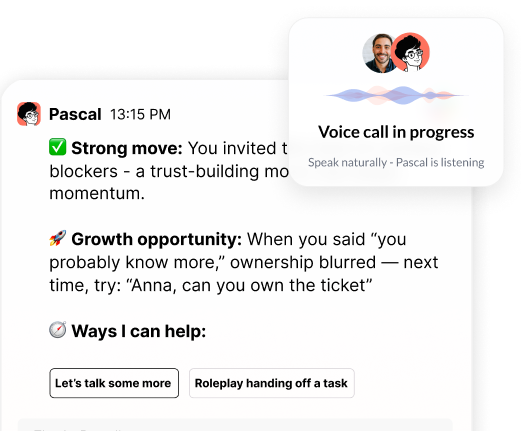
Ready to see how coaching data can transform your leadership development strategy? See how Pascal works inside Slack, Teams, and meetings to deliver real-time coaching and organizational insights.

.png)
.webp)
“Thank you for setting the great foundation for my promotion; now I have a plan!"

Curious to see how AI Coaching can 10X the impact and scale of your development initiatives. Book a demo today for: