

Your managers completed leadership training six months ago. They still struggle with difficult conversations. The training didn't stick because it taught generic frameworks, not how leadership works in your environment.
AI coaching trained on your organization's values, competency frameworks, and leadership principles delivers guidance that reinforces what effective leadership looks like at your company. Managers either use the tool once and forget it, or they build it into their daily practice. The difference is personalization.
Personalized AI coaching means training the system on your leadership frameworks, cultural values, competency models, and behavioral expectations. Every coaching interaction reinforces how leadership works at your company.
Here's how it works technically: HR uploads culture documents, competency frameworks, and policies through an admin portal. The AI uses retrieval-augmented generation (RAG) to search these documents when a manager asks a question, then generates responses that quote or paraphrase your specific frameworks. When a manager asks about giving feedback, the AI retrieves your feedback model, identifies the relevant section, and generates coaching that applies your approach to their situation.
A manager at Netflix asking about feedback receives coaching on radical candor because that's in Netflix's culture deck. A manager at a pharmaceutical company asking the same question gets guidance on stakeholder alignment and documentation because those values appear in their competency framework. Same question, different answers, both correct for their environment.
The system works at four layers: organizational values, department competencies, role expectations, and individual performance data. A sales manager and an engineering manager at the same company receive different coaching because their department competencies differ.
Effective customization requires three categories of content that work together to ensure the AI understands how leadership works in your organization.
Upload your culture deck, mission statement, and values definitions. The AI references these when coaching managers through decisions involving cultural trade-offs.
At Shopify, "move fast" is a core value. When a manager asks whether to ship a feature or wait for more testing, the AI references this value and explains how it applies to their specific situation. At Toyota, "quality first" drives the opposite answer to the same question. Both answers are correct because they match each company's culture.
What to upload: Culture deck, mission statement, values definitions with examples, leadership principles.
Define the competencies that matter at each level (individual contributor, manager, senior leader) and include behavioral indicators. If "inclusive leadership" is a competency, define what that looks like in meetings, hiring decisions, and team communications.
The AI provides feedback tied to your framework. A manager who dominates a brainstorming session receives coaching on inclusive facilitation techniques that match your competency definition. The coaching references specific behaviors from your framework, not generic advice about listening.
What to upload: Competency frameworks by level, behavioral indicators for each competency, performance review rubrics, training materials that explain your frameworks.
Upload HR policies, legal guidelines, and escalation procedures. The AI knows when to escalate sensitive situations (harassment, discrimination, mental health concerns) according to your protocols.
A manager describing a potential harassment situation triggers an immediate escalation to HR with the documentation your policy requires. The AI doesn't attempt to coach through issues that require human judgment and legal expertise. It says: "This situation requires immediate HR involvement. I'm notifying [HR contact] now. Here's what to document while you wait."
What to upload: HR policies, legal guidelines, escalation procedures, templates for documentation, contact information for escalation.
BetterUp, which provides AI coaching to over 600 companies, published results from a financial services client with 2,400 managers. The company uploaded their leadership competency model (built around "client-first decision making" and "risk awareness") and their feedback framework (a modified version of SBI that includes regulatory considerations).
After six months:
• 78% of managers used the AI coach at least weekly (compared to 23% who completed optional classroom training)
• Manager effectiveness scores (measured through direct report surveys) improved 12% on average
• Time-to-proficiency for new managers decreased from 8.7 months to 6.1 months
• The company spent $120 per manager annually (compared to $8,500 for their previous executive coaching program that reached only top performers)
The key finding: managers used the AI because it spoke their language. When a manager asked about giving feedback on a client interaction, the AI referenced the company's "client-first" value and applied their specific feedback framework. Generic advice would have been ignored.
The failure mode: in month two, the AI gave contradictory advice about risk escalation because the company had uploaded both old and new versions of their risk policy. Managers noticed and stopped trusting the system until HR cleaned up the documentation. This taught the implementation team to audit content before upload.
The comparison isn't about replacing human expertise. It's about scaling what works and making it accessible when managers need it.
AI coaching: Available in the moment. Costs $50-150 per manager per year (based on published rates from BetterUp, Sounding Board, and Torch). Reaches everyone. Consistent delivery globally. Personalized to company culture and individual development plans.
Human coaching: Available during scheduled sessions. Costs $5,000-15,000 per manager per year (ICF Global Coaching Study, 2023). Reaches top performers only. Quality varies by coach. Highly personalized to individual but not always aligned to company frameworks.
Classroom training: Available quarterly. Costs $500-2,000 per program (Training Industry Report, 2024). Reaches whoever attends. Inconsistent delivery across locations. Generic content that doesn't match your culture.
Traditional training programs run quarterly. Human coaches book weeks in advance. AI coaching meets managers when they're preparing for a difficult conversation, processing feedback from a meeting, or navigating a team conflict. That timing difference determines whether learning translates into behavior change.
Jeff Diana, former CHRO at Calendly and Atlas, emphasizes that AI coaching works best when it complements human expertise. The value comes from having AI handle continuous, contextual coaching while human coaches focus on complex, high-stakes development conversations.
Ask how the platform ingests your organizational content and how it uses that content in coaching conversations. Many vendors claim customization but only add your company logo or use employee names.
Ask to see a demo where the AI handles a contradiction between your culture and general best practices. If your organization values "move fast and break things" but the AI suggests extensive stakeholder consensus before decisions, you have a misalignment. The platform should prioritize your frameworks over generic advice.
Understand the data security model. Your competency frameworks, performance data, and cultural documentation are proprietary assets. Ask: "Is this SOC2 compliant? Does our data train public models? Where is data stored?" If the vendor hesitates on any answer, walk away.
Evaluate integration with your existing HR tech stack. AI coaching that lives in a separate app managers rarely open won't drive adoption. Look for solutions that work inside Slack, Teams, or wherever your managers spend their time.
Ask about measurement. How will you know if this is working? Look for platforms that provide individual metrics (coaching engagement, behavior change) and organizational insights (skill gaps, cultural alignment trends). The right solution should answer: "Is this coaching reinforcing the behaviors that matter most to us?"
Measure at three levels: individual behavior change, manager effectiveness, and organizational culture alignment.
Individual metrics: Coaching engagement frequency, completion of AI-suggested actions, self-reported confidence in handling management situations. These leading indicators predict whether managers are using the tool. Track weekly.
Manager effectiveness: Direct report satisfaction scores, retention rates, performance review quality. Track quarterly to understand whether coaching translates into better management.
Organizational culture alignment: Whether managers demonstrate your competencies and values in real interactions. Some AI coaching platforms analyze communication patterns (in aggregate, anonymized form) to measure how often managers exhibit desired behaviors. This replaces annual engagement surveys with continuous cultural health monitoring.
Calculate ROI by comparing costs to outcomes. AI coaching costs 1% of traditional executive coaching while reaching 100% of managers. Add the value of reduced turnover (the BetterUp client saved $2.1M annually from a 3% reduction in manager turnover), faster time-to-productivity for new managers, and improved team performance.
Treating this as a technology deployment rather than a culture initiative: Rolling out the platform without explaining how it reinforces your values and competencies leads to confusion and low adoption. Frame the launch around your development philosophy, not the technology. When Patagonia launched AI coaching, the CHRO's message focused on "making our environmental leadership principles accessible every day," not on the AI.
Uploading too much content without curation: The AI needs your most important frameworks and values, not every training deck from the past decade. Start with your core competency model, top three cultural values, and essential policies. Add more content based on how managers use the system. The financial services company in the BetterUp case study initially uploaded 47 documents. Managers got confused, contradictory answers. They cut to 12 core documents and adoption doubled.
Launching without executive sponsorship: When the CHRO and business leaders use and reference the platform, managers take it seriously. When it's positioned as "just another HR tool," adoption stalls. Make AI coaching part of how your leadership team talks about development.
Skipping escalation pathway configuration: The AI should know when to route concerns about harassment, discrimination, or mental health to human resources. Failing to configure these guardrails creates legal and ethical risks. A manager at a retail company asked the AI about a suicide threat from a direct report. The AI attempted to coach the manager through the conversation instead of escalating immediately. The company pulled the platform offline for three weeks to fix escalation rules.
Over-customizing initially: Start with your core frameworks and let usage patterns guide additional customization. Managers will tell you through their questions what content the AI needs next. This prevents analysis paralysis and gets you to value faster.
The AI reinforces toxic culture: If your culture deck says "we value aggressive goal-setting" but that's code for unrealistic expectations that burn people out, the AI will coach managers to set aggressive goals. It can't distinguish between healthy ambition and toxic pressure. Before uploading culture documents, ask: "Would we want managers to follow this advice literally?" If not, revise the document.
Contradictions between frameworks: Your culture deck says "move fast," your compliance policy says "document everything," and your competency model says "thoughtful decision-making." The AI gives different answers depending on which document it retrieves first. Solution: create a hierarchy (policies override culture, culture overrides generic advice) and audit for contradictions before upload.
Gaming the system: Managers learn that asking questions in certain ways triggers positive feedback. "I gave radical candor today" becomes a phrase managers use to get AI validation, whether or not they actually gave good feedback. Solution: measure outcomes (direct report satisfaction, team performance), not just AI engagement.
Misinterpreting context: A manager says "I need to move fast on this decision" and the AI coaches them to skip stakeholder input because your culture values speed. But the decision involves legal risk and requires compliance review. The AI doesn't understand context that isn't in the uploaded documents. Solution: train managers that AI coaching handles routine situations, human coaches handle high-stakes decisions.
Customization transforms AI coaching from generic advice into culture-aligned development. Training the AI on your values, competencies, and frameworks ensures managers receive guidance that works in your environment.
Three categories enable effective personalization: cultural foundation (values, mission, principles), behavioral standards (competencies, indicators, rubrics), and policies (escalation pathways, legal guidelines, templates). Start with these, add more based on usage.
Timing creates the behavior change advantage. AI coaching meets managers in the moment when they're preparing for difficult conversations or navigating team conflicts. This immediacy drives adoption and translates learning into action better than quarterly training programs.
Measurement happens at three levels: individual behavior change (engagement metrics), manager effectiveness (team outcomes), and organizational culture alignment (aggregate competency demonstration). This proves ROI and identifies improvement opportunities.
Implementation success requires treating AI coaching as a culture initiative. Executive sponsorship, clear communication about how the platform reinforces your values, and proper escalation pathways matter more than the technology. Start with core frameworks and let usage guide additional customization.
Ready to explore how AI coaching can reinforce your leadership culture? Pinnacle helps organizations implement AI coaching that aligns to their values and competencies. We handle the technical integration, content curation, and change management so your managers receive coaching that works in your environment. Contact us to discuss your leadership development goals.
Header photo by Alejandro Escamilla on Unsplash

.png)
.webp)
“Thank you for setting the great foundation for my promotion; now I have a plan!"

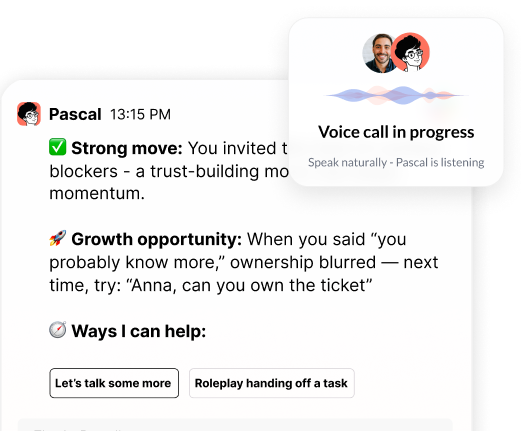
Curious to see how AI Coaching can 10X the impact and scale of your development initiatives. Book a demo today for: