

Organizations preparing for AI-enabled management face a culture problem, not a technology problem. Success requires establishing psychological safety, redefining manager roles, and embedding AI into daily workflows before deploying any tools.
An AI-ready management culture treats AI as a collaborative layer in decision-making, not a replacement for human judgment. Three characteristics define readiness: managers who view AI as a thinking partner (not a threat), leadership frameworks that explicitly define when humans lead and when AI supports, and rituals that normalize AI use in performance conversations, 1:1s, and team decisions.
Gartner research shows that by 2026, 20% of companies will use AI to reduce middle management roles by over 50%. This makes cultural preparation urgent. The organizations that survive this transition won't be those with the most sophisticated AI tools—they'll be the ones whose managers trust AI enough to use it daily.
Traditional cultures optimize for manager expertise and hierarchical decision-making. AI-ready cultures optimize for insight curation and human-AI collaboration. The shift from "manager as sole expert" to "manager as curator of insights" requires deliberate cultural work before any technology deployment.
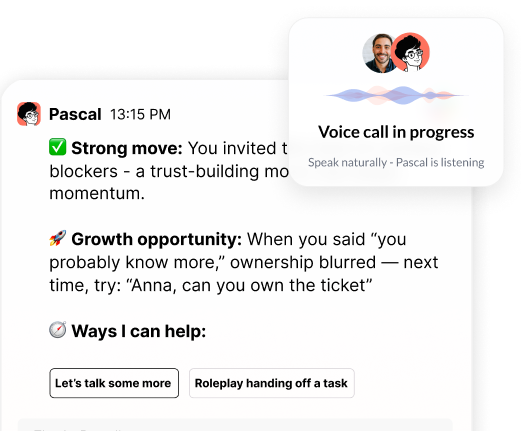
Here's what this looks like in practice: A manager preparing for a difficult performance conversation opens Slack and asks, "How do I address missed deadlines without damaging trust?" AI coaching surfaces three approaches based on the organization's values, the employee's communication style, and past successful conversations. The manager reviews the options, selects one, and adapts it to the specific situation. The AI didn't make the decision—it accelerated the manager's thinking and surfaced options they might have missed.
Traditional management culture optimizes for individual expertise, hierarchical decision-making, and scheduled development events. All three break down when AI enters the workflow.
Managers trained to "own the answer" struggle when AI surfaces conflicting recommendations or challenges their assumptions. Organizations that don't address this cultural mismatch see AI adoption stall at 15-20%, with managers reverting to familiar patterns despite available tools.
Salesforce CEO Marc Benioff noted at Davos that today's executives are "the last generation of CEOs to manage all-human workforces." Yet most leadership development programs still prepare managers for 20th-century challenges. The disconnect shows up in behavior: managers already use consumer AI tools like ChatGPT for sensitive decisions—without organizational guardrails, training, or privacy protection.
The expertise-hoarding model collapses when AI can surface insights faster than any individual. Scheduled learning fails when AI changes workflows monthly. Individual accountability frameworks can't measure human-AI team performance. These aren't technology problems—they're culture problems that technology exposes.
Data Breakdown:
• Dimension: Decision Authority | Traditional Management Culture: Manager owns final call | AI-Enabled Management Culture: Manager combines human judgment with AI insights
• Dimension: Development Model | Traditional Management Culture: Annual training with occasional coaching | AI-Enabled Management Culture: Continuous, contextual coaching (24/7 access)
• Dimension: Success Metrics | Traditional Management Culture: Individual performance | AI-Enabled Management Culture: Human-AI collaborative outcomes
• Dimension: Learning Approach | Traditional Management Culture: Scheduled workshops | AI-Enabled Management Culture: Real-time feedback in workflow
• Dimension: Privacy Framework | Traditional Management Culture: Managers use consumer AI unsupervised | AI-Enabled Management Culture: Enterprise-grade guardrails (SOC2, moderation)
Organizations must establish three foundational shifts before deploying AI management tools: psychological safety around AI experimentation, explicit role clarity for human vs. AI responsibilities, and leadership modeling of AI collaboration. Without these shifts, AI tools become shelfware within 90 days.
Jeff Diana, former CHRO at Calendly and Atlassian, emphasizes that "connections have to come before content—people teams need to understand how AI connects to business goals, personal benefits, and cultural values before they engage with the technology itself."
This means creating forums where managers can admit AI confusion without career risk, mapping which decisions require human judgment vs. AI augmentation, and ensuring C-suite visibly uses AI coaching in their own development.
The question "Will AI replace me?" must be addressed directly and honestly. Avoiding it creates anxiety that kills adoption.
Frame the conversation around role evolution, not replacement. Managers will spend less time on administrative tasks (scheduling, note-taking, basic performance documentation) and more time on high-value work (coaching, strategic thinking, relationship building). AI handles routine decisions; humans handle complex judgment calls involving ethics, culture fit, and long-term strategy.
Provide specific examples: "AI will draft your performance review based on documented feedback throughout the year. You'll review it, add context about team dynamics and growth trajectory, and deliver it in person. The AI saves you three hours of writing; you spend that time preparing for the conversation itself."
Be transparent about organizational changes. If AI will reduce management layers, say so. Explain the timeline, the support available (retraining, transition roles), and the criteria for decisions. Uncertainty is worse than bad news.
Design pilots with volunteer cohorts (20-50 managers) who become internal champions. Start during performance season when managers face high-stakes conversations and the value becomes immediately visible.
Trust in AI management systems builds through transparency, demonstrated value, and consistent privacy protection—not through mandates or top-down rollouts.
HubSpot achieved 98% employee AI tool usage by encouraging 60-second demos where employees share AI use cases, creating an "all boats rise" effect. Trust erodes when organizations deploy AI without explaining what data it uses, how decisions are made, or who can access insights.
Data transparency means publishing exactly what AI observes, stores, and shares. Show managers the data flow: "When you ask for coaching on a performance conversation, the AI sees your question and your team's anonymized performance data. It doesn't see Slack messages, emails, or customer data. Insights are aggregated across 50+ managers before being shared with leadership."
Value demonstration means showing managers time saved and performance improvements. Measure time spent on administrative tasks before and after AI adoption. Track team engagement scores, retention rates, and manager confidence levels.
Privacy architecture means ensuring SOC2 compliance, anonymous aggregated insights, and sensitive topic escalation. When a manager asks about termination procedures or reports harassment, the system should flag for human review rather than providing automated guidance.
Opt-in phases allow managers to choose AI coaching before making it standard. Feedback loops create channels where managers can report AI guidance that feels misaligned with organizational values.
The trust equation is simple: transparency + demonstrated value + privacy protection = adoption. Skip any element and watch your investment collect digital dust.
Effective training for AI-enabled management focuses on developing AI fluency—the ability to recognize when to use AI, interpret outputs critically, and make sound decisions based on AI insights—rather than teaching tool features.
Organizations should implement three training layers:
Foundational AI literacy covers what AI can and cannot do. A 2-hour workshop should address: AI excels at pattern recognition, data synthesis, and generating options based on past examples. AI fails at understanding unique context, reading emotional subtext, and making ethical judgments. Show examples of good AI outputs (three coaching approaches for a struggling employee) and bad AI outputs (generic advice that ignores team dynamics).
Role-specific AI collaboration skills teach managers how to use AI for performance reviews, conflict resolution, and team development. Sales managers need different AI skills than engineering managers. Create scenarios: "Your top performer just received a competing offer. What questions do you ask AI to prepare for the retention conversation?" Walk through the interaction: asking the right questions, evaluating AI recommendations, and adapting guidance to the specific person.
Ethical decision-making frameworks define when to override AI recommendations. Train managers to identify when AI guidance conflicts with organizational values or legal requirements. Example: AI suggests addressing a performance issue in a public channel for transparency. Manager recognizes this violates the organization's "praise publicly, criticize privately" value and adjusts the approach.
The most effective training happens in-the-flow. When managers receive contextual coaching during actual team interactions, learning becomes immediate and applicable. This is where purpose-built AI coaching outperforms generic tools—it teaches by doing, not by telling.
Success in AI-enabled management culture shows up in three measurement categories: adoption metrics, behavioral change indicators, and business impact measures.
Adoption metrics include daily active users, feature engagement rates, and manager self-reported confidence with AI tools. Track what percentage of managers use AI coaching weekly, which features they use most, and how confidence levels change over time.
Behavioral change indicators track observable improvements in manager effectiveness. Survey direct reports: "Has your manager's coaching improved in the past quarter?" Track team engagement scores, decision quality (measured through outcome analysis), and manager response time to team questions.
Business impact measures connect AI coaching to outcomes that matter: retention rates among high-performers, promotion readiness scores, time-to-productivity for new managers, and team performance metrics. Compare teams with high AI adoption vs. low adoption on these measures.
The measurement framework should balance leading indicators (adoption, engagement) with lagging indicators (retention, performance). Track both quantitative metrics (usage data, survey scores) and qualitative feedback (manager testimonials, team observations).
Avoid vanity metrics like total AI interactions or feature clicks. Focus on outcomes: Are managers making better decisions? Are teams more engaged? Are high-potential employees staying longer? These are the metrics that justify investment and demonstrate cultural transformation.
The most common failure mode is treating AI coaching as a technology project rather than a cultural transformation. Organizations deploy tools without addressing manager fears, skip the psychological safety work, and wonder why adoption flatlines at 15%. Technology without culture change produces expensive shelfware.
Another pitfall: mandating AI use before building trust. Forced adoption creates resentment and workarounds. Managers will comply on paper while avoiding the tools in practice. Voluntary pilots with visible champions create organic adoption that scales naturally.
Privacy missteps destroy trust instantly. If managers discover their AI coaching conversations are being monitored without consent, or that sensitive topics aren't properly protected, the entire initiative collapses. Enterprise-grade privacy isn't optional—it's foundational.
Organizations also fail when they select generic AI tools instead of purpose-built coaching platforms. ChatGPT doesn't know your culture, your values, or your leadership frameworks. It can't provide contextual guidance aligned with how your organization works. A manager asking ChatGPT "How do I handle a team conflict?" gets generic advice. A manager asking a purpose-built platform gets guidance based on the organization's conflict resolution framework, the team's communication norms, and past successful resolutions.
Finally, organizations underestimate the change management required. AI-enabled management isn't a tool rollout—it's a fundamental shift in how managers work. Budget for change management resources: internal champions, ongoing training, feedback loops, and iteration based on what you learn.
Evaluate your organization's readiness across five dimensions:
Psychological Safety: Can managers admit they don't know how to handle a situation without career risk? Do leaders share their own learning moments and mistakes? If managers hide uncertainty, they won't ask AI for help.
Role Clarity: Have you explicitly defined which decisions require human judgment vs. AI augmentation? Can managers articulate when to use AI and when to rely on their own experience? Without clear boundaries, managers either avoid AI entirely or defer too much to it.
Leadership Modeling: Do executives visibly use AI coaching in their own development? Do they share examples of how AI helped them prepare for difficult conversations? If the C-suite doesn't use it, middle managers won't either.
Privacy Infrastructure: Do you have SOC2 compliance, clear data policies, and sensitive topic escalation? Can you explain to managers exactly what data AI sees and who can access insights? Without this, trust never forms.
Learning Culture: Does your organization value continuous learning over scheduled training events? Do managers have time and permission to experiment with new approaches? AI coaching requires a culture that embraces iteration and learning from failure.
If you answered "no" to more than two of these, focus on cultural work before deploying AI tools.
• AI-ready management culture prioritizes psychological safety, role clarity, and leadership modeling over technology deployment—organizations that skip cultural preparation see adoption stall at 15-20%
• Address job security fears directly with specific examples of role evolution, transparent timelines for organizational changes, and support for transitions
• Trust builds through transparency (what data AI uses), demonstrated value (time saved, performance improvements), and privacy protection (SOC2 compliance, sensitive topic escalation)
• Effective training focuses on AI fluency—recognizing when to use AI, interpreting outputs critically, and making sound decisions—rather than teaching tool features
• Success metrics should balance adoption indicators with business impact: team engagement, retention rates, and manager confidence levels
• Common pitfalls include treating AI as a technology project rather than cultural transformation, mandating use before building trust, and selecting generic tools instead of purpose-built coaching platforms
Pascal by Pinnacle delivers proactive, contextual AI coaching where managers work—in Slack, Teams, and meetings. Built with enterprise-grade privacy (SOC2 compliant, never trains on your data) and trained by ICF-certified coaches, it helps managers navigate high-stakes conversations, develop their teams, and grow their leadership skills in real-time. Learn how Pascal scales coaching across your organization.

.png)
.webp)
“Thank you for setting the great foundation for my promotion; now I have a plan!"

Curious to see how AI Coaching can 10X the impact and scale of your development initiatives. Book a demo today for: