

Most companies spend 3–6 months deploying manager coaching programs. You can do it in 30 days if you eliminate scheduling friction, start with 15–20 early adopters, and integrate coaching into tools managers already use.
Traditional coaching programs need 3–6 months because they depend on human capacity: matching coaches to managers, scheduling sessions, coordinating calendars across time zones, conducting intake assessments. Each step requires manual work.
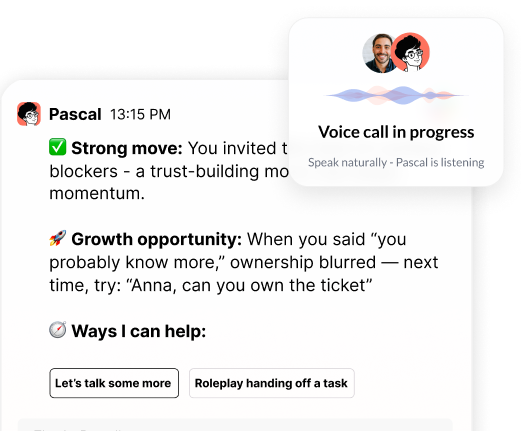
AI coaching removes these constraints. Platforms integrate into Slack, Teams, and Zoom (where managers already work) and provide guidance 24/7. No scheduling. No intake calls. No waiting three weeks for your next session.
The speed comes from three changes. First, zero scheduling friction. Managers get coaching instantly instead of booking sessions weeks out. Second, automated personalization. The platform ingests performance reviews, 360 feedback, and company competencies during setup and builds individualized coaching plans without manual configuration. Third, proactive outreach. The AI messages managers before they realize they need help ("I noticed tension in today's standup—want to talk through how to address it with Sarah?").
Traditional vs. AI Coaching Rollout:
Data Breakdown:
• Factor: Timeline | Traditional Coaching: 3–6 months | AI Coaching: 2–4 weeks
• Factor: Cost per manager | Traditional Coaching: $10,000–$15,000/year | AI Coaching: $100–$300/year
• Factor: Scalability | Traditional Coaching: 50–100 managers max | AI Coaching: Unlimited
• Factor: Access | Traditional Coaching: Manager schedules sessions | AI Coaching: Platform reaches out proactively
• Factor: Integration | Traditional Coaching: Separate platform, new login | AI Coaching: Embedded in Slack/Teams
A 30-day rollout has three phases: preparation (days 1–7), launch (days 8–14), and scale (days 15–30).
Days 1–7: Foundation
IT integrates the platform with Slack, Teams, and Zoom. Most vendors complete this in 48 hours. HR uploads company competency frameworks, values documentation, and leadership development materials. You identify 15–20 early adopters across departments (mix high-performers with influential skeptics who can provide credible feedback). Your executive sponsor records a 90-second video explaining why this matters now.
Days 8–14: Soft Launch
Early adopters get personalized invitations with a clear first action: "Ask Pascal to help you prepare for your next 1:1." The AI reaches out to each manager with prompts based on their calendar and recent meetings. HR monitors adoption daily and does 5-minute check-ins with early adopters. You capture 2–3 testimonials for the broader rollout.
Days 15–30: Scale
You announce to all 500+ managers with the executive video, early adopter testimonials, and specific use cases. The AI joins managers' recurring meetings (with permission) and provides real-time feedback. HR sends weekly tips highlighting one high-value use case. You track login rate, questions asked, and prompts accepted.
Timing matters. One tech company with 800 employees launched immediately after annual performance reviews, when managers were actively seeking development resources. They hit 67% adoption in two weeks.
Adoption depends on three things: eliminate friction, create immediate value, and build social proof.
Eliminate friction by integrating with tools managers use daily. If they need a separate login or must remember to open a new app, adoption drops to 15–20%. Managers spend 4–6 hours daily in Slack and Teams. Meet them there.
Create immediate value in the first interaction. "Here's a framework for the difficult conversation you have in 30 minutes" works. "Welcome to your AI coach" doesn't. Managers need a tangible win in the first five minutes or they won't come back.
Build social proof by sharing anonymized success stories weekly: "A manager in Engineering used this to navigate a performance issue and saw immediate improvement." People trust peers more than HR announcements.
The difference between 15% adoption and 70% adoption is whether managers must change their behavior to access coaching. Traditional learning management systems require managers to remember to log in, search for content, and apply it days later. AI coaching surfaces guidance before they ask.
The biggest risk is treating this like a software deployment instead of a behavior change initiative. Companies that announce "You now have access to AI coaching" without context see 15–20% adoption. Companies that frame it as a strategic capability investment ("We're scaling from 500 to 1,000 employees and need every manager operating at their best") and provide specific first actions see 60–70% adoption.
Three failure modes to avoid:
Insufficient executive sponsorship. Managers need to hear from the CEO or CHRO that this matters, not just an email from HR operations. Record a video. Explain why now. Make it personal.
Vague value propositions. "AI coaching for development" is too abstract. "Get real-time guidance before difficult conversations" is concrete. Tell managers exactly what they'll get and when they'll get it.
No feedback loop. If managers encounter issues in week one and hear nothing back, they disengage permanently. Monitor adoption daily. Respond to questions within 24 hours. Show you're paying attention.
Data privacy is the second risk, particularly in regulated industries. Financial services, healthcare, and life sciences companies worry about tools that record meetings or access employee data. Address this upfront with SOC2 compliance documentation, clear data usage policies (customer data never trains models), and organization-specific controls that let companies define what the AI can access.
The third risk is measuring the wrong things. Track engagement (login rate, questions asked, prompts accepted), behavior change (manager effectiveness scores from direct reports), and business impact (retention, promotion readiness, time-to-productivity for new managers). Ignore vanity metrics like "number of coaching sessions" that don't correlate with outcomes.
New managers and mid-level leaders deliver the fastest ROI because their work involves frequent, high-stakes decisions where real-time feedback compounds within weeks.
First-time managers show the highest engagement. They're managing teams for the first time and recognize the gap between their current skills and role demands. They're willing to ask for help.
Sales professionals are another high-impact population. Their work involves constant practice opportunities (customer calls, negotiations, presentations) where immediate feedback creates rapid skill development.
Distributed teams benefit because they lack the informal learning that happens in offices. Remote managers can't observe senior leaders handling difficult conversations or get real-time feedback from peers. AI coaching fills this gap.
Start with one high-impact population, prove value in 30 days, then expand. Engineering teams work well because they're comfortable with technology, provide credible feedback, and represent a large manager base in tech companies. After proving ROI with engineering managers, expand to operations, sales, and other functions.
Don't start with senior executives. VPs and C-suite leaders value AI coaching for complex situations, but they won't drive company-wide adoption. Focus on the 80% of managers wrestling with fundamental leadership challenges.
You won't see full financial ROI in 30 days. That takes 6–12 months. But you should see concrete improvements in adoption, learning speed, and early behavior change.
Target 60–70% adoption within 30 days, measured by managers who've had at least three meaningful interactions (asking a question, accepting a prompt, using the platform to prepare for a specific situation). Login-only metrics don't predict sustained engagement.
Expect time savings within two weeks. Managers use AI coaching to prepare for difficult conversations, draft feedback, and think through delegation decisions. One customer saved 150+ hours across their manager population in the first month. These time savings compound because managers reinvest the time in higher-value activities.
Look for early behavior change signals in direct report feedback. Managers who use AI coaching show measurable improvement in specific behaviors: providing more specific praise, delegating more effectively, addressing conflict earlier. These improvements show up in pulse surveys and 1:1 feedback within 4–6 weeks.
Full ROI takes 6–12 months. Retention improvements, promotion readiness, and team performance gains require sustained behavior change over quarters. But 30-day results should give you confidence you're on the right trajectory.
• Traditional coaching takes 3–6 months to deploy. AI coaching reaches 500+ managers in 30 days through automated onboarding, existing tool integration, and proactive engagement that eliminates scheduling friction.
• The 30-day rollout has three phases: preparation (days 1–7) for technical integration and early adopter identification, soft launch (days 8–14) with 15–20 champions, and scale (days 15–30) to the full manager population.
• Adoption depends on eliminating friction. Integrate with Slack and Teams where managers already work. Provide immediate wins in the first interaction. Build social proof through early adopter testimonials.
• Start with new managers and mid-level leaders who show the highest engagement because they're in transition moments and willing to ask for help.
• Expect 60–70% adoption within 30 days when you frame AI coaching as a strategic capability investment, provide executive sponsorship, and tie it to clear business priorities.
See how Pascal works inside Slack and Teams to deliver real-time coaching at scale. Request a demo to explore a 30-day rollout plan for your organization.
Header photo by Christina @ wocintechchat.com M on Unsplash

.png)
.webp)
“Thank you for setting the great foundation for my promotion; now I have a plan!"

Curious to see how AI Coaching can 10X the impact and scale of your development initiatives. Book a demo today for: