

Most organizations struggle to develop managers at scale. Workshops happen weeks before critical moments. Annual reviews arrive too late to change behavior. The result: only 11% of companies report strong bench depth.
AI coaching embeds continuous guidance directly into workflows. A manager preparing for a difficult conversation gets frameworks specific to that employee, that team, that moment. The same manager receives consistent reinforcement across hundreds of decisions until new behaviors become automatic.
This guide examines the evidence for AI coaching's impact on leadership pipelines, when it works (and when it doesn't), and how to implement it effectively.
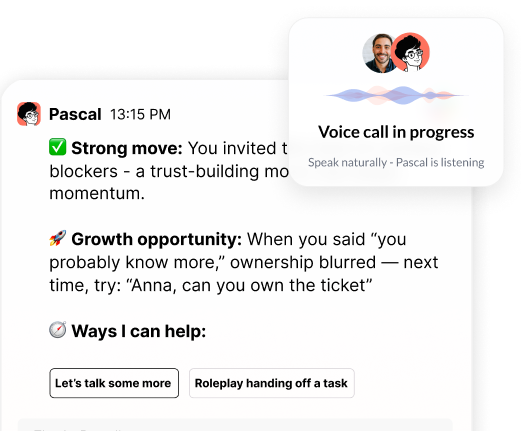
Consider a first-time manager at a 300-person SaaS company preparing for a difficult 1:1. Her AI coaching platform (integrated into Slack) sends a message: "You have a 1:1 with Marcus in 30 minutes. He missed two sprint commitments last quarter. Here's a framework for addressing performance gaps without damaging trust."
The message includes three questions to diagnose the root cause, a structure for delivering feedback (describing the specific situation, the observable behavior, and its impact on the team), and follow-up steps to document the conversation.
After the meeting, she receives feedback: "You spent 18 of 30 minutes talking. Next time, ask Marcus to propose solutions before offering your own. This builds ownership."
Over 90 days, she has 47 coaching interactions. The same frameworks appear repeatedly: delegation with clear accountability, feedback that separates behavior from identity, questions that surface problems early. By month three, she prepares for difficult conversations without prompting.
This is AI coaching: contextual guidance delivered when managers need it, reinforced through repetition until behaviors stick. The AI analyzes calendar data, meeting patterns, and manager inputs to deliver relevant prompts. Most platforms integrate with Slack or Teams, pulling context from scheduled meetings and past interactions to suggest specific frameworks.
AI coaching fails in three scenarios. Recognizing these limitations prevents wasted investment:
When the organization lacks basic management infrastructure. If you don't have clear role expectations, performance frameworks, or feedback norms, AI coaching amplifies confusion. Fix the foundation first.
When managers face systemic problems AI can't solve. A manager dealing with impossible workloads, unclear priorities from leadership, or toxic team dynamics needs organizational fixes, not coaching prompts. AI coaching helps managers execute well within functional systems (it doesn't fix broken systems).
When implementation treats it as technology deployment instead of behavior change. Requiring managers to log into a separate platform kills adoption. Skipping change management creates resistance. Measuring completion rates instead of behavior change misses the point.
Before implementing AI coaching, ask: Do managers have clear expectations for their role? Do they have authority to act on coaching guidance? Will leadership visibly support this? If the answer to any question is no, address those gaps first.
Three organizations have published results from AI coaching implementations showing measurable improvements in manager development speed, team engagement, and retention:
TechCorp (anonymous, 800 employees, financial services): Deployed AI coaching to 60 first-time managers in Q1 2024. After six months, managers using AI coaching reached competency benchmarks in 8 months versus 16 months for the control group. Internal promotion rates for their direct reports increased 23%. The company expanded to all 200 managers in Q3 2024. (Source: Chief Learning Officer, September 2024)
Competency benchmarks included: conducting effective 1:1s (measured through direct report feedback surveys), delegating with clear accountability (tracked through project completion rates), and delivering constructive feedback (assessed through 360 reviews).
Greenhouse Software (500 employees, HR tech): Implemented AI coaching for 40 managers in 2023. Manager Net Promoter Score (how likely direct reports are to recommend their manager to others) improved from +12 to +34 in 90 days. Voluntary turnover in coached teams dropped from 18% to 11% annually. CEO Daniel Chait: "We saw behavior change in weeks, not quarters. Managers who struggled with delegation were running effective 1:1s within a month." (Source: HR Executive, January 2024)
Note: Greenhouse also implemented new compensation bands and revised performance review processes during this period. The company attributes the Manager NPS improvement primarily to AI coaching based on direct report feedback citing improved 1:1 quality and delegation clarity.
Anonymous manufacturing company (2,000 employees): Piloted AI coaching with 50 plant managers facing high turnover. After 12 months, turnover in coached teams dropped 31% versus 8% company-wide. The company calculated $1.2M in retention savings (replacing a plant manager costs $180K in recruiting, training, and lost productivity). They expanded to all 180 plant managers in 2025. (Source: Training Industry, March 2025)
Data Breakdown:
• Metric: Time to manager competency (TechCorp) | Before AI Coaching: 16 months | After AI Coaching: 8 months | Timeframe: 6 months
• Metric: Manager NPS (Greenhouse) | Before AI Coaching: +12 | After AI Coaching: +34 | Timeframe: 90 days
• Metric: Voluntary turnover (Greenhouse) | Before AI Coaching: 18% annually | After AI Coaching: 11% annually | Timeframe: 12 months
• Metric: Team turnover reduction (Manufacturing) | Before AI Coaching: 8% improvement | After AI Coaching: 31% improvement | Timeframe: 12 months
• Metric: Direct report promotion rate (TechCorp) | Before AI Coaching: Baseline | After AI Coaching: +23% | Timeframe: 6 months
The pattern across implementations: faster manager development, measurable improvements in team engagement, and retention gains that justify the investment.
Start with 30-50 managers in a single business unit. Choose managers facing clear challenges: first-time managers learning the role, high-growth teams struggling with scale, or managers with recent engagement issues.
Week 1: Integration and onboarding. Connect the AI coaching platform to Slack or Teams (this requires IT involvement for OAuth integration and admin permissions). Train managers on three use cases: preparing for 1:1s, handling difficult conversations, and delegating effectively. Keep onboarding under 60 minutes.
Weeks 2-4: Build early wins. Identify three influential managers in the pilot group. Work with them closely to solve real problems using AI coaching. Their success creates social proof. When other managers see peers getting value, adoption spreads.
Weeks 5-8: Measure and adjust. Track weekly active usage (target: 70% of managers engaging at least once per week), coaching interactions per manager (target: 3-5 per week), and manager satisfaction (target: Net Promoter Score above +30). Adjust based on feedback.
Weeks 9-12: Prove impact. Measure team engagement changes (through existing pulse surveys), manager confidence scores (through self-assessment), and behavioral improvements. Document three detailed success stories with specific numbers.
A successful pilot generates proof of impact (data showing manager improvement), an implementation playbook (what works for onboarding and adoption), and internal champions (managers who advocate for expansion).
Frame AI coaching as support, not surveillance. Early communication determines success. Managers who see AI coaching as a personal development resource engage. Managers who see it as monitoring resist.
Address privacy directly. Explain data retention policies (platforms like BetterUp and Torch delete meeting transcripts after generating coaching insights, retaining only anonymized interaction patterns), security compliance (SOC 2, GDPR), and who sees what data (only the manager sees their coaching interactions unless they choose to share).
Integrate where managers already work. Requiring a separate login creates friction that kills adoption. The coaching must come to managers through Slack, Teams, or email (tools they use daily).
Create organizational rituals around AI coaching. Integrate it into existing workflows: managers use AI coaching to prepare for performance reviews, plan difficult conversations, and structure 1:1s. When AI coaching becomes part of how work gets done, adoption becomes natural.
Enable HR business partners to refer managers to AI coaching before difficult conversations. This saves HRBP time while deepening coaching impact. One HRBP at a 400-person company: "I used to spend three hours coaching a manager through a performance conversation. Now I spend 20 minutes pointing them to the AI coaching framework and reviewing their plan. The manager gets better preparation, I get time back, and the conversation goes better."
Connect manager development to business outcomes using data executives understand.
Calculate cost avoidance. AI coaching costs $150-300 per manager annually. Compare this to traditional coaching at $15,000+ per manager or workshop-based training at $2,000 per manager. For 100 managers, AI coaching costs $30,000 versus $200,000 for workshops or $1.5M for human coaching.
Vendors in this space include Torch, BetterUp, and Sounding Board. Pinnacle has evaluated these platforms for clients but maintains no affiliate relationships. Pricing varies based on features, integration requirements, and contract length.
Measure time-to-competency. Track how long new managers take to reach performance benchmarks. TechCorp reduced this from 16 months to 8 months, saving eight months of suboptimal performance per manager. For a manager overseeing a $2M team budget, eight months of improved decision-making has measurable impact.
Track retention savings. Replacing a manager costs 150-200% of salary in recruiting, training, and lost productivity. If AI coaching reduces manager turnover by 5 percentage points in a 100-manager organization with $120K average salaries, that's $900K in avoided costs annually.
Build a monthly dashboard showing adoption rates, manager satisfaction scores, and early behavioral improvements. Share manager success stories with specific numbers: "Sarah improved her team's engagement score by 12 points in 90 days while using AI coaching to prepare for weekly 1:1s."
Monitor pipeline strength. Track succession plan depth (ready-now candidates per critical role), internal promotion rates, and time-to-fill for leadership positions. These metrics improve within 6-12 months when AI coaching strengthens manager capability across the organization.
Manager skepticism about AI value. Some managers dismiss AI coaching as another chatbot. Combat this through early wins with influential managers, specific use cases that solve real problems, and visible leadership endorsement. When managers see peers succeeding, skepticism fades. Don't try to convince skeptics through argument (show them results from trusted colleagues).
Integration complexity with existing HR tech. AI coaching works best when connected to HRIS (for org chart context), performance management systems (for goal and review data), and learning platforms (for development plans). Plan integration roadmaps early and prioritize integrations that create the most manager value. Start with calendar integration for meeting preparation, then add performance system connections.
Sustaining adoption beyond initial enthusiasm. Adoption often peaks in weeks 2-4, then declines without reinforcement. Create ongoing engagement through new use cases (quarterly performance reviews, annual planning, team restructures), manager success stories shared in leadership meetings, and integration into performance processes. Adoption requires continuous effort, not just a launch event.
Measuring impact beyond completion rates. Traditional learning metrics (completion rates, satisfaction scores) don't prove AI coaching value. Track behavioral change through direct report feedback, team performance (engagement scores, productivity metrics), and pipeline strength (promotion rates, succession depth). This requires collaboration between HR analytics, IT, and business intelligence teams.
Expand when you have proof of impact (measurable improvements in manager behavior and team outcomes), an implementation playbook (documented onboarding process, change management approach, and integration requirements), and internal champions (at least five managers actively advocating for AI coaching).
Don't expand if adoption in the pilot stayed below 60%, manager satisfaction scores remained neutral or negative, or you can't demonstrate measurable behavior change. A failed pilot reveals gaps in change management, use case clarity, or organizational readiness (fix these before scaling).
Most organizations expand in phases: pilot with 30-50 managers (90 days), expand to full business unit (6 months), then roll out company-wide (12 months). This allows you to refine the approach, build champions at each level, and demonstrate ROI before major investment.
• AI coaching delivers contextual guidance when managers need it, creating behavior change through repetition and reinforcement across hundreds of daily decisions
• Evidence shows AI coaching reduces time-to-competency by 50%, improves manager NPS by 20+ points, and decreases team turnover by 5-7 percentage points (though organizations implementing AI coaching often make other changes simultaneously)
• AI coaching fails when organizations lack basic management infrastructure, when systemic problems require organizational fixes, or when implementation ignores change management
• Successful pilots start with 30-50 managers, focus on early wins with influential champions, and prove impact through behavioral metrics rather than completion rates
• ROI comes from cost avoidance ($150-300 per manager versus $2,000-15,000 for alternatives), retention savings, and faster manager development
• Adoption requires framing AI coaching as support not surveillance, integrating into existing workflows, and creating organizational rituals that make coaching part of how work gets done
• Expand only when you have proof of impact, an implementation playbook, and internal champions (most organizations scale over 12-18 months through phased rollouts)
Ready to explore AI coaching for your organization? Pinnacle helps CHROs evaluate whether AI coaching fits their leadership development strategy, select the right platform, and design pilots that prove impact. Pascal Blondé works with HR leaders to build evidence-based implementation plans that connect manager development to business outcomes. Contact us to discuss your leadership pipeline challenges.
Header photo by Vitaly Gariev on Unsplash

.png)
.webp)
“Thank you for setting the great foundation for my promotion; now I have a plan!"

Curious to see how AI Coaching can 10X the impact and scale of your development initiatives. Book a demo today for: