

Most enterprises treat AI manager coaching platforms as side projects, but they function as core leadership infrastructure and need the same governance rigor as performance management, compensation, and promotions. When a coaching platform sits inside Slack or Teams and shapes what a manager says right before a hard conversation, it is part of your people system, not an optional learning add-on.
Today, enterprise manager coaching platforms are usually AI-assisted, always on, and embedded where people actually work. They are not static learning libraries or long training videos. They give prompts in the moment, during 1:1s, performance reviews, hiring decisions, and conflict. They can coach the manager, shape the meeting, and influence the outcome, all in a few lines of text.
That is why governance matters so much, especially as companies head into the performance review season. If a platform can shape how feedback is given, how ratings are explained, and how risk is handled, it needs the same level of discipline you already apply to performance management, compensation, and promotions.
The direct answer: enterprise manager coaching platforms are harder to govern because they work in the flow of work, touch real people decisions, and learn from your internal data over time. This is very different from a standalone LMS or one-off training.
“In the flow of work” means prompts do not wait for a classroom. They show up in:
Three things raise the bar for governance:
As companies gear up for year-end reviews and next-year planning, this matters even more. Poorly governed coaching prompts can quietly change how managers talk about ratings, stretch roles, or exits, without any formal policy change at all.
Governance usually fails in three places: content control, decision boundaries, and accountability for outcomes. Underneath all three is a simple truth: no one clearly owns what the AI coach is allowed to say and do.
Content control is the first weak spot. Generic AI coaching can easily drift away from your leadership expectations, feedback style, and local rules. For example, a VP of Engineering with 12 direct reports may get coaching on hard feedback that leans on harsh radical candor, while your organization prefers strengths-based, future-focused feedback. Now different teams are hearing different rules about what good leadership looks like.
Decision boundaries are the next break point. You need clear lines between where AI coaching should support and where it must step back and route to humans. That usually includes topics like:
Without guardrails, a frontline manager might ask in Slack how to handle what could be a harassment claim. The platform might give well-meaning but risky suggestions instead of clearly directing them to HR and Legal.
Then there is accountability. When HR, IT, L&D, and Legal all touch the platform but no one owns it, things fall through the cracks. You see:
Over time, the AI coach can become the de facto playbook, while the official one gathers dust.
The direct answer: treat your enterprise manager coaching platform like a live, co-owned policy and practice layer. You define what it should teach, where it must defer to humans, and how often it is reviewed.
We recommend starting with clear design principles:
Then put a simple but firm governance framework in place:
Good governance should not slow the platform down. Done right, it gives you confidence to let AI coaching handle appropriate day-to-day scenarios inside tools like Slack or Teams, while clearly escalating higher-risk or complex situations to human experts.
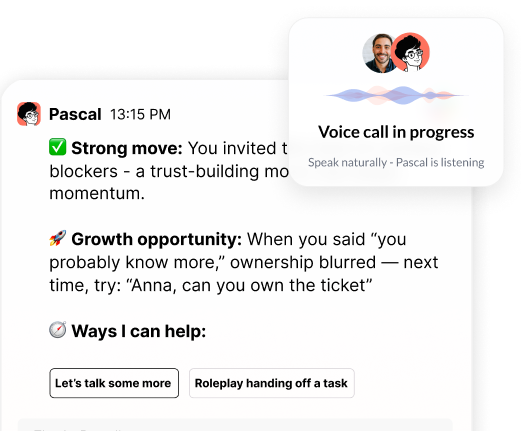
When governance is working, managers experience the platform as consistent, trustworthy help. The guidance sounds like your company, supports your standards, and flags when human experts need to step in.
Consider three common moments:
These daily moments show your governance decisions in action: tone of voice, references to your internal frameworks, thresholds for escalation, and who gets notified on certain triggers. For managers and teams, good governance feels like steady, on-brand coaching that matches what they hear from HR and senior leaders, available right where they work.
Before you roll out any enterprise manager coaching platform at scale, you should be able to answer five basics clearly. If you cannot, you are not ready yet.
Use this quick checklist:
At Pinnacle, we build Pascal with this governance-first approach: configurable guardrails, alignment to your leadership standards, and controls that keep HR and L&D in charge of how AI coaching shows up for your managers when it matters most. Our view is simple: AI coaching should augment, not replace, human judgment and human conversations.
If you are ready to build a stronger leadership bench, our team at Pinnacle AI is here to help you get started with an enterprise manager coaching platform designed for real-world performance. We work with you to align coaching workflows with your culture, KPIs, and existing tools so managers actually use what they learn. Take the next step toward consistent, data-informed leadership development and see how scalable coaching can look in your organization.
Author: Pascal

.png)
.webp)
“Thank you for setting the great foundation for my promotion; now I have a plan!"

Curious to see how AI Coaching can 10X the impact and scale of your development initiatives. Book a demo today for: