

AI observes your one-on-one conversations and delivers immediate feedback based on what happened in that specific meeting. Unlike traditional coaching that arrives weeks later, real-time coaching analyzes the conversation as it happens and provides guidance within minutes.
An AI coach joins your one-on-one meetings (with consent from both people) and provides feedback either during the conversation or immediately after. The system analyzes communication patterns, leadership behaviors, and development opportunities tied to that exact interaction.
Gartner research shows managers who receive immediate coaching demonstrate 23% higher performance improvement compared to those receiving delayed feedback. The difference is timing and specificity.
The AI joins your Slack, Teams, or Zoom meetings and builds a record of your communication patterns and relationships. It captures conversation dynamics (tone, participation balance, question types, follow-through on commitments). Feedback arrives when it's actionable: immediately after the meeting or during the conversation via private message.
Traditional coaching can't scale to every manager. AI coaching costs a fraction of the price while maintaining constant availability. The technology learns your organization's values and culture to provide aligned guidance.
Full disclosure: This piece focuses on Pascal by Pinnacle because it's the most developed example of this technology. The statistics cited come from Pascal's customer data unless otherwise noted. Independent research on AI coaching effectiveness is limited because the category is new.
The AI joins your scheduled 1:1 with both participants' consent, transcribes the conversation, analyzes communication patterns against leadership frameworks, and delivers feedback during or after the meeting.
Before the meeting: The AI reviews past 1:1s with this employee, recalls open action items, and surfaces relevant context. If you discussed a project deadline last month, it reminds you before the meeting starts.
During the meeting: Transcription captures what's said while analyzing participation balance, question types, emotional tone, and meeting structure. The system tracks whether you're asking open-ended questions, whether the employee is speaking half the time, and whether you're following up on previous commitments.
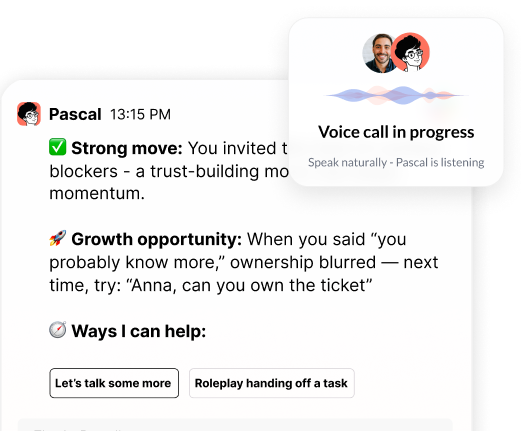
Live guidance: You can privately message the AI during the meeting ("How should I bring up this performance issue?") and receive immediate suggestions without interrupting the conversation.
After the meeting: Within minutes, the AI delivers structured feedback on specific moments. "You acknowledged John's concern about workload at 8:32, but when he mentioned feeling stuck on the API integration, you moved to the next topic without offering support."
Pattern recognition: Over time, the system identifies trends across multiple 1:1s. If you consistently dominate airtime or avoid difficult topics, the AI surfaces these patterns with data.
Pascal's architecture (a database that maps relationships and context across your organization) means it understands not just what was said, but the relationship history and individual communication preferences. The system is SOC2 compliant (meets security standards for handling sensitive data) and never trains AI models on customer data.
Real-time coaching provides immediate, context-rich guidance while the conversation is fresh. Traditional feedback arrives days or weeks later when you've moved on and forgotten the interaction's nuances.
Timing: Feedback within minutes versus weeks means you can immediately apply learnings to your next 1:1. Behavior change is strongest when reinforcement happens close to the original action.
Context: AI coaches reference specific moments. "When Sarah mentioned feeling overwhelmed at minute 14, you pivoted to solutions without acknowledging her emotion" carries more weight than generic advice like "practice active listening."
Scale: Every manager gets coaching after every 1:1, not just senior leaders flagged for development. This opens access to personalized guidance previously reserved for executives.
Continuous improvement: Weekly patterns emerge across multiple 1:1s, showing trends traditional coaching misses. You might not notice you consistently interrupt direct reports, but AI tracking across 20 conversations surfaces this blind spot immediately.
Pascal reports that 83% of direct reports see improvement in their managers' effectiveness. Traditional quarterly coaching sessions show 40-50% improvement rates. Training workshops show 5-15% sustained application. (These numbers come from Pascal's customer data and haven't been independently verified. The Gartner research cited earlier found 23% improvement from immediate coaching in general, not AI coaching specifically.)
Real-time coaching solves the gap between what managers learn in training and what they do when leading their teams. Melinda Wolfe, former CHRO at Bloomberg, Pearson, and GLG, states: "Managers rarely need help in a workshop—they need it when preparing for a tough 1:1 or in the middle of a team conflict."
Addresses the manager crisis: 60% of new managers report feeling unprepared. Organizations ask more of managers with fewer resources. Real-time coaching provides support that traditional training can't deliver.
Scales personalized development: Makes coaching accessible to all managers, not just executives. When every people leader receives support, organizational culture shifts faster.
Reduces risk: Better 1:1 conversations mean fewer mishandled accountability discussions, performance issues, and offboarding situations. Managers who receive guidance on difficult conversations make fewer mistakes that lead to legal claims or unwanted attrition.
Provides culture insights: Aggregated, anonymized data from 1:1s gives CHROs continuous visibility into team health versus waiting for quarterly engagement surveys. You see patterns emerging weeks before they show up in traditional metrics.
Pascal customers report 20% increases in manager NPS and 150+ hours saved per manager annually. These numbers come from Pascal's internal data and haven't been independently verified.
Managers worry about privacy, surveillance, and whether AI feedback will be used against them in performance reviews. The most common objections center on trust, not technology.
Privacy and surveillance: Managers fear their conversations will be monitored by HR or used for performance evaluation. The solution is clear policy: AI coaching data stays private to the individual manager unless they choose to share it. Pascal's architecture separates coaching insights from HR systems entirely. (However, the system does provide aggregated, anonymized data to CHROs about patterns across the organization. Individual conversations remain private, but trends become visible to leadership.)
Quality of feedback: Skepticism about whether AI can provide nuanced guidance on complex human interactions is valid. Generic chatbots fail. Purpose-built coaching systems trained on frameworks from the International Coaching Federation (the largest coaching credentialing organization) and fed organizational context deliver more sophisticated feedback. Whether this matches human coach quality remains an open question—the technology is too new for independent comparative studies.
Employee consent: Managers worry about how their direct reports will react to having AI in 1:1s. Both parties consent before the AI joins, and either can request the AI leave at any time. The consent process varies by implementation (some use a button at meeting start, others use email opt-in). Employees can change their consent status meeting-to-meeting.
Time investment: Concerns about adding another tool to an overwhelming workload are legitimate. Real-time coaching can save time (managers spend less preparing for 1:1s because the AI surfaces relevant context automatically), but this depends on adoption and workflow integration.
Data security: Enterprise organizations need SOC2 compliance and guarantees that customer data never trains AI models. Pascal meets these requirements. Conversations stay within your organization's security perimeter.
Start with high-stakes moments where managers need support most (performance review season, new manager onboarding, cultural transformation initiatives) rather than rolling out to everyone at once. Organizations that tie AI coaching to existing programs see higher sustained engagement than when it's positioned as optional development.
Anchor to existing pain points: Launch during performance cycles when managers face difficult conversations and need immediate support. When the need is obvious and urgent, adoption happens naturally.
Secure executive sponsorship: Get your CHRO or head of learning and development to champion the initiative and model usage in their own 1:1s. When senior leaders visibly use the tool and share their learnings, it signals this isn't just another HR initiative to ignore.
Start with volunteers: Identify 15-20 managers who are already coaching-curious and willing to experiment. These early adopters become your internal advocates who can share real stories about impact with their peers.
Set clear expectations: Explain exactly what the AI observes, how data is used, and what privacy protections exist. Managers need to know their conversations aren't being monitored by HR—they're getting personalized coaching that stays between them and the AI (with the caveat about aggregated data mentioned above).
Integrate with existing workflows: Choose tools that work inside Slack, Teams, or Zoom rather than requiring managers to log into another platform. Pascal integrates directly into the tools managers already use.
Measure what matters: Track behavior change metrics like manager NPS, direct report feedback quality, and time spent on development conversations—not just usage statistics. The goal is better leadership, not more logins.
Measure through three layers: immediate behavioral metrics (coaching engagement, feedback application), team health indicators (manager NPS, direct report satisfaction), and business outcomes (time saved, retention improvement, productivity gains). The most compelling data comes from direct reports, not managers themselves.
Behavioral metrics: Track how many managers use coaching after 1:1s, how often they apply specific feedback, and whether communication patterns improve over time. Pascal users average 2.3 coaching sessions per week (from Pascal's customer data).
Team health indicators: Survey direct reports quarterly on manager effectiveness. Organizations using real-time coaching see 20% increases in manager NPS within 90 days (from Pascal's customer data). This metric matters more than manager self-assessment because it measures actual impact on team experience.
Time savings: Calculate hours saved on 1:1 preparation, performance review drafting, and HR escalations. The average manager saves 150+ hours annually when AI handles meeting prep, suggests talking points, and provides post-meeting summaries (from Pascal's customer data).
Retention and productivity: Track whether teams with coached managers show lower attrition and higher performance ratings. While harder to isolate causation, organizations report improved retention in teams whose managers receive regular AI coaching.
Culture transformation speed: For organizations using AI coaching to drive specific cultural changes, measure how quickly desired behaviors spread. When every manager receives feedback on cultural competencies, change happens in weeks instead of quarters.
Build a business case using this formula: (Cost of tool per manager × number of managers) versus (hours saved × average hourly cost + retention improvement × average replacement cost). For 100 managers at $100/year per manager ($10,000 total), compare against: (150 hours saved × $75/hour × 100 managers = $1,125,000) + (retention improvement of even 2-3 employees × $50,000 average replacement cost = $100,000-150,000).
• Real-time coaching delivers immediate, contextual feedback during or right after 1:1 meetings, creating 23% higher performance improvement compared to delayed coaching (Gartner research on immediate coaching in general, not AI coaching specifically)
• AI coaching scales personalized development to every manager at lower cost than traditional coaching, opening access beyond senior executives
• Effective implementation requires anchoring to high-stakes moments like performance cycles, securing executive sponsorship, and integrating into existing workflows
• Privacy concerns require clear policies separating coaching data from HR systems and requiring mutual consent before AI joins meetings (though aggregated, anonymized data may still flow to leadership)
• Measure ROI through direct report feedback, time savings, and behavior change metrics (most available data comes from vendor reports, not independent research)
Pascal integrates directly into Slack, Teams, and Zoom to deliver personalized coaching when managers need it. See how Pascal works inside your existing tools and transforms manager effectiveness at scale.
Header photo by Zulfugar Karimov on Unsplash

.png)
.webp)
“Thank you for setting the great foundation for my promotion; now I have a plan!"

Curious to see how AI Coaching can 10X the impact and scale of your development initiatives. Book a demo today for: