

AI coaching delivers measurable improvements in manager decision-making and team engagement. Organizations using purpose-built AI coaching report observable improvements in manager effectiveness, with managers saving significant time on development activities.
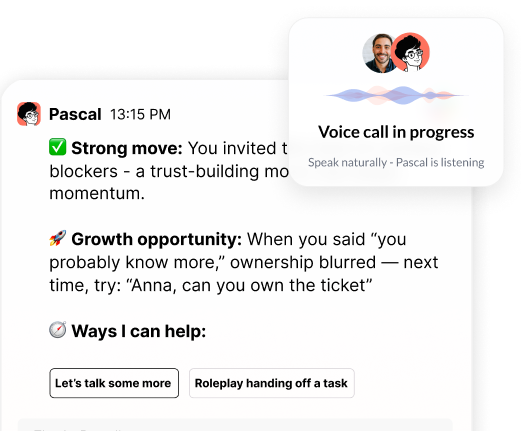
AI coaching provides guidance at the moment decisions matter—before difficult conversations, during team conflicts, and when navigating ambiguous situations. It embeds directly in Slack, Teams, and meetings, observing work dynamics and offering personalized feedback grounded in real interactions.
Managers receive coaching when preparing for tough 1:1s, addressing performance issues, or making delegation decisions—not weeks later in a classroom. They rehearse difficult conversations through roleplay, receiving immediate feedback on communication approach before the real interaction. AI coaches follow up after meetings to reinforce learned skills, creating continuous development cycles.
Former Bloomberg, Pearson, and GLG CHRO Melinda Wolfe explains the shift: "Managers rarely need help in a workshop—they need it when preparing for a tough 1:1 or in the middle of a team conflict." This move from scheduled learning to contextual coaching changes how managers develop decision-making capabilities.
Companies implementing AI coaching report three primary outcomes: observable manager behavior change from direct reports, engagement lift measured through Manager Net Promoter Score, and time savings previously spent on traditional development activities.
The metrics connect directly to business outcomes. When managers make better decisions and teams feel more engaged, organizations see reduced turnover, faster onboarding, and improved performance—all measurable through existing HR systems.
Traditional Coaching vs. AI Coaching: Cost and Feature Comparison
Data Breakdown:
• Dimension: Availability | Traditional Workshops: Scheduled quarterly | LMS Platforms: Self-paced, async | Human Coaching: Monthly sessions | Purpose-Built AI Coaching: 24/7, in-the-moment
• Dimension: Context | Traditional Workshops: Generic scenarios | LMS Platforms: Pre-built modules | Human Coaching: Retrospective discussion | Purpose-Built AI Coaching: Real-time work situations
• Dimension: Cost per manager | Traditional Workshops: $2,000–5,000/year | LMS Platforms: $500–1,500/year | Human Coaching: $15,000–30,000/year | Purpose-Built AI Coaching: $150–500/year
• Dimension: Behavior reinforcement | Traditional Workshops: Single event | LMS Platforms: Completion-based | Human Coaching: Session-dependent | Purpose-Built AI Coaching: Continuous, automated
• Dimension: Scalability | Traditional Workshops: Limited by facilitators | LMS Platforms: High but low engagement | Human Coaching: Very limited | Purpose-Built AI Coaching: Unlimited
• Dimension: Personalization | Traditional Workshops: Cohort-based | LMS Platforms: Pathway-based | Human Coaching: Highly personalized | Purpose-Built AI Coaching: Contextually personalized
According to SHRM's State of AI in HR 2025 report, HubSpot reported 98% of employees had used an AI tool on the job, with 84% feeling comfortable doing so. This adoption rate demonstrates that when AI tools integrate naturally into workflows, employees embrace them.
The cost efficiency matters for scale. AI coaching delivers results at a fraction of traditional executive coaching costs while being available 24/7. This economic model allows organizations to extend coaching beyond senior executives to every manager who needs support.
Real organizations embed AI coaching into daily workflows where engagement happens—team meetings, 1:1 conversations, and project collaborations. Companies integrate AI coaching into existing communication platforms, making development inseparable from work itself.
HubSpot set an organizational expectation around AI adoption with high trust. This cultural stance resulted in 98% employee AI tool usage. The key was treating AI as a capability to develop rather than a threat to manage.
Zapier embedded AI expectations into existing leadership behaviors rather than creating new frameworks. CHRO Brandon Sammut notes: "With AI you can delegate the work, you cannot delegate the accountability." This distinction helps managers understand their evolving role—they're responsible for outcomes even when AI handles execution.
Marriott focused on solving real business problems through AI while building employee trust and new skills simultaneously. The approach avoided treating AI as a separate initiative, instead weaving it into how work gets done.
The key differentiator is proactive engagement. AI coaches provide post-meeting summaries, identify communication patterns, and suggest improvements based on actual interactions.
AI coaching outperforms traditional alternatives—workshops, LMS platforms, and human coaching—by solving the "last mile" problem: translating learning into actual behavior change in real work situations. Purpose-built AI coaching succeeds because it operates where work happens, not in separate training environments.
Traditional workshops provide valuable frameworks but lack real-time application support. Managers forget most content within weeks because there's no reinforcement mechanism when they face actual challenges. The workshop ends, managers return to work, and the learning evaporates.
LMS platforms suffer from low utilization rates because they're disconnected from actual work. Employees must remember to log in, find relevant content, and apply abstract concepts to specific situations. The friction prevents consistent usage.
Human coaching remains highly effective but prohibitively expensive, limiting access to senior executives only. Organizations can't afford $15,000–30,000 per manager annually for one-on-one coaching, which means most managers never receive personalized development support.
Generic AI chatbots provide surface-level advice without understanding company culture, team dynamics, or individual context. They answer questions but can't observe actual work patterns, reference past interactions, or provide feedback grounded in real situations.
Former Calendly, Atlassian, and SuccessFactors CHRO Jeff Diana explains the critical distinction: "People need the ability to gain insights, act in context, and iterate quickly." Purpose-built AI coaching delivers all three by embedding in daily workflows, understanding organizational context, and providing continuous feedback loops.
Long-term behavior change requires three elements: consistent practice opportunities, immediate feedback on real situations, and reinforcement over time. AI coaching delivers all three by observing managers in actual work contexts, providing feedback after real interactions, and following up to ensure skill application continues.
Observable improvement from direct reports represents behavior change, not self-reported learning. Direct reports notice when managers communicate more clearly, delegate more effectively, and handle conflicts better. These aren't abstract competencies—they're daily experiences that teams can measure.
Time savings represent hours previously spent in workshops, LMS modules, or waiting for coaching sessions. Managers apply that time to actual work while receiving better development support. This efficiency gain compounds over time as managers build skills faster and apply them more consistently.
Manager Net Promoter Score lifts among high-engagement users demonstrate sustained impact. Manager NPS measures how likely employees are to recommend their manager to others. Increases mean teams actively prefer working with managers who use AI coaching—a strong signal of real behavior change.
Organizations should measure AI coaching impact across three dimensions: adoption metrics showing consistent usage patterns, engagement depth revealing how managers apply insights, and outcome metrics connecting to business results.
Adoption metrics include active user rates, session frequency, and feature utilization. High adoption indicates the tool fits naturally into workflows. Low adoption signals friction that prevents managers from accessing coaching when they need it.
Engagement depth measures how managers use the coaching—are they just asking surface questions or engaging in roleplay, requesting feedback on real situations, and implementing suggested approaches? Depth matters more than frequency because it indicates genuine skill development.
Outcome metrics connect coaching to business results: manager effectiveness scores from direct reports, team engagement levels, retention rates, and performance improvement. These metrics prove coaching drives value beyond learning for learning's sake.
Real-time, anonymized, and aggregated insights about cultural hotspots, performance trends, and organizational patterns help HR leaders identify issues, target interventions, and measure impact at scale—capabilities traditional engagement surveys can't match.
Implementation success depends on five critical factors: integration depth, cultural alignment, leadership modeling, privacy protection, and continuous improvement cycles.
Integration depth means embedding AI coaching into existing tools rather than adding another platform. When coaching lives in Slack, Teams, or meeting tools managers already use, adoption happens naturally. Separate platforms create friction that kills usage.
Cultural alignment requires matching AI coaching to company values and leadership competencies. Generic advice feels irrelevant. Coaching grounded in "how we do things here" resonates because it reflects organizational reality.
Leadership modeling matters because managers watch what executives do, not what they say. When senior leaders openly use AI coaching and share their learning, it signals that development is valued at every level.
Privacy protection builds trust. Managers won't engage honestly if they fear their conversations will be monitored or used against them. SOC2 compliance, clear data policies, and anonymized aggregation create the safety managers need to be vulnerable about their challenges.
Continuous improvement cycles mean treating AI coaching as a capability that evolves, not a product that's "done." Organizations that iterate based on usage data, manager feedback, and outcome metrics see sustained value. Those that deploy once and forget see declining engagement.
• AI coaching drives measurable behavior change through observable improvements in manager effectiveness and team engagement
• Context matters more than content: AI coaching embedded in daily workflows outperforms traditional training because it provides guidance at the exact moments decisions matter
• Real organizations prove the model works: HubSpot, Zapier, and Marriott demonstrate that integrating AI coaching into existing tools and cultural expectations drives adoption and impact
• The economic model enables scale: At a fraction the cost of traditional coaching, AI coaching extends personalized development to every manager, not just executives
• Implementation quality determines outcomes: Integration depth, cultural alignment, leadership modeling, and privacy protection separate successful deployments from failed pilots
Pascal by Pinnacle delivers AI coaching where your managers actually work—in Slack, Teams, and meetings. See how contextual, privacy-protected coaching drives measurable improvements in manager effectiveness and team engagement. Explore Pascal's approach to embedded AI coaching.
Header photo by Igor Omilaev on Unsplash

.png)
.webp)
“Thank you for setting the great foundation for my promotion; now I have a plan!"

Curious to see how AI Coaching can 10X the impact and scale of your development initiatives. Book a demo today for: