

As AI coaching becomes more common inside HR and people platforms, many organizations face an architectural decision that quietly determines success or failure.
Some tools embed general-purpose AI into existing workflows. Others are designed from the ground up as coaching systems. Both approaches promise convenience and scale. Only one consistently drives sustained behavior change.
The difference shows up less in feature lists and more in how coaching actually fits into daily work.
Coaching opportunities rarely happen inside HR systems.
They surface during unclear emails that spiral into back-and-forth threads, one-on-ones that drift without direction, or meetings that end without alignment. These moments unfold in Slack, email, or live conversations, not inside performance management software.
Architectural choices determine whether AI coaching meets managers in those moments or asks them to leave their workflow to seek help later.
That distinction shapes whether coaching becomes a daily practice or an occasional reflection exercise.
Modern HR suites have evolved beyond simple quarterly reviews and now include one-on-one toolings. However, even these advanced embedded systems face a fundamental constraint: they require managers to come to them. Whether it's logging into your performance management platform to prepare for a one-on-one or navigating to a coaching module within your HRIS, embedded tools create friction at the moment when coaching guidance is most needed.
Consider the manager facing an unclear email that's about to create three rounds of back-and-forth, or struggling to keep a one-on-one on track in real-time. While they might later document the interaction in their HR suite, the coaching opportunity happens in the moment, in Gmail, in Slack, in the meeting itself.
The embedded approach also reflects suite vendors' business logic rather than learning logic. These platforms succeed when managers spend time in their systems, creating detailed records and following prescribed workflows. But effective coaching often requires the opposite: quick, contextual guidance that doesn't interrupt the flow of work.
Purpose-built coaching systems take a fundamentally different approach: instead of asking managers to change their behavior to access coaching, they meet managers where work actually happens. This architectural difference-proactive presence versus reactive access-often determines whether coaching becomes a daily practice or remains an occasional reflection exercise.
Purpose-built AI coaching systems start with a different premise: coaching is a distinct discipline that requires its own architecture, data model, and user experience. They’re designed not just to add functionality, but to enable lasting behavior change.
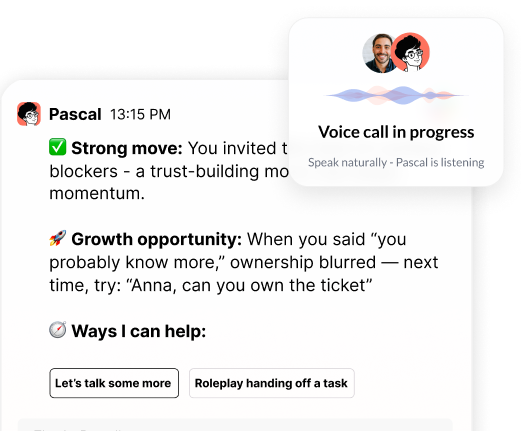
They meet people in their workflow, not the other way around. Instead of pulling managers into separate applications, purpose-built coaches integrate with Slack, Teams, email, and meeting tools, providing guidance at the moment of need, when new habits can actually form.
Privacy-first design enables honest engagement. When employees control what they share and with whom, they engage authentically. This creates the rich behavioral signals that power truly personalized development, rather than the shallow self-reporting that embedded solutions collect.
Behavioral telemetry over administrative data. Rather than relying on quarterly ratings and survey scores, purpose-built systems measure what actually predicts performance: communication clarity, meeting effectiveness, follow-through consistency, and hand-off quality. These leading indicators let you intervene before problems compound.
Rapid iteration on what works. Purpose-built platforms can A/B test nudges, experiment with habit formation techniques, and continuously optimize coaching effectiveness. They move far faster than embedded solutions, which are bound by release cycles that often lag behind the pace of behavioral learning.
As AI coaching becomes more widespread, the real question for organizations is about how it is designed to show up at work. Coaching creates the most value when it shapes behavior in the moments where decisions, communication, and habits are formed. That depends on the architecture.
Systems built around administrative workflows naturally optimize for documentation, compliance, and reporting. Systems built around coaching optimize for timing, trust, and learning. Over time, those design choices compound. They influence whether managers actually use the tool, whether employees engage honestly, and whether guidance translates into better conversations, clearer decisions, and stronger follow-through.
For organizations serious about developing managers at scale, AI coaching is not just a feature to add to existing platforms. It is an infrastructure decision about how learning fits into everyday work.

.png)
.webp)
“Thank you for setting the great foundation for my promotion; now I have a plan!"

Curious to see how AI Coaching can 10X the impact and scale of your development initiatives. Book a demo today for: