

Manager quality drives 70% of team engagement variance, yet most organizations reserve coaching for the top 5%. AI-powered platforms now deliver personalized coaching to all managers at $150–300 per person annually (versus $15,000–$50,000 for traditional executive coaching). Organizations extending coaching beyond the C-suite see measurable improvements in retention, manager effectiveness, and team performance within 60–90 days.
Your managers make dozens of high-stakes decisions every week: hiring calls, performance conversations, conflict resolution, team restructuring. Most make these decisions without real-time support.
Traditional executive coaching costs $15,000–$50,000 per person annually. You can't scale that to 500 managers. So you reserve it for senior leaders while first-time and mid-level managers—the people making the most frequent decisions—get generic training modules they'll access weeks before or after they need them.
According to Gallup research, manager quality determines 70% of team engagement variance. When you limit coaching to executives, you're optimizing the wrong layer. Your frontline managers affect more employees, make more daily decisions, and create more compounding impact than any executive team.
The gap between where coaching is available (C-suite) and where it's needed (frontline managers) creates expensive problems: costly hiring mistakes, botched performance conversations, unresolved team conflicts, and turnover that ripples through entire organizations.
The counter-argument: "We have learning platforms and manager training programs." True. But LMS platforms see 15–20% engagement because they deliver content, not contextual guidance. A manager facing a difficult performance conversation in 30 minutes doesn't need a training module on feedback frameworks. They need specific advice for this conversation with this person right now.
In our analysis of organizations extending coaching to all managers, we see three categories of measurable improvement:
Retention: Manager turnover drops 15–25 percentage points within 12 months. For a 500-person organization where replacing a manager costs $75,000 (conservative estimate including recruiting, onboarding, lost productivity, and team disruption), a 20-percentage-point improvement in manager retention saves $750,000 annually if you have 50 managers.
Manager effectiveness: Direct reports report observable improvement in 83% of coached managers within 90 days (measured through 360-degree feedback and manager NPS surveys). Manager NPS—the likelihood that direct reports would recommend their manager to others—increases an average of 20 percentage points within six months.
Productivity: Managers save 150+ hours annually through faster decision-making and reduced escalations. This comes from three sources: 40 hours saved in decision-making (getting unstuck faster on hiring, performance, and team decisions), 60 hours saved in escalation prevention (handling situations before they require HR or senior leader intervention), and 50 hours saved in rework (getting decisions right the first time).
Pascal customers report these improvements within 60–90 days of implementation. HubSpot reported 98% of employees used AI tools on the job with 84% feeling comfortable doing so after democratizing access across the organization.
ROI Comparison: Executive-Only vs. Democratized Coaching
Data Breakdown:
• Metric: Cost per person | Executive-Only Coaching: $15,000–$50,000 | Democratized AI Coaching: $150–$300
• Metric: Reach | Executive-Only Coaching: 50–100 executives | Democratized AI Coaching: 500+ managers
• Metric: Time to impact | Executive-Only Coaching: 6–12 months | Democratized AI Coaching: 60–90 days
• Metric: Manager effectiveness improvement | Executive-Only Coaching: Limited to coached executives | Democratized AI Coaching: 83% show measurable improvement
• Metric: Annual organizational benefit | Executive-Only Coaching: $500K–$1M | Democratized AI Coaching: $2–4M
For a 500-person organization with 50 managers, the math works like this: AI coaching costs $15,000 annually ($300 × 50 managers). Retention savings alone deliver $750,000. That's 50× ROI before counting productivity gains or improved team performance.
AI coaching costs $150–300 per person annually. Traditional executive coaching costs $15,000–50,000. This 50–100× cost reduction makes it economically viable to provide every manager with coaching support embedded in their daily workflow.
The cost per coaching interaction drops from $200–500 (human coach, one-hour session) to $0.50–2 (AI coach, real-time guidance). You can provide coaching to 500 managers for the cost of 3–5 executive coaches.
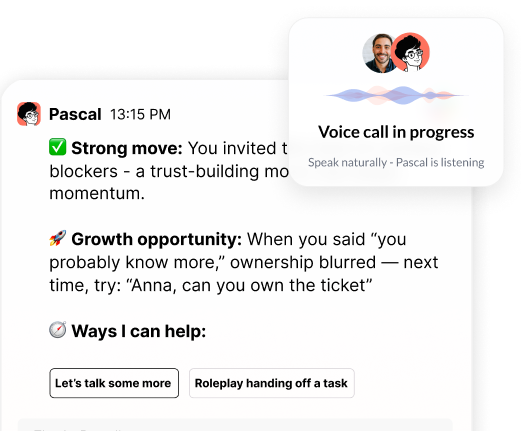
Here's what that looks like in practice: Your manager has a difficult performance conversation in 30 minutes. They open Slack and ask their AI coach: "I need to tell Sarah her work quality has dropped. She's been defensive in past conversations. How do I approach this?" The AI coach, which has context on your organization's feedback frameworks and this manager's previous conversations, provides specific guidance: a conversation structure, language suggestions, and follow-up steps. Total interaction: 3 minutes, $1.50.
Traditional coaching would require scheduling a session (probably after the conversation already happened), spending an hour discussing the situation, and hoping the manager remembers the advice next time. Cost: $300–500. Timing: too late.
The economics transform coaching from a scarce executive perk into organizational infrastructure. Instead of rationing access, you embed coaching into every manager's daily work.
Learning platforms deliver content. AI coaching delivers contextual guidance during real decisions.
Your LMS has a module on performance conversations. Completion rate: 40%. Application rate: unknown. A manager watches the video, nods along, then faces a real performance conversation three weeks later and can't remember the framework.
AI coaching joins the manager's workflow. It integrates with Slack, Teams, and meeting platforms. It reaches out before critical moments ("You have a performance review in 30 minutes—here's a framework for this conversation"). It provides real-time feedback ("You interrupted Sarah three times in that 1-on-1—try asking open-ended questions next time"). It builds a knowledge graph of interactions to understand context (this manager struggles with delegation, prefers direct communication, works with a remote team).
This explains the engagement gap: LMS platforms see 15–20% engagement; AI coaching platforms see 60–80% active usage. When coaching happens in workflow instead of as a separate task, managers actually use it.
AI Coaching vs. Traditional Development Tools
Data Breakdown:
• Dimension: Cost per person | LMS Platforms: $50–150 | Human Coaching: $15,000–$50,000 | Performance Management: $30–100 | AI Coaching: $150–$300
• Dimension: Scalability | LMS Platforms: High | Human Coaching: Very Low | Performance Management: High | AI Coaching: High
• Dimension: Contextual relevance | LMS Platforms: Low | Human Coaching: Very High | Performance Management: Low | AI Coaching: High
• Dimension: Engagement rate | LMS Platforms: 15–20% | Human Coaching: 95%+ | Performance Management: 40–60% | AI Coaching: 60–80%
• Dimension: Real-time support | LMS Platforms: No | Human Coaching: Limited | Performance Management: No | AI Coaching: Yes
Melinda Wolfe, former CHRO at Bloomberg, Pearson, and GLG, captures the shift: "If we can democratize coaching, make it specific, timely, and integrated into real workflows, we solve one of the most chronic issues in the modern workplace."
First-time managers deliver the fastest ROI. They make frequent high-stakes decisions (hiring, feedback, conflict resolution) without the experience or support systems that senior leaders have developed. In our customer base, first-time managers show 30–40% faster ramp to proficiency with AI coaching support.
Mid-level managers (managing 5–15 people) see the highest engagement rates at 70–85%. They're experienced enough to know when they need help but not senior enough to have dedicated executive coaches.
Sales managers using AI coaching improve team performance metrics by 15–25% within the first quarter. They face high-frequency coaching moments (pipeline reviews, deal strategy, team motivation) where real-time guidance compounds quickly.
Distributed teams benefit disproportionately. Remote managers lack the informal coaching that happens naturally in office environments—the hallway conversation before a difficult meeting, the casual debrief after a team conflict. AI coaching fills this gap with consistent support regardless of location or time zone.
Start with one of these populations. Set clear success metrics: manager NPS, direct report engagement scores, time-to-proficiency for new managers, retention rates. Measure at 60 and 90 days to demonstrate early wins.
Frame this as infrastructure investment, not a training program. The business case rests on three pillars:
Retention economics: Calculate your current cost of manager turnover. For most organizations, replacing a manager costs $50,000–150,000 (recruiting, onboarding, lost productivity, team disruption). Multiply by your expected retention improvement (15–25 percentage points based on customer data). Compare to AI coaching investment.
Productivity gains: 150+ hours saved per manager annually translates to 3–4 weeks of productive time. For 50 managers, that's 7,500 hours or 3.75 full-time equivalents. Value that at loaded cost (salary + benefits + overhead).
Scaled impact: Every improved manager affects 5–15 direct reports. If coaching improves manager effectiveness by 20% and each manager has 10 direct reports, you've improved the work experience for 500 employees.
Build executive sponsorship by connecting coaching to business priorities. If your CEO cares about customer satisfaction, show how manager coaching improves team performance metrics that drive NPS. If your CFO focuses on efficiency, demonstrate productivity gains and retention savings. If your board asks about AI strategy, position coaching as a practical, measurable AI deployment that builds organizational capability.
Address the "why not just use ChatGPT?" question directly. Generic AI tools lack organizational context (they don't know your feedback frameworks, culture, or values). They don't integrate with daily workflows (managers won't context-switch to a separate tool). They can't provide proactive guidance (they wait to be asked). They raise data security concerns (you can't control what gets shared or how it's used).
Purpose-built AI coaching platforms offer enterprise-grade security (SOC2 compliance, no training on customer data), cultural customization (trained on your organization's frameworks and values), and workflow integration (embedded in Slack, Teams, and meeting platforms).
The strongest business cases combine hard ROI (retention savings, productivity gains) with strategic positioning (AI capability building, competitive advantage in talent development).
• Manager quality drives 70% of team engagement variance, yet most organizations reserve coaching for the top 5%
• AI coaching costs $150–300 per person annually versus $15,000–50,000 for traditional executive coaching
• Organizations extending coaching to all managers see measurable improvements in retention (15–25 percentage points), manager effectiveness (83% show observable improvement), and productivity (150+ hours saved per manager annually)
• First-time managers, sales leaders, and distributed teams deliver the fastest ROI (60–90 days to measurable improvement)
• For a 500-person organization with 50 managers, retention savings alone deliver 50× ROI ($750,000 saved vs. $15,000 invested)
Democratizing coaching extends support to every manager during the moments that matter most. See how Pascal by Pinnacle delivers real-time coaching at scale, embedded in the tools your teams already use.
Header photo by Mimi Thian on Unsplash

.png)
.webp)
“Thank you for setting the great foundation for my promotion; now I have a plan!"

Curious to see how AI Coaching can 10X the impact and scale of your development initiatives. Book a demo today for: