

AI coaching strengthens leadership pipelines by accelerating manager development at scale, improving succession readiness, and filling capability gaps that traditional training cannot address. The core mechanism: contextual guidance delivered when managers face real decisions.
Data Breakdown:
• Dimension: Reach | Traditional Leadership Development: Top 5% of managers | AI-Enabled Leadership Development: 100% of managers
• Dimension: Frequency | Traditional Leadership Development: Quarterly workshops | AI-Enabled Leadership Development: Daily guidance
• Dimension: Cost per manager | Traditional Leadership Development: $300–$1,000/hour for executive coaching | AI-Enabled Leadership Development: Fraction of traditional costs
• Dimension: Data visibility | Traditional Leadership Development: Annual engagement surveys | AI-Enabled Leadership Development: Continuous behavioral feedback
AI coaching delivers five advantages over traditional methods:
Democratizes access: Purpose-built platforms deliver 24/7 coaching at a fraction of traditional costs, making quality development economically viable for all management levels. Development quality no longer depends on who your direct leader happens to be.
Accelerates readiness: Coaching occurs at the moment of need (before a difficult conversation, during meeting preparation, immediately after team interactions) rather than weeks later. Managers receive immediate feedback on actual team interactions instead of waiting for quarterly check-ins.
Identifies high-potentials earlier: Continuous interaction data reveals leadership capability patterns invisible in annual reviews. Organizations gain visibility into who's applying feedback, developing team members effectively, and demonstrating readiness for expanded scope.
Fills specific gaps: AI coaching addresses leadership development, communication improvement, and career development challenges that traditional programs struggle to solve. The platform provides role-specific guidance that adapts to individual challenges rather than generic content.
Scales culture transmission: Enterprise platforms can be trained on company-specific leadership frameworks, values, and competencies, ensuring consistent cultural alignment as the organization grows. This matters during hypergrowth when maintaining culture becomes exponentially harder.
AI coaching handles routine coaching moments with consistency but cannot replace human judgment in complex situations. It works best for:
• Daily management challenges (delegation, feedback, meeting preparation)
• Reinforcing workshop concepts between training sessions
• Providing frameworks for common scenarios
AI coaching is not appropriate for:
• Career transitions requiring strategic counsel
• Conflict resolution with emotional complexity
• Executive-level strategic decision-making
• Situations requiring organizational political navigation
• Performance issues involving legal or HR policy
Organizations should reserve human coaches for these high-stakes moments while using AI for continuous skill-building.
Choose platforms that integrate into daily workflows (Slack, Teams, meeting tools) rather than functioning as standalone tools employees must remember to use. The most effective systems embed where managers already work.
Deep business context: The platform must understand your organizational structure, goals, and company-specific leadership frameworks. Generic chatbots that lack context about your culture and values deliver generic advice that managers ignore.
Privacy and compliance: Verify SOC 2 Type II compliance and data protection guarantees. Enterprise-grade platforms never use customer data to train models. This matters in regulated industries where data governance determines whether adoption is possible.
Aggregated insights without individual exposure: The best systems surface trends (30% of managers struggle with delegation) without exposing individual conversations. This balance enables interventions while maintaining trust.
Integration with existing programs: Use AI for reinforcement of workshop concepts, pre-work before human coaching sessions, and post-training application support. Organizations that approach AI coaching as infrastructure see higher adoption than those positioning it as a standalone learning tool.
Start with new managers and high-potential leaders where time-to-competency matters most. These populations show fastest ROI and create internal champions who advocate for broader rollout.
Measure specific outcomes:
• Direct report engagement scores
• Promotion readiness assessments
• Retention rates among high-potential managers
• Time-to-competency for new managers
Avoid vanity metrics like login frequency or completion rates. Focus on business impact.
Layer AI coaching alongside human expertise. Use AI for daily guidance and routine coaching moments while reserving human coaches for complex, emotionally charged situations requiring judgment. This hybrid model maximizes both reach and depth.
"It makes it easier not to make mistakes. And it gives you frameworks to think through problems before you act." — Melinda Wolfe, Former CHRO at Bloomberg, Pearson, and GLG
• AI coaching strengthens leadership pipelines by providing continuous, contextual development at scale, reaching 100% of managers instead of just the top 5%.
• The most effective implementation strategy layers AI coaching alongside human expertise—using AI for daily guidance and routine coaching moments while reserving human coaches for complex, emotionally charged situations requiring judgment.
• AI coaching cannot replace human coaches in high-stakes situations (career transitions, conflict resolution, executive strategy, organizational politics). Organizations must define clear boundaries between AI and human coaching.
• Enterprise-grade platforms must provide deep business context, integrate into existing workflows (Slack, Teams, meetings), and maintain SOC 2 Type II compliance with guarantees never to train models on customer data.
• Success requires measuring specific outcomes (direct report engagement scores, promotion readiness, retention rates) rather than vanity metrics, with new managers and high-potential leaders showing fastest ROI as initial adoption populations.
Ready to strengthen your leadership pipeline? Pascal by Pinnacle works inside Slack to deliver continuous development for every manager on your team.
Header photo by Priscilla Du Preez 🇨🇦 on Unsplash

.png)
.webp)
“Thank you for setting the great foundation for my promotion; now I have a plan!"

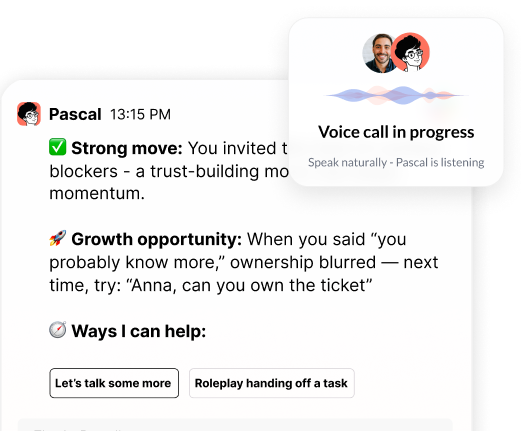
Curious to see how AI Coaching can 10X the impact and scale of your development initiatives. Book a demo today for: