

Mid-market tech and life sciences companies promote individual contributors into management without support, creating underprepared leaders who struggle to build teams. Traditional solutions (workshops, LMS platforms, executive coaching) don't scale to the manager population that needs help most.
The question: Can AI coaching platforms improve manager effectiveness and succession planning visibility?
The answer requires examining what works, what fails, and what evidence exists for new approaches.
Leadership pipeline strength determines whether organizations can execute growth strategies and retain talent. Companies with strong pipelines fill critical roles 2.5x faster and experience 30% higher employee engagement (DDI Global Leadership Forecast, 2023).
Most mid-market firms (200–4,000 employees) struggle with shallow bench depth. They lack enterprise L&D budgets but face the same leadership complexity as larger organizations. The gap: 86% of organizations say developing leaders is critical, but only 14% believe they do it well (DDI, 2023).
Traditional development fails at scale. Workshops reach 10–15% of managers annually. Human coaching costs $15,000+ per executive. LMS completion rates hover around 20%. Training Industry research shows 70–80% skill decay within 90 days of training completion.
Three constraints limit traditional approaches:
Workshops and cohort programs separate learning from application. Managers attend a two-day session, return to work, and face situations the workshop didn't cover. Without reinforcement, most revert to old behaviors within weeks.
LMS platforms and e-learning offer flexibility but lack context. A manager facing their first difficult conversation can't pause to watch a 45-minute video. By the time they complete the module, the moment has passed.
Executive coaching works but doesn't scale. At $15,000+ per engagement, organizations reserve it for senior leaders. First-time managers and mid-level managers (the largest population) receive no ongoing support.
The result: managers learn in classrooms but develop (or fail to develop) in isolation.
AI coaching platforms embed guidance in daily work. Instead of separating learning from application, they provide support during team meetings, difficult conversations, and decision moments.
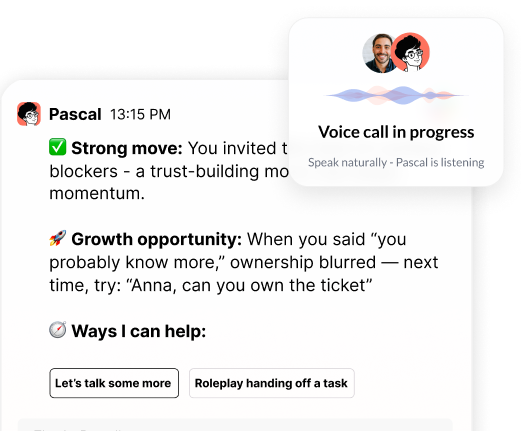
Here's what the experience looks like: Sarah, a first-time engineering manager at an 800-person SaaS company, opens Slack at 9am and sees a message from her AI coach: "I noticed you have a 1-on-1 with Alex in an hour. Last week you mentioned he's struggling with prioritization. Here are three questions that might help..."
The platform integrates with meeting tools, communication platforms, and calendars. It observes patterns (without storing sensitive content) and provides guidance based on what's happening in the manager's actual work.
Purpose-built platforms track specific behaviors: delegation quality, feedback frequency, meeting effectiveness. They measure improvement over time, giving HR leaders quantitative data on leadership readiness that annual assessments miss.
The cost difference matters. At $150–500 per manager annually, organizations can extend development to every manager level.
Data Breakdown:
• Method: Workshops | Reach: 10–15% annually | Cost per Manager: $2,000–5,000 | Timing: Scheduled events | Behavioral Change: 15–20% apply learning
• Method: LMS/e-learning | Reach: 50–70% (low completion) | Cost per Manager: $500–1,500 | Timing: Self-paced | Behavioral Change: <10% behavior change
• Method: Human coaching | Reach: <5% (executives only) | Cost per Manager: $15,000+ | Timing: Weekly sessions | Behavioral Change: 40–50% show improvement
• Method: AI coaching platforms | Reach: Potential for 100% | Cost per Manager: $150–500 | Timing: Real-time, in-workflow | Behavioral Change: Data limited
The table reveals a gap: no solution combines broad reach, low cost, real-time support, and proven behavioral change. AI coaching platforms offer the first three. The fourth (proven behavioral change) requires more research.
Here's the honest answer: limited published evidence.
Most AI coaching platforms launched in the past 2–3 years. Peer-reviewed studies on their effectiveness don't exist yet. Vendor case studies exist but lack independent validation.
What we know:
Continuous reinforcement works. Research on behavior change shows that spaced repetition and immediate feedback improve skill retention. AI coaching platforms apply these principles, but we need studies comparing AI-coached managers to control groups.
Context matters. Generic chatbots that answer questions without understanding the manager's situation show low engagement. Platforms that integrate with work tools and provide contextual guidance report higher usage, but usage doesn't equal effectiveness.
Measurement is possible. Platforms that track specific behaviors (delegation frequency, feedback quality, meeting effectiveness) can quantify change over time. Whether these metrics correlate with team performance and business outcomes requires validation.
The gap between promise and proof matters. Organizations considering AI coaching should treat it as a promising experiment, not a proven solution. Set clear success metrics before deployment. Track behavioral changes and team outcomes. Compare results to managers who don't use the platform.
If you decide to pilot AI coaching, prioritize five capabilities:
Contextual awareness: The platform should understand what's happening in the manager's work. Look for integration with meeting platforms, communication tools, and calendars. Avoid tools that wait for managers to ask questions.
Behavioral tracking: Demand quantitative measurement of specific leadership behaviors and improvement trajectories over time. Without this data, you cannot prove ROI or identify which managers need support.
Culture alignment: The platform should understand your organization's values, leadership competencies, and frameworks. Coaching should reinforce your culture, not generic best practices.
Privacy protection: Verify SOC2 compliance and confirm that customer data never trains the AI models. Enterprise-grade security is non-negotiable.
Integration with existing workflows: The platform should work within tools managers already use (Slack, Zoom, Teams) rather than requiring them to log into another system.
Three pipeline vulnerabilities represent opportunities for AI coaching:
First-time managers receive the least support while facing the steepest learning curve. They need guidance for delegation decisions, feedback conversations, and team dynamics. AI coaching could provide access to support that organizations can't afford to deliver through human coaches.
Mid-level managers often wait years for executive coaching programs. They need feedback on strategic thinking, cross-functional collaboration, and leadership presence. AI coaching could accelerate development without waiting for budget approval.
Succession planning relies on annual reviews and subjective assessments. Platforms that track behavioral patterns across all leadership levels could provide objective data on which managers consistently demonstrate coaching behaviors, delegate effectively, and develop their teams.
The conditional language matters. AI coaching could address these challenges. Whether it does depends on implementation quality, platform capabilities, and organizational commitment to measuring results.
Set realistic expectations:
Timeline: Behavioral change takes 90+ days. Don't expect transformation in the first month.
Adoption: Not every manager will engage. Plan for 60–70% active usage in the first six months.
Measurement: Track specific behaviors (delegation frequency, feedback quality, 1-on-1 consistency), not platform logins. Compare team engagement scores and retention rates for managers who use the platform versus those who don't.
Integration: Budget time for platform configuration, culture alignment, and manager onboarding. Generic implementations fail.
Early pilots suggest first-time managers show the fastest improvement. They receive support for moments that cause anxiety (first difficult conversation, first delegation failure, first team conflict), preventing the pattern of new managers reverting to individual contributor behaviors when stressed.
Mid-level managers report value in strategic thinking support and cross-functional collaboration guidance. They appreciate coaching on navigating organizational complexity and building influence without authority.
HR leaders gain visibility into leadership bench strength through behavioral data. Instead of relying on annual reviews alone, they can access information on which managers consistently demonstrate coaching behaviors and develop their teams.
The financial impact compounds over time through reduced external hiring costs for leadership roles, decreased time-to-fill for critical positions, and improved retention of high-potential talent who see clear development paths.
AI coaching platforms offer a promising approach to leadership development at scale. They embed guidance in daily work, track behavioral patterns, and cost a fraction of traditional coaching.
The evidence gap matters. Published research on AI coaching effectiveness doesn't exist yet. Organizations should treat implementation as a measured experiment, not a proven solution.
If you pilot AI coaching, set clear success metrics before deployment. Track behavioral changes and team outcomes. Compare results to managers who don't use the platform. Measure what matters: delegation quality, feedback frequency, team engagement, retention.
Traditional development methods (workshops, LMS platforms, executive coaching) don't scale to the manager population that needs help most. AI coaching could fill that gap. Whether it does depends on platform quality, implementation rigor, and organizational commitment to measurement.
Ready to explore AI coaching for your leadership pipeline? Pascal by Pinnacle delivers continuous development embedded in the tools your managers already use. Learn more at heypinnacle.com.
Header photo by Vitaly Gariev on Unsplash

.png)
.webp)
“Thank you for setting the great foundation for my promotion; now I have a plan!"

Curious to see how AI Coaching can 10X the impact and scale of your development initiatives. Book a demo today for: