

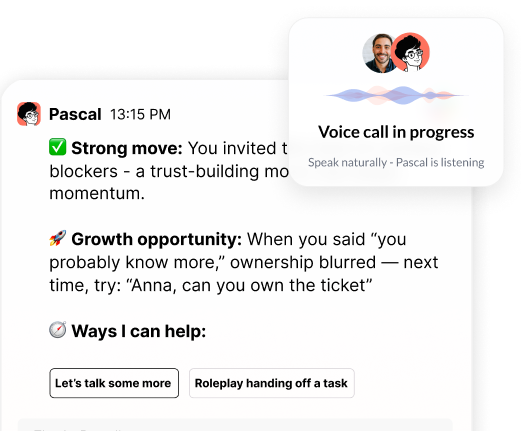
AI coaching inside Slack and Teams delivers leadership guidance in the tools managers already use. Unlike standalone platforms, these coaches join meetings, observe team dynamics, and provide feedback without requiring managers to context-switch.
AI coaching inside Slack and Teams means having a coach that lives in your communication tools, providing guidance without opening another app. This addresses the adoption problem that defeats most leadership development: managers are too busy to add another platform, so resources go unused.
The structural difference is critical. Traditional coaching platforms (AI or human) require managers to seek help, log into a separate system, and context-switch from their work. Platforms requiring login face steep adoption cliffs. Behavior change happens when coaching arrives at the moment managers need it.
Embedded AI coaching capabilities:
• Joins video calls to observe team dynamics
• Delivers feedback after critical conversations via Slack or Teams
• Surfaces pre-meeting briefs based on relationship history
• Provides guidance during performance reviews and difficult conversations
• Integrates with calendars to anticipate leadership moments
This integration drives higher adoption because it eliminates the "remembering to ask for help" problem.
Both platforms deliver comparable coaching when properly implemented. The choice depends on your organization's primary communication platform. The platform matters less than whether the AI coach can access contextual data.
Slack-based coaching:
• Native threading makes conversations feel organized
• Strong integration with Zoom and Google Calendar
• Preferred by tech companies and startups
• Better suited for asynchronous interactions
Teams-based coaching:
• Deeper integration with Microsoft 365 (Outlook, SharePoint, OneDrive)
• Native video calling eliminates separate meeting platform
• Preferred by enterprises with Microsoft-first stacks
• Better compliance and security controls for regulated industries
Platform selection questions:
• Where do your managers spend their time?
• What video conferencing platform does your organization use?
• Do regulatory requirements favor one ecosystem?
• How mature is your existing integration infrastructure?
HR leaders should prioritize five factors: proactive delivery, contextual depth, coaching quality, integration breadth, and data protection.
Does the coach come to the manager, or does the manager have to seek it? Research shows 67% of managers avoid giving feedback, and only 35% can handle difficult conversations well. Passive tools that require managers to remember to seek help fail during high-stakes moments.
Look for platforms that join meetings, observe dynamics, and deliver feedback after critical conversations.
Generic advice fails because it ignores your team's dynamics, your organization's values, and your communication patterns. Effective AI coaches build a knowledge graph of your interactions, remembering relationship details and adapting to your company's frameworks.
Look for platforms that integrate with:
• HRIS systems (Lattice, Workday, BambooHR) for performance data
• Calendar systems for meeting context
• Communication platforms for relationship history
• Video conferencing for real-time observation
Not all AI coaching is equal. The best platforms are trained by ICF-certified coaches and ground guidance in validated leadership frameworks.
Data Breakdown:
• Quality Factor: Training methodology | What to Look For: ICF-certified coaches involved | Red Flags: Generic LLM with no coaching expertise
• Quality Factor: Framework grounding | What to Look For: Specific leadership models (Situational Leadership, Radical Candor, GROW) | Red Flags: Vague "best practices" claims
• Quality Factor: Personalization depth | What to Look For: Adapts to company values | Red Flags: One-size-fits-all advice
• Quality Factor: Feedback specificity | What to Look For: References actual interactions | Red Flags: Generic suggestions
• Quality Factor: Escalation protocols | What to Look For: Clear handoff to human support | Red Flags: No guardrails for sensitive topics
The more seamlessly the AI coach integrates into workflows, the higher the adoption. Look for connections to Slack, Teams, Zoom, Google Meet, Outlook Calendar, Google Calendar, HRIS systems, and knowledge management tools.
Platforms that send coaching nudges through multiple channels (Slack, Teams, email, calendar) see higher engagement than single-channel solutions.
Enterprise-grade security is non-negotiable. Look for SOC2 compliance, clear data handling policies, and guarantees that customer data is never used to train models.
For regulated industries (healthcare, life sciences, financial services), verify the platform meets industry-specific compliance requirements. Some organizations disable meeting recording due to regulatory constraints, so ensure the platform can function without those capabilities.
Embedded AI coaches use multi-layered guardrails to identify sensitive topics and escalate appropriately. These systems combine automated moderation (keyword matching and sentiment analysis), topic detection (ML classification of conversation themes), and clear escalation protocols.
Guardrail mechanisms:
• Automated moderation flags harassment, discrimination, or legal concerns
• Sensitive topic detection identifies mental health discussions, personal crises, or ethical violations
• Organization-specific controls allow companies to define boundaries
• Clear escalation paths direct managers to HR business partners or employee assistance programs
When an AI coach detects a sensitive topic, it acknowledges the situation and directs the manager to human resources: "This conversation involves mental health concerns that require professional support. I recommend connecting with your HR business partner or your company's Employee Assistance Program."
What AI coaches should NOT do:
• Provide therapy or mental health counseling
• Make hiring or termination decisions
• Handle legal matters without human oversight
• Replace human judgment in high-stakes situations
The best platforms maintain transparency about their limitations and provide aggregated, anonymized insights to leadership teams (showing trends like common skill gaps) while keeping individual conversations confidential.
Note: "Anonymized" in small teams (5-10 people) may still allow identification. Ask vendors how they handle small team privacy.
Organizations see behavioral improvements within 30-60 days and measurable business outcomes within 90 days when using AI coaching platforms integrated into daily workflows.
Expected outcomes by timeframe:
30 days:
• Managers report feeling more prepared for difficult conversations
• Increased frequency of feedback delivery
• Higher confidence in delegation and communication
60 days:
• Observable improvements in team dynamics
• Reduction in escalations to HR business partners
• Managers demonstrate consistent application of coaching frameworks
90 days:
• Direct reports observe improvement in manager effectiveness
• Average lift in Manager Net Promoter Score among high-adoption teams
• Hours saved per manager on performance management tasks
The key to sustained results is continuous reinforcement. One-time training fades within weeks. Daily coaching nudges, pre-meeting briefs, and post-conversation feedback create the repetition that builds lasting habits.
Success factors that accelerate results:
• Executive sponsorship and visible leadership support
• Integration into existing performance management cycles
• Clear communication about how AI coaching complements (not replaces) human support
• Pilot programs with high-visibility teams to demonstrate value
• Regular measurement of adoption metrics and behavior change indicators
New managers face the steepest learning curve in their careers. According to Gallup, 70% of the variance in team engagement comes down to the manager, yet 60% of new managers report feeling unprepared.
Embedded AI coaching addresses this gap by providing:
• Real-time guidance during first-time delegation conversations
• Scripts and frameworks for delivering constructive feedback
• Pre-meeting briefs that surface relevant context about direct reports
• Post-conversation analysis highlighting what worked and what to improve
• Role-play scenarios to practice difficult conversations before they happen
Common new manager use cases:
• Preparing for first performance review conversations
• Learning to delegate without micromanaging
• Navigating team conflicts and interpersonal dynamics
• Setting clear expectations and accountability
• Balancing individual contributor work with management responsibilities
The advantage of embedded coaching is that it meets new managers where they already work. Instead of requiring them to remember to seek help or complete a training module, the AI coach surfaces guidance based on calendar events, communication patterns, and observed interactions.
For L&D teams, this scalability is transformative. Small teams can support hundreds of new managers without hiring additional staff. The AI coach handles routine development needs, freeing HR business partners to focus on complex situations requiring human judgment.
• Embedded AI coaching in Slack and Teams eliminates adoption friction by delivering guidance in the tools managers already use
• Platform choice (Slack vs. Teams) matters less than integration depth—the best solutions work in both environments and connect to calendar, video conferencing, and HRIS systems
• Proactive delivery is the critical differentiator—AI coaches that join meetings, observe dynamics, and provide immediate feedback outperform passive tools requiring managers to remember to seek help
• Enterprise-grade guardrails protect sensitive conversations—effective platforms use automated moderation, topic detection, and clear escalation protocols to identify when human expertise is required
• Measurable results appear within 30-90 days—organizations see behavioral improvements in 30 days, observable team impact in 60 days, and business outcomes in 90 days
Pascal delivers ICF-certified coaching in Slack and Teams, joining your meetings and providing feedback at the moment it matters. See how Pascal works or schedule a demo to experience embedded AI coaching in your workflow.

.png)
.webp)
“Thank you for setting the great foundation for my promotion; now I have a plan!"

Curious to see how AI Coaching can 10X the impact and scale of your development initiatives. Book a demo today for: