
Embedded AI tools integrate general-purpose models like ChatGPT into existing platforms for convenience. Purpose-built AI coaches combine specialized coaching frameworks, organizational context, and proactive engagement designed for behavior change. The architectural choice determines whether managers adopt the tool once or build sustained habits that improve team performance.
The AI coaching market reached $6.25 billion in 2024. CHROs now face a critical decision: embed general-purpose AI into existing HR platforms or deploy purpose-built coaching systems designed for manager development.
The embedded approach means HR platforms like Workday, Lattice, and Microsoft Viva add ChatGPT-style capabilities into their interfaces. The purpose-built approach means platforms architect entire systems around coaching methodology, organizational context, and sustained behavior change.
"If we can finally democratize coaching—make it specific, timely, and integrated into real workflows—we solve one of the most chronic issues in the modern workplace," notes Melinda Wolfe, former CHRO at Bloomberg, Pearson, and GLG. Gallup research shows 60% of new managers feel unprepared, and traditional coaching costs make scaling impossible.
The architectural differences predict adoption rates, engagement sustainability, and whether your investment drives measurable manager effectiveness or becomes another underutilized tool.
Embedded AI tools bolt general-purpose language models onto existing platforms as reactive features. Purpose-built coaches construct specialized architectures with coaching expertise, contextual memory systems, and proactive engagement loops as foundational design principles.
The foundation is general-purpose LLMs like ChatGPT, Claude, or Gemini accessed via API. Integration follows a feature-addition pattern—a chatbot sidebar or help assistant bolted onto existing platforms.
The knowledge base consists of generic training data plus basic company documentation. The interaction model is reactive: users must initiate every conversation. Memory is session-based or simple conversation history. Customization happens through prompt engineering and retrieval-augmented generation (pulling relevant company documents to inform responses) on company docs.
The foundation is coaching frameworks developed with ICF-certified coaches, specialized for leadership development. Integration is a standalone system with connections into workflow tools like Slack, Teams, and Zoom.
The knowledge base includes organizational competencies, individual performance data, relationship graphs, and communication patterns. The interaction model is proactive: the system initiates coaching moments based on context. Memory is a knowledge graph (a database that maps relationships between people, conversations, and behavioral patterns) tracking interactions over time. Customization means organization-specific coaching models aligned to culture and values.
Pascal by Pinnacle exemplifies the purpose-built approach: it joins meetings via calendar integration to provide real-time feedback, builds a knowledge graph of team interactions, and delivers coaching at a fraction of traditional coaching costs while maintaining SOC2 compliance.
Data Breakdown:
• Component: Foundation | Embedded AI Tools: General-purpose LLMs (ChatGPT, Claude) | Purpose-Built AI Coaches: Coaching frameworks developed with ICF-certified coaches
• Component: Integration | Embedded AI Tools: Feature add-on to existing platform | Purpose-Built AI Coaches: Standalone system with workflow integration
• Component: Knowledge Base | Embedded AI Tools: Generic training data + company docs | Purpose-Built AI Coaches: Org competencies + performance data + relationship graphs
• Component: Interaction Model | Embedded AI Tools: Reactive (user-initiated) | Purpose-Built AI Coaches: Proactive (context-triggered)
• Component: Memory | Embedded AI Tools: Session-based conversation history | Purpose-Built AI Coaches: Knowledge graph tracking patterns over time
• Component: Customization | Embedded AI Tools: Prompt engineering + document retrieval | Purpose-Built AI Coaches: Organization-specific coaching models
Purpose-built AI coaches maintain higher retention through proactive engagement and contextual relevance. Embedded tools see engagement drop to 10-20% within months as managers revert to familiar workflows and generic guidance fails to address specific challenges.
Initial adoption favors embedded tools—managers already have access, no new login required. But sustained usage tells a different story. Purpose-built systems create habit loops through proactive nudges, meeting integration, and timely coaching moments.
The engagement cliff happens because embedded AI requires managers to remember to use it, know what to ask, and translate generic advice into specific actions. Purpose-built systems join meetings, provide feedback on actual interactions, and suggest practice conversations.
The architectural reason: embedded tools wait for managers to come to them. Purpose-built coaches meet managers where work happens—in meetings, Slack conversations, and critical moments when decisions matter.
Purpose-built AI coaches embed organizational competencies, culture, and values into their core architecture, enabling coaching aligned to how your company defines leadership. Embedded tools provide generic best practices disconnected from your specific context.
Embedded AI approach: Upload company handbook and competency framework to knowledge base. AI retrieves relevant sections when asked. Coaching remains generic with occasional company-specific references. No understanding of how competencies connect to individual roles or team dynamics.
Purpose-built coaching approach: Organizational competencies become evaluation criteria for every coaching interaction. Performance review data, 360 feedback, and engagement surveys inform individual coaching. Culture and values shape coaching tone, recommendations, and escalation triggers. The system learns company-specific patterns—how your best managers handle difficult conversations.
Pascal's architecture integrates company documentation, performance data, and communication patterns to deliver coaching that reflects your organization. When a manager at a life sciences company asks about delegation, Pascal references the company's leadership competencies and suggests approaches that align with their culture of scientific rigor and collaborative decision-making.
Proactive AI coaching architectures that initiate conversations based on meeting context and behavioral patterns drive higher engagement than reactive systems that wait for managers to ask for help. The most valuable coaching moments happen when managers don't know they need guidance.
Reactive embedded tools require managers to recognize they need help, formulate the right question, and interrupt their workflow to seek guidance. Most managers don't do this consistently. They're busy, they don't know what they don't know, and the friction of context-switching kills adoption.
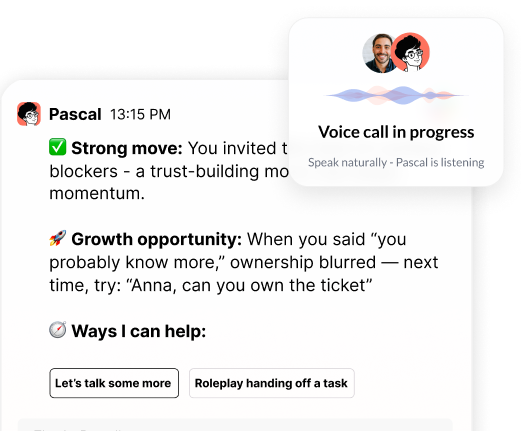
Proactive purpose-built coaches monitor actual work through calendar integration and communication tool APIs, then surface coaching at the moment it matters. Pascal joins your 1:1 with a struggling team member via calendar access and provides feedback immediately after: "You interrupted Sarah three times when she tried to explain the technical blocker. Here's how to create more space for her perspective."
The architectural distinction is fundamental. Embedded tools are pull-based: managers must pull information from the system. Purpose-built coaches are push-based: the system pushes relevant coaching when context indicates it's needed.
Purpose-built AI coaches maintain knowledge graphs that track relationships, communication patterns, and behavioral trends over months, enabling longitudinal coaching that references past conversations and measures progress. Embedded tools rely on session-based memory that forgets context between interactions.
Embedded AI tools retain conversation history within a session or across recent chats. They don't build a persistent understanding of who you are, how you interact with your team, or what patterns emerge over time. Each conversation starts relatively fresh.
Purpose-built coaching platforms architect memory as a core capability. Pascal builds a knowledge graph from every meeting it joins (via calendar integration and meeting transcription APIs), every Slack conversation (via Slack API access), every coaching interaction. It knows you tend to dominate conversations with certain team members. It remembers you committed to delegating more three weeks ago and checks whether you followed through.
This architectural difference enables coaching that evolves. "Last month you said you wanted to improve at giving critical feedback. I've noticed you're still using softening language that dilutes your message. Let's practice a more direct approach."
The memory architecture also enables relationship-aware coaching. Pascal can suggest practicing a difficult conversation with an AI simulation of your specific colleague, using prompt engineering based on how that person communicates in past meeting transcripts and interaction history.
Purpose-built AI coaches implement multi-layered safety architectures with moderation flags, sensitive topic escalation to HR, and organization-specific controls. Embedded tools rely on general-purpose content filters that miss workplace-specific risks and lack escalation pathways for serious issues.
Embedded AI tools use the safety guardrails built into their underlying models—ChatGPT's content policy, Claude's constitutional AI. These catch obvious problems but don't understand workplace context. They can't distinguish between a manager asking for coaching on a performance issue versus a situation that requires HR intervention.
Purpose-built coaching platforms architect safety for workplace contexts. Pascal's guardrails include moderation flags for inappropriate content, sensitive topic detection that escalates to HR when managers discuss potential harassment or discrimination (flagged for human review by HR team members), organization-specific controls that align with company policies, and anonymous aggregated insights that protect individual privacy while surfacing organizational patterns.
The architectural difference matters for legal and ethical risk. When a manager uses an embedded AI tool to draft a termination conversation, the tool provides generic advice with no escalation. When a manager uses Pascal for the same scenario, the system recognizes the sensitivity, provides coaching aligned to company policy, and flags the conversation for HR review.
Purpose-built AI coaches architect deep integrations with communication and collaboration tools as core functionality, delivering coaching inside Slack, Teams, and meetings where work happens. Embedded tools remain confined to their host platform, requiring managers to leave their workflow to access guidance.
Embedded AI lives where the host platform lives. If it's in your HRIS, managers must navigate to the HRIS to use it. If it's in your LMS, they must remember to log into the LMS. This architectural constraint creates friction that kills sustained usage.
Purpose-built coaches architect integration as a primary design principle. Pascal lives in Slack, Teams, Zoom, and Google Meet—the tools managers use all day. It joins meetings via calendar integration to provide real-time feedback. It responds to questions in Slack threads via Slack API. It sends proactive nudges when context indicates a coaching opportunity.
The architectural approach is different: instead of asking managers to come to the coaching tool, the coaching tool goes where managers work. This reduces friction from minutes to seconds and transforms coaching from an occasional activity to a continuous presence.
• Embedded AI tools bolt general-purpose models onto existing platforms with reactive, session-based interactions. Purpose-built coaches architect specialized coaching expertise, proactive engagement, and memory systems from the ground up.
• Purpose-built AI coaches maintain higher retention because proactive, context-aware coaching meets managers where work happens rather than waiting for them to seek help.
• Organizational context becomes a core architectural component in purpose-built systems, enabling coaching aligned to your specific competencies, culture, and values rather than generic best practices.
• Knowledge graphs in purpose-built platforms enable longitudinal coaching that tracks patterns, measures progress, and references past conversations. Embedded tools forget context between sessions.
• Integration architecture determines friction. Purpose-built coaches live in Slack, Teams, and meetings where managers work. Embedded tools require navigating to separate platforms.
The architectural differences between embedded AI tools and purpose-built AI coaches reflect fundamental design philosophy. One approach adds AI capabilities to existing systems. The other builds coaching systems from scratch with AI as the enabling technology.
See how Pascal works inside Slack to deliver proactive, context-aware coaching that scales manager effectiveness across your organization.
Header photo by ThisisEngineering on Unsplash

.png)
.webp)
“Thank you for setting the great foundation for my promotion; now I have a plan!"

Curious to see how AI Coaching can 10X the impact and scale of your development initiatives. Book a demo today for: