

An AI coach waiting passively for managers to remember it exists is like a fitness trainer who only shows up if you call. Most managers won't call, and the coaching moment will have passed. The evidence is clear: proactive AI coaching drives 75%+ regular usage and measurable behavior change, while on-demand models stall at 51% adoption because they require activation energy that busy managers rarely have.
Quick Takeaway: Proactive AI coaching surfaces guidance before managers realize they need it, delivering feedback within minutes of key moments while context is fresh. This approach eliminates friction, creates consistent habits, and drives the 40% higher retention and 60% faster goal achievement that reactive models simply can't match.
The question facing CHROs isn't whether to adopt AI coaching. That decision has been made by competitive pressure and market momentum. The real question is which deployment model will actually drive adoption and measurable behavior change: proactive systems that meet managers in their workflow, or on-demand tools that require them to remember to seek help.
Proactive coaching surfaces guidance before managers realize they need it, after meetings, before difficult conversations, and when patterns suggest a development opportunity. It meets managers in their existing workflow rather than requiring them to navigate to a separate platform. The difference from reactive models is fundamental: proactive systems initiate contact at moments when guidance creates the most value, while on-demand tools wait passively for users to ask.
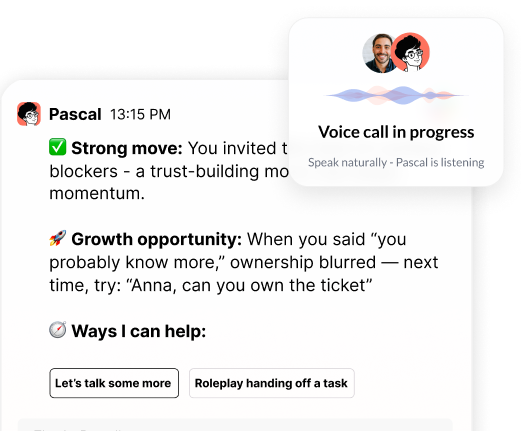
Proactive coaching delivers feedback immediately after key moments while context is fresh. When a manager finishes a team meeting, Pascal surfaces specific observations: "Strong move: You invited the team to surface blockers—a trust-building move that keeps momentum. Growth opportunity: When you said 'you probably know more,' ownership blurred. Next time, try: 'Anna, can you own the ticket?'" This immediacy makes feedback concrete and actionable while details remain vivid in the manager's mind.
The system also identifies coaching opportunities through observation of actual work interactions. Rather than requiring managers to recognize their own development needs, proactive AI coaching analyzes patterns across multiple interactions to surface skill gaps before they become entrenched problems. It checks in on development goals and surfaces growth opportunities automatically during natural moments like performance review season.
Proactive AI coaching achieves 75%+ regular usage versus 51% for on-demand tools, with 94% monthly retention and an average of 2.3 sessions per week. The difference comes down to friction: managers don't fail to use coaching tools because they lack motivation. They fail because they're overwhelmed, and remembering to open another app ranks low on their priority list.
Research shows proactive approaches achieve 40% higher client retention and 60% faster goal achievement compared to reactive models. AI can provide up to 90% of day-to-day coaching functions, with particular strength in continuous feedback, nudges, and personalized learning recommendations. All of these capabilities depend on proactive engagement rather than waiting for users to initiate.
Organizations embedding coaching into daily workflows see adoption above 80% within the first month versus 30% for standalone platforms. 83% of colleagues report measurable improvement in their manager with proactive engagement, and highly engaged users see a 20% average lift in Manager Net Promoter Score. These outcomes reflect sustained behavior change, not just sporadic tool usage.
Effective AI coaches are selectively proactive, initiating outreach when data indicates risk, opportunity, or need rather than overwhelming managers with constant notifications. The most valuable moments for proactive coaching are after meetings while context is fresh, before scheduled difficult conversations, during organizational rituals like performance reviews, and when behavioral patterns suggest a development opportunity.
After team meetings or one-on-ones, immediate feedback creates the highest learning impact because the manager can immediately apply insights to their next interaction. Before performance reviews, goal-setting cycles, and other predictable high-stress moments, proactive coaching provides preparation and roleplay support that builds confidence. When patterns across multiple interactions suggest a skill gap—a manager consistently avoids conflict or struggles with delegation—proactive nudges surface the pattern while it's still emerging.
Never should an AI coach initiate on sensitive topics like harassment, medical issues, or terminations. Those always escalate to humans with guidance on how to prepare for appropriate conversations. Organization-specific controls let you define which topics the AI coach won't respond to, ensuring alignment with your risk tolerance and policies.
Habit formation requires consistent repetition at predictable intervals. Reactive tools depend on managers initiating contact, which happens inconsistently if at all. Proactive systems create the consistency that builds lasting behavior change through repeated practice and reinforcement at moments when learning sticks best.
Weekly development nudges keep growth front-of-mind without overwhelming managers. Consistent practice with immediate feedback accelerates skill development 2-3 times faster than crisis-only support. Managers develop skills through repeated application in real work contexts rather than one-time learning events. Proactive feedback after every meeting creates automatic behavior patterns that replace old habits over time.
On-demand tools see engagement drop to less than one session per month after initial novelty fades because they require managers to overcome multiple friction points: remembering the tool exists, navigating to it, explaining their situation, and waiting for a response. By the time all that happens, the coaching moment has passed.
Traditional training delivers content far removed from when managers actually need it. A two-day workshop on feedback skills happens months before a manager faces a difficult performance conversation. By then, the learning has evaporated. Traditional training targets the 10% of learning that happens formally rather than the 70% that occurs on the job. Managers rarely need help in a workshop; they need it when preparing for a tough one-on-one or in the middle of a team conflict.
Proactive AI coaching addresses this gap by meeting managers in actual moments of need. Traditional programs see 90% knowledge loss within a week because learning happens separately from application. Proactive coaching delivers guidance at the exact moment it's relevant, when application is immediate and learning sticks. One tech company using Pascal estimated saving 150+ hours per 50 employees in their initial rollout.
As Jeff Diana, former CHRO at Calendly and Atlassian, notes: "So much of the real learning and value comes from in-context coaching in the moment to drive performance and solve problems in the moment." This principle explains why proactive models drive behavior change that episodic training cannot match.
Purpose-built coaching platforms include escalation protocols that recognize sensitive topics and route them to HR while helping managers prepare for appropriate human conversations. This architecture de-risks AI adoption while ensuring human judgment remains involved in complex situations.
Moderation systems detect toxic behavior or mental health concerns and flag them appropriately. Sensitive employee topics—harassment, medical issues, terminations—automatically escalate to HR rather than receiving AI guidance alone. Organization-specific controls let you define which topics the AI coach won't respond to. Data stored at user level prevents cross-account information leakage. Platforms never train AI models on customer data; all information remains encrypted with enterprise-grade security.
| Metric | Proactive Model | On-Demand Model |
|---|---|---|
| Regular usage rate | 75%+ | 51% |
| Monthly retention | 94% | 20-30% |
| Sessions per week | 2.3 average | Less than 1 |
| Colleague-reported improvement | 83% report improvement | Varies widely |
Pascal, Pinnacle's AI coach, demonstrates proactive engagement by joining your meetings, observing team dynamics, and delivering real-time feedback in Slack and Teams rather than waiting for managers to remember it exists. Pascal understands your organization's culture and each manager's context, surfacing guidance at moments when it matters most. The platform recognizes when sensitive topics require human expertise and escalates appropriately, protecting both your organization and your people.

.png)
.webp)
“Thank you for setting the great foundation for my promotion; now I have a plan!"

Curious to see how AI Coaching can 10X the impact and scale of your development initiatives. Book a demo today for: