

Organizations track AI coaching impact through three distinct measurement levels: adoption leading indicators that predict sustained engagement, behavioral change metrics that show real skill development, and business outcomes that justify continued investment. Organizations using purpose-built AI coaching report 83% of direct reports seeing measurable manager improvement and 20% average lift in Manager Net Promoter Score, proving that the right measurement framework separates transformative investments from expensive experiments.
Quick Takeaway: Effective AI coaching measurement requires tracking three distinct levels—adoption leading indicators, behavioral changes in managers, and business outcomes like retention and team engagement—rather than relying on engagement metrics alone. 80% of managers using a tool weekly means nothing if they don't apply what they learn. Purpose-built coaching systems show measurable behavior change in 40–60% of participants within 3–6 months.
AI coaching works when managers apply new behaviors consistently, direct reports notice measurable improvement, and organizational outcomes shift positively. This requires abandoning vanity metrics like weekly active users in favor of three interconnected measurement levels that predict sustained value.
Adoption alone doesn't prove effectiveness. The Conference Board's 2025 research confirms AI can deliver 90% of career coaching value when properly implemented, with working alliance metrics showing no significant difference from human coaches. Organizations using contextual AI coaching report 83% of direct reports see measurable improvement in their manager's effectiveness. The distinction matters because it separates organizations capturing real value from those chasing metrics that look impressive in board presentations but predict nothing about sustained impact.
Track weekly active users (target 60% by week 4), sessions per user per week (target 2+), and time to first value (under 48 hours). These metrics predict whether the platform becomes part of daily workflow or remains a novelty.
Platforms with contextual awareness maintain 94% monthly retention and average 2.3 sessions per week because coaching feels personalized. Session depth matters more than total users; measure whether managers use advanced features like roleplay and proactive coaching. Adoption velocity matters as much as absolute numbers; if adoption stays flat or grows, you're building foundation for long-term impact. Generic AI tools see engagement spike and decline because advice doesn't account for specific situations or team dynamics.
Real impact shows up in how managers actually lead. Measure feedback frequency, delegation clarity, one-on-one consistency, and psychological safety through direct report surveys and 360 feedback.
Direct reports should report increased feedback quality and frequency within 60 days as a leading indicator of sustained behavior change. Track 360-feedback trends on specific competencies before and after 90 days for improvements in delegation, feedback delivery, emotional intelligence, and one-on-one quality. The accountability dial framework provides one structured approach to measuring whether managers are applying coaching guidance on performance conversations. Survey managers on trust: "I feel confident the AI coach respects confidentiality" and "I know when to escalate to HR rather than relying on AI." Behavioral changes sustained at 3–6 months post-intervention in roughly 40–60% of participants, suggesting initial coaching engagement creates lasting habit formation.
Sustainable ROI appears in retention, promotion rates, team performance, and time savings. These metrics confirm that behavior change drives organizational value.
Organizations implementing AI coaching see 6–12% productivity gains and 25–35% faster skill development within 90 days. Manager ramp time for new managers accelerates measurably; track time to first positive team performance milestone. Voluntary attrition among direct reports of highly engaged managers should decline over 12 months. 70% of employee engagement links directly to manager quality, so even modest improvements in manager effectiveness compound across the organization. One tech company using contextual AI coaching estimated 150 hours saved across 50 managers in the first month from automated feedback and eliminated HR escalations.
Purpose-built AI coaches integrate company data to deliver personalized guidance, driving adoption and measurable outcomes faster than generic tools. Generic tools see engagement spike and decline because advice doesn't account for specific situations, team dynamics, or organizational culture.
Contextual platforms access performance reviews, 360 feedback, team dynamics, and company culture documentation to tailor guidance. Organizations like HubSpot achieved 98% employee usage and 84% comfort levels when embedding AI into daily workflows and tailoring guidance to role and context. Proactive coaching drives 40% faster skill development than reactive tools because guidance arrives at the moment of maximum relevance. Managers using contextual AI coaching average 2.3 sessions per week with 94% monthly retention, compared to sporadic usage of generic tools.
| Measurement Level | Key Metrics | Expected Results |
|---|---|---|
| Adoption (Weeks 1–8) | Weekly active users, session frequency, time to first value | 60%+ weekly active, 2+ sessions/week, under 48 hours |
| Behavioral Change (Weeks 9–12) | Feedback quality, delegation clarity, 360 feedback trends | 70%+ direct reports see improvement, +15–20% NPS lift |
| Business Outcomes (Month 3+) | Retention, promotion velocity, team engagement, financial ROI | 20–30% attrition reduction, 3–5× financial return |
Combine quantitative efficiency metrics with behavioral change evidence and retention outcomes. Lead with time savings and faster ramp, then anchor credibility with behavioral improvement and business impact.
Month 1–3: Adoption rate (60%+), session frequency (2+ per week), user satisfaction (90%+), time saved per manager (3–5 hours monthly). These metrics show the platform is being used and managers find it valuable.
Month 3–6: Direct report feedback on manager improvement (target 70%+), manager NPS lift (target +15–20%), behavioral changes in feedback quality and delegation. These indicators prove coaching is driving real behavior change, not just engagement.
Month 6–12: Retention impact among managed teams, promotion velocity for coached managers, team engagement scores, full financial ROI (target 3–5× investment). These outcomes demonstrate sustainable business value that justifies continued investment and expansion.
"AI coaching is most effective when it combines real-time feedback, personalized learning paths, and continuous performance monitoring integrated into the flow of work."
Include specific examples of behavior change from actual managers; stories create emotional resonance that numbers alone cannot achieve. When you combine concrete efficiency metrics like hours saved or faster ramp time with outcome metrics like improved manager quality and reduced turnover, you're not just presenting data. You're demonstrating that AI coaching translates into the manager effectiveness and team performance outcomes that drive business value.
Traditional manager training consistently fails because it targets formal learning rather than the 70% of development that happens on the job. AI coaching solves this by delivering guidance at the exact moment managers need it. The measurement frameworks that prove this work focus on capturing behavior change in real time rather than waiting for quarterly reviews.
Track these leading indicators weekly during your first 90 days. When adoption metrics show 60% weekly active users by week four, you know the platform is becoming part of daily workflow. When session frequency holds steady at 2+ per week, you know managers find the coaching valuable enough to return consistently. When direct reports report increased feedback quality within 60 days, you know behavior is actually changing. These signals predict whether you'll see the business outcomes that justify continued investment.
Organizations implementing AI coaching can expect rapid, measurable returns within 90 days when they focus on these three measurement horizons. Leading organizations have found that integrating AI into daily workflows drives adoption above 80%, which directly correlates with sustained behavioral change and business impact.
"If we can finally democratize coaching, make it specific, timely, and integrated into real workflows, we solve one of the most chronic issues in the modern workplace."
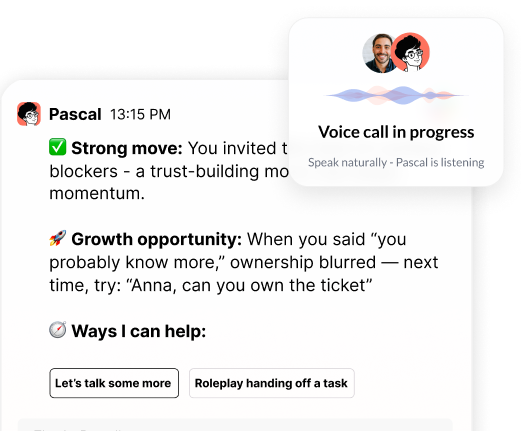
Pascal delivers the measurement capabilities you need to demonstrate real impact. With built-in 360 feedback synthesis, real-time behavioral tracking after meetings, and proactive engagement monitoring, you'll see adoption, behavior change, and business outcomes in your first 90 days. Book a demo to explore how Pascal's contextual awareness and measurement capabilities help you prove ROI to your board and understand what results your organization should realistically expect.

.png)
.webp)
“Thank you for setting the great foundation for my promotion; now I have a plan!"

Curious to see how AI Coaching can 10X the impact and scale of your development initiatives. Book a demo today for: