
AI coaching is working when managers apply new behaviors consistently, direct reports notice measurable improvement, and organizational outcomes shift positively. This requires tracking three distinct levels of impact: adoption leading indicators that predict sustained engagement, behavioral change metrics that show real skill development, and business outcomes that justify continued investment. The difference between vanity metrics and proof separates transformative investments from expensive experiments.
Quick Takeaway: AI coaching is working when managers apply new behaviors consistently, direct reports notice measurable improvement, and organizational outcomes shift positively. This requires tracking three distinct levels of impact: adoption leading indicators, behavioral change metrics, and business outcomes. The Conference Board's 2025 research confirms AI can deliver 90% of career coaching value when properly implemented, with working alliance metrics showing no significant difference from human coaches.
Selecting an AI coaching platform is easy. Proving it works is harder. Most vendors showcase adoption rates and user satisfaction scores, but CHROs need evidence that coaching translates into actual manager effectiveness, team performance, and business impact. In our work implementing AI coaching across organizations, we've learned that the organizations capturing real value focus on three measurement horizons that predict success more reliably than surface-level engagement numbers.
AI coaching is working when managers apply new behaviors consistently, direct reports notice measurable improvement, and organizational outcomes shift positively. This requires tracking three distinct levels of impact: adoption leading indicators, behavioral change metrics, and business outcomes. Each level answers a different question about whether your investment is delivering value.
Adoption alone doesn't prove effectiveness. 80% of managers using a tool weekly means nothing if they don't apply what they learn. Purpose-built coaching systems grounded in people science show measurable behavior change in 40-60% of participants within 3-6 months, according to external research. The Conference Board's 2025 research confirms AI can deliver 90% of career coaching value when properly implemented, with working alliance metrics showing no significant difference from human coaches.
Organizations using contextual AI coaching report 83% of direct reports see measurable improvement in their manager's effectiveness, with 20% average lift in Manager Net Promoter Score among highly engaged users. These aren't vanity metrics. They're leading indicators of the retention, engagement, and team performance outcomes that justify coaching investments.
Strong adoption predicts sustained impact. Track weekly active users (target 60% by week 4), sessions per user per week (target 2+), and time to first value (under 48 hours). These metrics tell you whether the platform is becoming part of managers' daily workflow or remaining a novelty they tried once.
Platforms with contextual awareness maintain 94% monthly retention and average 2.3 sessions per week because coaching feels personalized, not generic. Generic AI tools see adoption spike and decline rapidly as users recognize advice doesn't account for their specific situations. Session depth matters more than total users. Measure whether managers use advanced features like roleplay, follow-ups, and proactive coaching rather than just asking basic questions.
The velocity of adoption matters as much as the absolute numbers. If you hit 60% weekly active users by week four but drop to 40% by week eight, that signals the platform isn't delivering sustained value. If adoption stays flat or grows, you're building the foundation for long-term impact.
Real impact shows up in how managers actually lead. Measure feedback frequency, delegation clarity, one-on-one consistency, and psychological safety through direct report surveys and manager self-assessment. These behavioral shifts are the bridge between using a tool and changing how you work.
Direct reports should report increased feedback quality and frequency within 60 days. This is a leading indicator of sustained behavior change. Survey questions like "My manager gives me specific, actionable feedback" and "I feel psychologically safe sharing concerns with my manager" correlate directly with manager effectiveness scores. 83% of colleagues see measurable improvement in their managers using purpose-built AI coaching, indicating behavior shift is real and observable to the people who experience it daily.
Track 360-feedback trends on specific competencies before and after 90 days. Look for improvements in delegation, feedback delivery, emotional intelligence, and one-on-one quality. These competencies shift when managers have consistent coaching support. The accountability dial framework provides one structured approach to measuring whether managers are applying coaching guidance on performance management conversations.
Sustainable ROI appears in retention, promotion rates, team performance, and time savings. These metrics confirm that behavior change drives organizational value. Organizations implementing AI coaching see 6-12% productivity gains and 25-35% faster skill development within 90 days. Manager ramp time for new managers accelerates measurably. Track time to first positive team performance milestone and compare it for managers using AI coaching versus those relying on traditional support.
Voluntary attrition among direct reports of highly engaged managers should decline. Compare turnover for teams with active AI coaching users versus non-users over a 12-month period. Time savings compound quickly. One tech company using Pascal estimated 150 hours saved across 50 managers in the first month, primarily from automated feedback collection and eliminated escalations to HR.
Purpose-built AI coaches integrate company data to deliver personalized guidance. Generic tools provide the same advice to every user regardless of role, team, or organizational context. This distinction determines whether managers trust and apply coaching.
Contextual platforms access performance reviews, 360 feedback, team dynamics, and company culture documentation. Generic tools rely only on public knowledge. Ask vendors: Does your AI know each manager's direct reports, their communication styles, and recent performance history? Can it reference past coaching conversations and track progress? Platforms that leverage your company's competency frameworks and values show measurably higher satisfaction (68% learning satisfaction vs. industry standard of 40-50%).
Proactive engagement drives 40% faster skill development than reactive models. Managers must ask for help in reactive systems, which means they miss the moments when coaching would be most valuable. Contextual AI coaches observe meetings, identify coaching opportunities, and surface guidance before managers realize they need it.
Effective AI coaching includes clear boundaries for sensitive topics and escalation to humans. Track whether sensitive issues are handled appropriately and whether managers feel safe using the system. Moderation should identify and escalate potential harassment, mental health concerns, and termination discussions to HR. This protects both organization and employee.
Survey managers on trust: "I feel confident the AI coach respects confidentiality" and "I know when to escalate to HR rather than relying on AI." Measure escalation accuracy. If sensitive topics are being missed or over-escalated, the system needs recalibration. Proper escalation protocols ensure managers get guidance they need while maintaining human oversight for situations requiring judgment and legal expertise.
Combine quantitative and qualitative proof. Lead with time savings and efficiency, then anchor credibility with behavioral change and retention outcomes. Organizations that frame AI coaching as a strategic transformation rather than a point solution see faster board support and sustained investment.
Month 1-3: Adoption rate (60%+), session frequency (2+ per week), user satisfaction (90%+), time saved per manager (3-5 hours monthly). These metrics show the platform is being used and managers find it valuable.
Month 3-6: Direct report feedback on manager improvement (target 70%+), manager NPS lift (target +15-20%), behavioral changes in feedback quality and delegation. These indicators prove coaching is driving real behavior change, not just engagement.
Month 6-12: Retention impact, promotion velocity for coached managers, team engagement scores, full financial ROI (target 3-5× investment). These outcomes demonstrate sustainable business value that justifies continued investment and expansion.
The most compelling board presentations combine concrete efficiency metrics (hours saved, faster ramp time) with outcome metrics (improved manager quality, reduced turnover). Include specific examples of behavior change from actual managers. Stories create emotional resonance that numbers alone cannot achieve.
Ready to see how contextual AI coaching drives measurable behavior change in your organization? Book a demo to explore how Pascal delivers proof points your board will believe in. Discover how our purpose-built coaching expertise, deep contextual awareness, and proactive engagement create the adoption rates, behavioral shifts, and business outcomes that separate transformative investments from expensive experiments.

.png)
.webp)
“Thank you for setting the great foundation for my promotion; now I have a plan!"

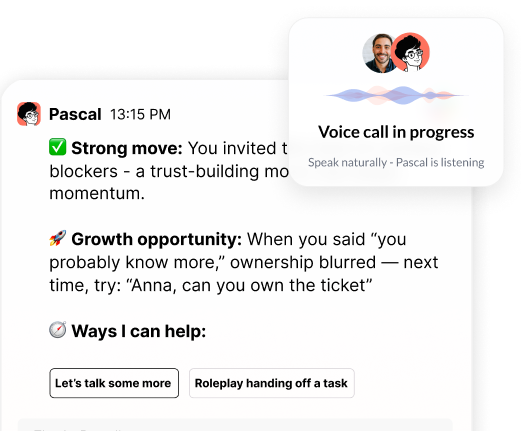
Curious to see how AI Coaching can 10X the impact and scale of your development initiatives. Book a demo today for: