

Privacy-first AI coaching means the platform stores data at the user level, preventing cross-account leakage; never trains on customer data; encrypts everything; escalates sensitive topics to humans; and gives employees transparent control over their information. Organizations that balance contextual data access with robust privacy safeguards see sustained adoption and measurable ROI. Those that don't face breaches, legal exposure, and eroded trust.
Quick Takeaway: Effective AI coaching requires balancing contextual data access with robust privacy safeguards. Data isolation, encryption, escalation protocols, and transparent governance allow organizations to deliver personalized coaching while protecting employee privacy and organizational assets. Purpose-built platforms address this balance; generic tools create unnecessary risk.
The tension between personalization and privacy defines AI coaching in 2025. CHROs want coaching that feels custom rather than templated. Employees want support that understands their challenges without surveillance. The answer isn't maximizing data access. It's being intentional about which data actually improves coaching quality, and how to protect it.
Privacy-first AI coaching means the platform stores data at the user level, preventing cross-account leakage; never trains on customer data; encrypts everything; escalates sensitive topics to humans; and gives employees transparent control over their information. This architectural approach separates purpose-built coaching systems from generic AI tools repurposed for workplace use.
Pinnacle completed its SOC 2 examination, validating controls for security, availability, and confidentiality. User-level data isolation makes it technically impossible for one employee's conversation to expose another's information. Clear escalation protocols for medical issues, terminations, harassment, and grievances ensure appropriate human involvement. Organizations can customize guardrails to match their risk tolerance and policies. Employees can view and edit what the AI knows about them anytime.
This transparency builds trust that generic AI tools cannot match. When managers understand their conversations remain confidential and their data won't train external models, they engage authentically with coaching. That authenticity drives the behavior change that proves ROI.
The risk isn't that AI coaches use company data. It's whether they use it responsibly. Organizations need clear policies defining what data the AI can access, who owns escalation decisions, and what happens if the contract ends. Without governance, even well-intentioned data integration creates liability.
The EU AI Act (mandatory August 2, 2025) requires transparency documentation, risk assessment, and governance structures for high-risk AI systems. CISA's 2025 AI data security guidance emphasizes data-centric controls across the AI lifecycle, including supply-chain vetting and data-quality monitoring. The International Coaching Federation's 2025 AI Coaching Framework establishes that security hinges on the CIA triad: confidentiality (preventing unauthorized access), integrity (protecting data from tampering), and availability (ensuring reliable service).
For AI coaching specifically, governance means documented risk assessments covering how systems handle sensitive coaching content. Clear user-facing policies explaining data collection, storage, and retention practices. Governance structures overseeing vendor selection and incident response before deployment. These aren't compliance theater. They're the foundation that enables confident adoption.
Purpose-built AI coaches recognize when conversations touch legal or ethical minefields and escalate to HR while helping managers prepare for those conversations appropriately. This dual approach protects the organization while maintaining the coaching relationship.
Moderation systems detect toxic behavior, harassment, and mental health indicators automatically. Sensitive topic escalation identifies medical issues, employee grievances, terminations, and discrimination concerns. Pascal escalates conversations about sensitive employee topics to HR while helping users prepare for those conversations. Organizations can customize which topics trigger escalation based on their specific policies. Escalation maintains the coaching relationship rather than creating fear or abandonment. Aggregated, anonymized insights surface to people teams to identify emerging patterns without exposing individual conversations.
This approach differs fundamentally from generic AI tools that treat all queries equally. When a manager asks ChatGPT how to fire someone, they receive comprehensive talking points without legal review. When they ask Pascal, the system recognizes the sensitivity, escalates appropriately, and helps them prepare for an HR conversation instead.
Generic AI tools have no organizational context, no escalation protocols, and may use your data for training. Purpose-built platforms integrate with your systems, understand your culture, and maintain strict privacy boundaries.
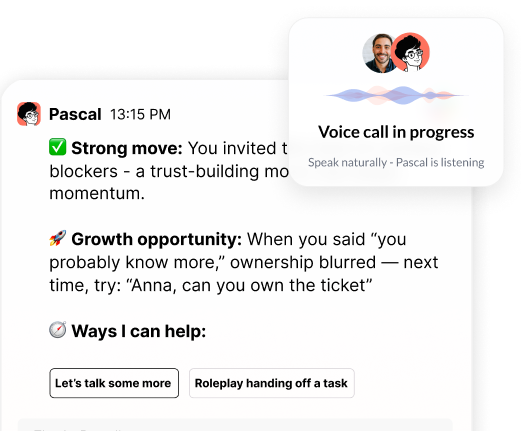
Pascal is designed with core security principles: no chat data is shared, AI is never trained on your data, and there's no risk of data leakage across users. Generic tools treat all queries equally; purpose-built coaches recognize when human expertise is required. Pascal provides personalized guidance grounded in actual organizational context—performance reviews, meeting dynamics, company values. Organizations using context-aware platforms report 94% monthly retention with an average 2.3 coaching sessions per week. 83% of colleagues report measurable improvement in their managers using purpose-built AI coaching.
The difference compounds over time. Generic tools see engagement drop after initial curiosity. Purpose-built systems see sustained usage because relevance drives adoption.
Move beyond vendor assurances to scenario-based testing, contractual verification, and third-party audit reports. Ask specific questions about encryption, data isolation, training policies, and escalation protocols.
Request SOC2 or equivalent security audit reports. Ask vendors how they handle specific sensitive scenarios during demos. Verify data is stored at user level with encryption following NIST standards. Confirm in writing that customer data never trains AI models. Test escalation protocols with realistic scenarios. Review customer references specifically on security, privacy, and escalation effectiveness. Examine whether the platform provides transparency into security architecture, not just compliance checkboxes.
| Evaluation Criterion | What to Ask | Red Flags |
|---|---|---|
| Data Isolation | Is data stored at user level? Can cross-account access happen? | Shared data structures, unclear isolation model |
| Training Data | Is customer data used for model training? In writing? | Vague answers, no written commitment |
| Encryption | What standards? In transit and at rest? | No encryption detail, consumer-grade standards |
| Escalation | How does it handle harassment, medical issues, terminations? | No escalation protocols, treats all topics equally |
| Compliance | SOC2? GDPR? CCPA? Current certifications? | No third-party audit, vague compliance claims |
CHROs must establish governance frameworks before deployment, defining risk tolerance, working with Legal and IT to set escalation thresholds, and ensuring cross-functional alignment on sensitive topic handling. This proactive governance prevents problems rather than managing crises.
Create clear policies on what data AI coaches can access and use. Define escalation triggers and ownership for different categories: performance issues, harassment, mental health. Establish cross-functional governance teams including HR, IT, and Legal. Measure escalation effectiveness through engagement metrics and business outcomes. Champion the strategic value of human expertise alongside AI capabilities.
"By automating routine follow-ups and analysis, AI frees human coaches to focus on empathy, intuition, and strategic reflection. The key is building systems where AI handles what it does well and humans handle what requires judgment."
Jeff Diana, former CHRO at Atlassian and Calendly, emphasizes that successful AI adoption requires cross-functional partnerships between HR, IT, and product teams. The most effective governance treats AI coaching as a strategic initiative requiring intentional leadership, not as a technology procurement decision.
Implementation success requires combining technical safeguards with clear communication and measurement. Organizations that move too fast without governance create problems. Those that move too slowly miss competitive advantage. The answer is deliberate speed with proper foundations.
Start with vendor selection focused on the criteria outlined above. Run a focused one to two month pilot with clear success metrics tied to adoption, engagement, and business outcomes. Communicate transparently about data usage and privacy protections to build employee trust. Measure leading indicators like session frequency and manager confidence alongside lagging indicators like team performance and retention.
Pascal is built with enterprise-grade security at its foundation: user-level data isolation, SOC2 compliance, zero customer data training, and sophisticated guardrails that escalate sensitive topics to your HR team while maintaining confidentiality. The platform integrates into Slack, Teams, and Zoom so coaching happens securely within your organizational perimeter, not in external systems.
The organizations getting this right recognize that privacy isn't a constraint on AI coaching. It's the foundation that enables trust, which drives adoption, which delivers measurable outcomes. When employees trust that their coaching conversations remain confidential and their data won't be exploited, they engage authentically. That authenticity creates the behavior change that proves ROI.

.png)
.webp)
“Thank you for setting the great foundation for my promotion; now I have a plan!"

Curious to see how AI Coaching can 10X the impact and scale of your development initiatives. Book a demo today for: