

Extending AI coaching access beyond executives to all managers drives measurable business outcomes because it addresses the fundamental gap between where coaching is needed most and where it's currently available. Organizations that democratize coaching see faster manager ramp time, higher quality feedback conversations, improved retention, and measurable improvements in team engagement. The economics work—AI coaching costs 1/20th to 1/100th what traditional executive coaching costs—making universal access viable for the first time.
Quick Takeaway: Democratizing coaching beyond the C-suite isn't just equitable—it's a business imperative. When every manager has access to personalized, contextual guidance, organizations accelerate leadership capability at scale, improve team performance, and deliver ROI that traditional training programs can't match. The technology exists, the economics work, and the business case is undeniable.
For decades, coaching has been a luxury reserved for senior leaders. Organizations invest thousands of dollars per executive while first-time managers—the people most likely to struggle and most likely to leave—receive minimal support. This creates a systemic leadership gap that compounds across every level of the organization.
Organizations that extend coaching access to all managers see faster manager ramp time, higher quality feedback conversations, improved retention of high performers, and measurable improvements in team engagement. The cost per manager drops from thousands annually to tens of dollars, making universal access economically viable for the first time.
The coaching industry reached $6.25 billion in 2024 with 109,200 credentialed practitioners, signaling professionalization that supports broader access. Virtual coaching adoption jumped to 72% in 2023 from 40% in 2020, enabling cost-effective, distributed access beyond executives. Organizations with strong manager development see 70% of team engagement variance driven by manager quality alone, yet most first-time managers receive zero formal training.
Pascal customers report 83% of direct reports see measurable improvement in their manager's effectiveness when coaching is accessible daily. One tech company with 50 employees estimated saving 150 hours in manager time during their initial rollout. These aren't abstract metrics—they translate directly to reduced turnover, faster team productivity, and stronger organizational capability.
AI coaching scales personalized, contextual guidance to every manager without the cost constraints of human coaching. By living in Slack and Teams where work happens, it meets managers in moments they actually need support—not in quarterly workshops.
65% of businesses now regularly use AI, with 45% of coaches expecting AI to augment their practice rather than replace it, according to recent industry analysis. Pascal maintains 94% monthly retention with an average of 2.3 coaching sessions per week—engagement rates that traditional digital learning platforms rarely exceed. Traditional executive coaching costs $200–600 per hour; AI coaching at 1/20th to 1/100th that cost enables universal access.
"If we can finally democratize coaching, make it specific, timely, and integrated into real workflows, we solve one of the most chronic issues in the modern workplace."
The difference between generic AI and purpose-built coaching platforms becomes clear when you examine what managers actually need. As Melinda Wolfe explains, managers rarely need help in a workshop—they need it when preparing for a tough 1:1 or in the middle of a team conflict. This is where AI coaching that lives in daily workflows creates value that traditional training can't match.
Democratized coaching drives faster manager effectiveness, improved feedback quality, reduced regrettable attrition, and organizational insights that weren't previously visible. These outcomes directly address CHRO KPIs and connect to business performance.
83% of direct reports report measurable improvement in their manager when coaching is accessible and proactive. 20% average lift in Manager Net Promoter Score among highly engaged Pascal users demonstrates sustained impact. New managers reach baseline effectiveness 30–40% faster with consistent, contextual guidance. Performance review quality improves when every manager has access to coaching on feedback delivery and goal-setting. Organizations can identify emerging team health issues through aggregated coaching patterns before they escalate into formal complaints.
The retention impact alone justifies investment. When managers receive consistent coaching support, their direct reports experience better leadership, which correlates with higher engagement and lower voluntary turnover. For organizations struggling with talent retention, democratized coaching becomes a strategic retention lever.
Three factors converge: AI technology sophisticated enough to understand organizational context, remote work normalizing virtual coaching, and economic pressure forcing CHROs to scale impact without scaling headcount.
72% of coaches now offer virtual options, making geographic and scheduling barriers obsolete. Jeff Diana, former CHRO at Calendly and Atlassian, emphasizes that real learning and value come from in-context coaching—solving problems in the moment, not in a classroom. As Melinda Wolfe states:
"We haven't had the people power to provide this level of guidance. Now we finally do—and it's scalable."
The convergence of these factors means organizations can finally afford what they've always needed: coaching access for every manager. The technology handles the volume, the economics work at scale, and the remote work infrastructure is already in place.
Start with clear outcomes tied to CHRO priorities, pilot with a willing cohort, measure both adoption and behavioral change, and communicate wins early to build momentum.
Begin with the highest-need population: first-time managers or teams with engagement challenges. Measure leading indicators (weekly active users, sessions per manager) alongside outcome metrics (manager effectiveness scores, team engagement). Link coaching investment to retention, time-to-productivity, and feedback quality improvements your organization tracks. Involve HR and IT early; align on governance, data privacy, and escalation protocols for sensitive topics.
Three veteran CHROs recently joined Pinnacle as strategic advisors, bringing decades of experience scaling people programs. Their insight reflects a consistent pattern: organizations that build clear business cases, pilot with intention, and measure rigorously see adoption and impact that exceed expectations.
The business case itself is straightforward. Calculate the cost of manager turnover in your organization. Estimate the productivity impact of improved manager effectiveness. Compare these numbers to the cost of scaling AI coaching to all managers. Most organizations find the ROI is obvious within the first year.
Successful implementations combine purpose-built coaching expertise, contextual awareness of your people and culture, proactive engagement, and integration into existing workflows. Organizations like HubSpot and Zapier are demonstrating what becomes possible when AI coaching is designed specifically for manager development.
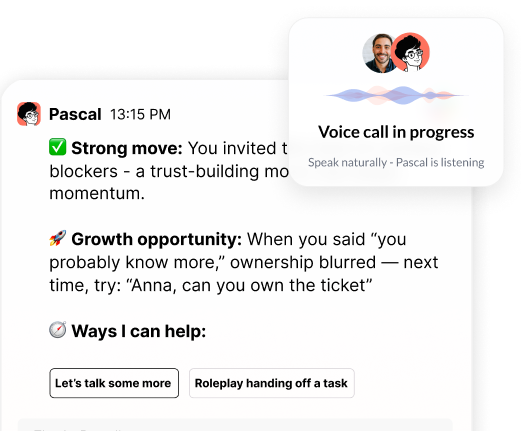
Pascal brings together 50+ proven leadership frameworks, deep integration with your HR systems, and real-time feedback from actual meetings. Most importantly, it lives where managers already work: Slack, Teams, Zoom. When a manager finishes a difficult conversation, they get immediate feedback on what went well and what to adjust next time. This tight feedback loop drives behavior change in ways quarterly training programs never could.
The organizational insights that emerge from scaled coaching represent an underutilized opportunity. When you have visibility into what challenges managers face across your organization, you can make strategic decisions about where to focus development resources, which team dynamics need intervention, and where systemic issues exist before they become crises.
Key Insight: The organizations winning today aren't waiting for perfect clarity. They're piloting purpose-built AI coaching platforms that combine contextual awareness, proactive engagement, and appropriate guardrails—then measuring impact in real time.
Book a demo to see how Pascal democratizes coaching access across your organization and delivers the measurable outcomes your business needs. Discover how purpose-built AI coaching helps new managers develop faster, improves feedback quality across your leadership population, and proves ROI through adoption, behavior change, and team outcomes.

.png)
.webp)
“Thank you for setting the great foundation for my promotion; now I have a plan!"

Curious to see how AI Coaching can 10X the impact and scale of your development initiatives. Book a demo today for: