

The AI-powered learning tools market is too new for universal standards. But early adopters are converging on five data categories that matter: who's using the tool, how deeply they're engaging, whether skills improve, whether behaviors change, and what patterns emerge across teams. This guide explains what each category reveals and how to evaluate vendor claims.
Modern learning platforms track five things: adoption (who uses it and how often), engagement depth (quality of interactions), skill development (competency growth over time), behavioral outcomes (real-world application), and organizational patterns (aggregate trends). Traditional LMS platforms report course completions. AI coaching platforms claim to show whether managers apply feedback frameworks in their next 1-on-1.
Adoption metrics include active users by role, engagement frequency, time to first use, and sustained usage over 30/60/90 days. These numbers reveal whether the tool becomes a habit or collects dust. Some vendors report managers engaging 3-5 times per week when the coach lives in Slack or Teams rather than a separate portal.
Engagement depth measures conversation topics, session length, follow-up questions, and proactive versus reactive interactions. This layer shows whether people have meaningful coaching conversations or check a box. When an AI coach joins meetings and provides real-time feedback, engagement depth metrics track whether managers apply that guidance in subsequent conversations.
Skill development tracking captures competency assessments over time, framework application rates, and personalized learning paths completed. The Ebbinghaus forgetting curve shows people forget most of what they learned within weeks without reinforcement. AI coaching platforms claim to solve this by observing actual team interactions and adapting guidance to individual contexts.
Behavioral outcomes measure post-coaching action rates, meeting effectiveness scores, and direct report feedback improvements. Some vendors report 83% direct report improvement rates. (Ask for methodology, sample size, and independent verification before trusting any vendor's self-reported numbers.)
Organizational insights provide anonymized aggregate trends by department, common skill gaps, and areas requiring intervention. One vendor case study describes a tech company that deployed an AI coach and within 60 days identified that mid-level engineering managers struggled with goal-setting conversations. The L&D team created targeted content, and the AI surfaced it before quarterly planning meetings.
Data Breakdown:
• Metric Category: Adoption | Traditional LMS: Course enrollment numbers | AI Coaching Platform: Daily active users, proactive engagement triggers
• Metric Category: Engagement | Traditional LMS: Completion rates, time on platform | AI Coaching Platform: Conversation depth, topic diversity, follow-through
• Metric Category: Skill Development | Traditional LMS: Quiz scores, certificate completion | AI Coaching Platform: Competency application in real scenarios, behavioral scoring
• Metric Category: Business Impact | Traditional LMS: Training hours delivered | AI Coaching Platform: Manager NPS improvement, direct report feedback scores, time saved
• Metric Category: Organizational Insights | Traditional LMS: Department-level completion reports | AI Coaching Platform: Real-time skill gap identification, cultural trend analysis
Behavioral data captures what people do after learning. Traditional training metrics measure inputs: hours of training delivered, completion rates, satisfaction scores. Behavioral data measures outcomes: did the manager have a better performance conversation, did the team's engagement scores improve, did the direct report receive clearer feedback.
Some AI coaching platforms attend meetings and observe Slack conversations to track whether a manager applies a coaching framework, provides specific feedback using company values, or navigates a difficult conversation. (Ask vendors exactly how this works: Is it recording audio? Transcribing? Reading every message? What's stored and for how long?)
The ROI proof shifts from "500 managers completed communication training" to "managers who engaged with AI coaching saw 20% higher direct report satisfaction scores within 90 days." CHROs need to justify L&D budgets with business outcomes, not activity reports.
AI coaching claims to solve the skill decay problem by reinforcing learning in the flow of work. The platforms surface relevant guidance before critical moments—before a difficult conversation, during a conflict, when setting team goals.
Track daily active users, engagement frequency by role and tenure, proactive versus reactive interaction ratios, and sustained usage beyond 30 days. The critical metric is whether the tool becomes a daily habit.
Active usage rate measures the percentage of licensed users engaging weekly. Target 60% or higher for manager populations. Anything below 40% signals poor integration into workflow or lack of perceived value. (Ask vendors for their median customer active usage rate, not their best customer.)
Engagement frequency tracks average interactions per user per week. AI coaching vendors claim 3-5 interactions weekly. LMS platforms typically see less than one. This difference matters because behavior change requires repetition and reinforcement.
Time to value measures days from onboarding to first meaningful interaction. Some platforms achieve this in under 7 days through proactive meeting attendance—managers don't need to remember to use the tool because it shows up in their calendar. Traditional platforms require weeks of onboarding and often never achieve meaningful engagement.
Retention curves show the percentage still engaging at 30/60/90 days, indicating habit formation versus novelty effect. A spike in the first week followed by a cliff drop signals poor workflow integration. Sustained engagement curves indicate the tool has become essential to how people work.
Proactive engagement ratio measures the percentage of interactions initiated by the AI versus user-initiated. Some vendors claim proactive approaches achieve 40% higher retention and 60% faster goal achievement. (Ask for the research citation. If they can't provide it, the claim is marketing.)
Red flags in adoption data include high variance by department (suggesting inconsistent manager sponsorship), low engagement from target populations like new managers while high engagement from unexpected groups, and rapid drop-off after initial novelty.
AI learning tools embedded in daily work claim to provide continuous, real-time visibility into team health, skill gaps, and cultural dynamics. The promise is replacing quarterly engagement surveys with always-on organizational intelligence. Anonymized, aggregated insights might reveal patterns like "mid-level managers in the Boston office are struggling with delegation" without exposing individual data.
Traditional engagement surveys provide occasional snapshots. By the time you analyze results and plan interventions, the data is stale. AI coaching platforms that observe actual work claim to provide continuous signals.
Skill gap identification shows which competencies are most requested across the organization, revealing training priorities. If 200 managers ask an AI coach for help with difficult conversations in a given month, that signals where to invest in targeted training. Traditional needs assessments rely on manager self-reporting.
Cultural patterns identify departments or teams with elevated stress, conflict, or communication challenges requiring intervention. Some platforms detect patterns like increased conflict language in team Slack channels or managers repeatedly asking for help with the same direct report.
Manager effectiveness patterns correlate coaching engagement with direct report satisfaction, performance review quality, and retention. This data claims to prove which interventions work. When you can show that managers who engaged with AI coaching for 90 days saw 20% higher team engagement scores, you've proven ROI in a way traditional training never could. (Again: ask for methodology and independent verification.)
Training ROI measurement tracks whether specific workshops or programs lead to sustained behavioral change. Some platforms observe whether managers apply learned frameworks in real meetings, providing evidence of training effectiveness.
Succession planning signals surface high-potential employees seeking development, managers struggling with team dynamics, and skill gaps that might prevent internal promotions.
Demand SOC2 compliance, explicit commitments that customer data never trains AI models, and transparent data handling policies before evaluating any other features. Security is table stakes for any AI tool accessing workplace communications and performance data.
Many AI tools use customer interactions to improve their algorithms, creating potential data leakage risks. When managers discuss sensitive performance issues or confidential business information with an AI coach, that data must stay within your organization's control. Ask vendors explicitly: Does our data train your models? Where is it stored? Who has access?
Data residency determines where your data is stored and processed. Ensure the vendor can meet your geographic and regulatory requirements. Some industries require data to remain within specific jurisdictions.
Anonymization and aggregation protect individual privacy while providing organizational insights. Best practice is surfacing aggregate trends by department but never reporting individual coaching conversations to HR. This confidentiality is essential for building trust—employees won't use the tool if they think HR is monitoring their individual interactions.
Access controls determine who can see what data. Establish clear policies about what HR leaders can access versus what remains private. Provide organizational insights and trends to leadership while keeping individual coaching conversations confidential unless there's a specific escalation trigger.
Escalation protocols define when and how the AI surfaces sensitive situations to human HR. Look for moderation flags for concerning topics and escalation paths for situations requiring human expertise—harassment, discrimination, mental health crises, or legal risks. The AI should recognize its limitations and involve humans when appropriate.
• AI-powered learning tools are too new for universal standards, but early adopters track five data layers: adoption metrics, engagement depth, skill development, behavioral outcomes, and organizational patterns
• Behavioral data showing actual application of skills matters more than traditional training metrics measuring activity—but verify vendor claims with methodology and independent research
• Track daily active users, engagement frequency, and sustained usage beyond 30 days to ensure the tool becomes a habit
• AI coaching platforms claim to provide continuous organizational intelligence that replaces quarterly surveys—evaluate these claims carefully and ask for customer references
• Prioritize SOC2 compliance and explicit commitments that customer data never trains AI models before evaluating any other platform features
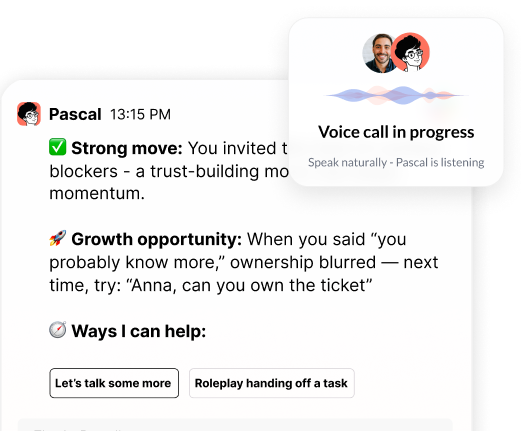
Pascal delivers real-time coaching and organizational insights directly in Slack, Teams, and meetings. Explore Pascal's approach to AI coaching.
Header photo by Vitaly Gariev on Unsplash

.png)
.webp)
“Thank you for setting the great foundation for my promotion; now I have a plan!"

Curious to see how AI Coaching can 10X the impact and scale of your development initiatives. Book a demo today for: