

The difference between an AI coach that transforms manager effectiveness and one that gets abandoned within weeks comes down to one thing: whether it knows your people, your culture, and how work actually happens in your organization. Effective AI coaching systems integrate four data layers—individual employee information, organizational knowledge, real-time work patterns, and temporal context—to eliminate friction and drive measurable behavior change that generic tools simply cannot match.
Quick Takeaway: Purpose-built AI coaches synthesize performance reviews, career goals, team feedback, company values, meeting transcripts, and communication patterns to deliver guidance grounded in observable behavior rather than generic frameworks. Without this foundation, coaching remains irrelevant and managers abandon the tool. With it, organizations see 83% of direct reports reporting measurable improvement in their managers, with 20% average lifts in Manager Net Promoter Score among highly engaged users.
Effective AI coaches synthesize performance reviews, career goals, team feedback, company values, meeting transcripts, and communication patterns to deliver guidance grounded in observable behavior rather than generic frameworks. Without this foundation, coaching remains irrelevant and managers abandon the tool.
Performance reviews and 360 feedback reveal development patterns and actual strengths, not self-reported preferences. Career aspirations and role information enable coaching tailored to individual goals and organizational context. Company values, competency frameworks, and culture documentation ensure guidance reinforces your specific leadership expectations. Meeting transcripts and communication patterns from Slack, Teams, or Zoom show how leadership actually works in practice. Organizations using AI-powered training with company-specific data report 57% higher course completion rates, 60% shorter completion times, and 68% higher satisfaction scores.
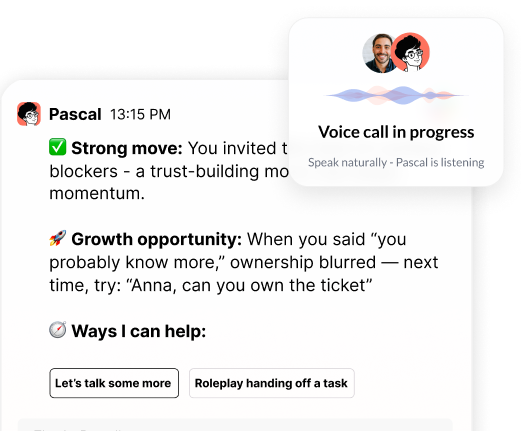
Pascal, Pinnacle's AI coach, demonstrates this principle by integrating performance data with real-time observational learning. When a manager asks for delegation coaching, Pascal doesn't offer generic frameworks. Pascal knows whether this manager tends to over-explain tasks, which team members are ready for stretch assignments, and current project pressures creating bottlenecks. The guidance becomes immediately actionable because it's grounded in observable behavior and real team dynamics.
ChatGPT and similar tools provide one-size-fits-all advice because they lack knowledge of your people, culture, and actual work patterns. Managers quickly recognize the mismatch and abandon the tool because the guidance doesn't apply to their specific situation.
Generic tools require managers to repeatedly explain team dynamics, performance history, and organizational norms before receiving useful guidance. 57% of professional coaches believe AI cannot deliver real coaching when divorced from organizational context. When coaching guidance conflicts with organizational norms, managers face an impossible choice: follow the AI's advice and violate cultural expectations, or ignore the tool entirely. Managers engage with contextual AI coaches 2.3 times per week on average with 94% monthly retention, compared to single-digit engagement with generic tools.
Three veteran CHROs recently joined Pinnacle as strategic advisors specifically because they recognized that purpose-built platforms with proper context deliver measurably better outcomes than generic tools.
Purpose-built AI coaches connect to your HRIS, performance management systems, communication platforms, and company documentation through secure integrations, then synthesize this information into contextual understanding that improves with every interaction.
Individual context includes role, level, career goals, past performance feedback, and communication preferences. Organizational context encompasses values statements, competency models, culture documentation, and leadership principles. Relational context covers team composition, reporting structures, collaboration patterns observed through actual meetings. Temporal context captures performance review cycles, goal-setting seasons, current projects, and historical coaching continuity. Melinda Wolfe, former CHRO at Bloomberg and Pearson, emphasizes that "if we can finally democratize coaching, make it specific, timely, and integrated into real workflows, we solve one of the most chronic issues in the modern workplace".
Personal health information, family details, and sensitive demographic data create compliance risk without improving coaching quality. Purpose-built platforms practice data minimization—accessing only work-related context necessary to deliver useful guidance.
Extra demographic or sensitive data can increase algorithmic bias without improving guidance quality. Employees need transparency about what data the AI accesses and explicit control over their information. By 2027, at least one global company is predicted to face an AI deployment ban due to data protection non-compliance. Effective platforms isolate coaching conversations at the user level, making cross-employee data leakage technically impossible.
The most effective AI coaches store data at the user level with enterprise-grade encryption, maintain explicit consent protocols, include escalation procedures for sensitive topics, and never train AI models on customer data. This architecture ensures personalization doesn't create surveillance concerns.
Data encrypted and stored individually prevents information from leaking across accounts. Coaching conversations remain confidential unless the employee explicitly shares insights. Automatic escalation for sensitive topics like harassment, medical issues, or terminations ensures appropriate human expertise engages. Companies like HubSpot, Zapier, and Marriott succeeded by embedding AI into existing workflows and making clear that the technology augments rather than replaces human judgment.
Organizations using contextual AI coaching report faster manager ramp time, higher quality feedback conversations, and sustained behavior change because relevance drives immediate application. 83% of direct reports report measurable improvement in their managers, with 20% average lift in Manager Net Promoter Score among highly engaged users.
34% time savings per employee monthly (45 hours) when AI handles routine coaching frees HR teams for strategic work. One tech company estimated 150 hours saved in the first quarter with a 50-person rollout. Sustained engagement stems directly from coaching relevance; managers return because guidance addresses their actual challenges. Jeff Diana, former CHRO at Calendly and Atlassian, notes that "so much of the real learning and value comes from in-context coaching in the moment to drive performance and solve problems in the moment".
| Data Layer | What It Includes | Impact on Coaching Quality |
|---|---|---|
| Individual employee information | Role, goals, performance history, career aspirations | Personalizes guidance to specific development needs |
| Organizational knowledge | Values, competencies, culture documentation | Ensures coaching reinforces organizational priorities |
| Real-time work patterns | Meeting dynamics, communication style, team interactions | Enables proactive feedback on observable behavior |
| Temporal context | Performance cycles, goal-setting seasons, current projects | Surfaces coaching at moments of maximum relevance |
The organizations winning with AI coaching recognize that context isn't a luxury feature. It's the foundation that makes guidance relevant, builds trust that drives adoption, and enables proactive support that changes behavior. When managers don't need to repeatedly explain their situation, friction disappears and adoption becomes natural. AI coaching that understands your organization's context delivers guidance specific to your people and culture, grounded in actual development needs rather than hypothetical scenarios.
Ready to see how contextual AI coaching actually works in your organization? Book a demo with Pascal to explore how purpose-built AI coaching integrates your organizational data—performance metrics, team dynamics, company values—to deliver personalized guidance that managers trust and apply immediately, while maintaining enterprise-grade privacy and security.

.png)
.webp)
“Thank you for setting the great foundation for my promotion; now I have a plan!"

Curious to see how AI Coaching can 10X the impact and scale of your development initiatives. Book a demo today for: