

An AI coach that knows nothing about your people delivers generic advice managers ignore within weeks. An AI coach that knows everything creates privacy nightmares and erodes trust. The real question is how much context actually improves coaching outcomes, and what safeguards make that safe.
Quick Takeaway: Effective AI coaches need four distinct layers of context—individual employee data (role, goals, performance history), organizational knowledge (values, competencies, culture), real-time work patterns (meeting dynamics, communication style), and temporal context (current projects, upcoming milestones)—to eliminate friction and deliver personalized guidance that managers actually apply. Without this foundation, coaching remains generic and managers abandon the tool within weeks.
Managers engage with contextual AI coaches 2.3 times per week on average, compared to single-digit engagement with generic tools. When managers don't need to repeatedly explain their situation, friction disappears and adoption becomes natural. The distinction between context-aware and context-blind AI coaching determines whether your investment becomes a trusted daily resource or another underutilized tool.
Effective AI coaches need four distinct layers of context to deliver personalized guidance that managers trust enough to apply immediately. Individual context includes role, tenure, career aspirations, and communication preferences. Organizational context encompasses company values, competency frameworks, and culture documentation. Relational context covers team composition, reporting structures, and collaboration patterns. Temporal context captures recent feedback, ongoing projects, and historical coaching continuity.
When these layers integrate, coaching becomes immediately actionable. Rather than offering generic frameworks, a contextual AI coach can reference specific moments from recent conversations and suggest concrete improvements grounded in observed behavior. Organizations using contextual AI coaching report 83% of direct reports seeing measurable improvement in their managers, with highly engaged users showing a 20% lift in Manager Net Promoter Score. This dramatic difference stems from relevance—when guidance addresses a manager's actual situation within their actual culture, they implement it immediately.
Generic AI platforms like ChatGPT provide the lowest common denominator of leadership advice because they lack knowledge of your people, culture, and actual work patterns, forcing managers to repeatedly explain situations before receiving any useful guidance.
Only 29% of coaches report using company data directly in AI-driven sessions; 71% rely on self-reported information or generic benchmarks, stripping away organizational nuance. When coaching guidance conflicts with organizational norms, managers face an impossible choice: follow the AI's advice and violate cultural expectations, or ignore the tool entirely. Most choose the latter. When managers don't need to repeatedly explain their situation, friction disappears and adoption becomes natural.
The engagement data tells the story. Managers engage with contextual AI coaches 2.3 times per week on average, compared to single-digit engagement with generic tools. This sustained usage reflects coaching relevance that managers trust enough to return to consistently. Context eliminates the friction that kills adoption.
Personal health information, family details, and sensitive demographic data create compliance risk without improving coaching quality. Purpose-built platforms practice data minimization—accessing only work-related context necessary to deliver useful guidance.
Extra demographic or sensitive data can increase algorithmic bias without improving guidance quality. By 2027, at least one global company is predicted to face an AI deployment ban due to data protection non-compliance, underscoring why robust privacy architecture can't be an afterthought. Effective platforms isolate coaching conversations at the user level, making cross-employee data leakage technically impossible.
Link AI into platforms employees already use (HRIS, Slack, Teams, LMS) to gather contextual data, then enforce strict privacy controls, user-level data isolation, and transparent governance that delivers personalization while respecting boundaries.
Data stored at the user level prevents information from leaking across accounts. Never use customer data for AI model training; this protects confidentiality and prevents your organizational insights from improving competitors' systems. Clear communication about what data informs coaching, why it's needed, and who can access it removes adoption barriers.
| Data Source | Coaching Value | Privacy Considerations |
|---|---|---|
| Performance reviews and goals | Personalizes feedback and development planning | Moderate risk, requires access controls |
| Team structure and role information | Enables team dynamics awareness | Low risk, generally non-sensitive |
| Company values and competencies | Aligns coaching with organizational culture | Low risk, typically public internally |
| Meeting transcripts and communication patterns | Identifies coaching moments and behavioral patterns | Moderate risk, requires transparency |
Sophisticated AI coaches recognize when situations require human judgment and create smooth escalation pathways rather than attempting to handle everything algorithmically, flagging terminations, harassment, mental health concerns, and other sensitive topics for HR involvement.
Moderation filters detect toxic behavior and flag concerning patterns while maintaining individual privacy. Sensitive topic detection identifies employee grievances, medical issues, and legal risks that require HR involvement. The International Coaching Federation's 2024 ethics update requires AI coaches to maintain confidentiality, disclose their use, and align with core coaching values, which means limiting data access to what's professionally necessary.
Key Insight: The most sophisticated AI coaches include guardrails that recognize boundaries and escalate appropriately, building trust rather than creating surveillance concerns. When conversations touch on mental health concerns, harassment, discrimination, or other topics requiring human expertise, the AI escalates to HR rather than attempting to provide guidance on matters requiring human judgment and legal expertise.
Contextual AI coaching maintains 94% monthly retention with an average of 2.3 coaching sessions per week, far exceeding typical digital learning completion rates because managers receive guidance immediately applicable to their actual situations.
Organizations that prioritize contextual data integration while maintaining robust privacy safeguards see adoption rates above 90% and measurable improvements in manager effectiveness that justify continued investment. Companies like HubSpot, Zapier, and Marriott succeeded by embedding AI into existing workflows and making clear that the technology augments rather than replaces human judgment.
"So much of the real learning and value that comes from this comes from in-context coaching in the moment to drive performance and to solve problems in the moment."
This principle explains why context matters so much. When coaching arrives at moments of maximum relevance, managers apply it immediately. When coaching arrives weeks later in a training module, managers forget the lessons or struggle to translate them into their specific context. Three veteran CHROs recently joined Pinnacle as strategic advisors specifically because they recognized that purpose-built platforms with proper context, guardrails, and organizational alignment deliver measurably better outcomes than generic tools.
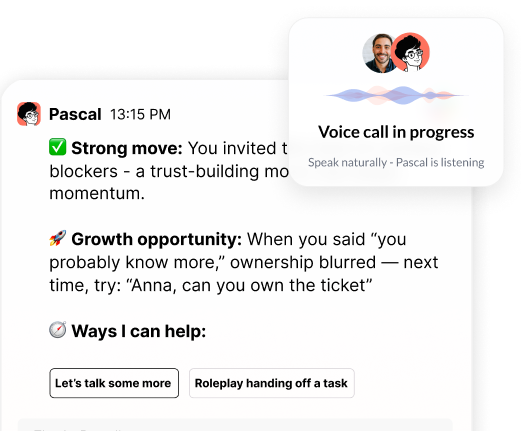
The difference between generic AI and purpose-built coaching comes down to context. Pascal integrates with your HRIS, performance systems, and communication tools to understand your people and culture, then delivers personalized guidance in Slack, Teams, or Zoom without requiring managers to explain situations repeatedly. With customizable guardrails, user-level data isolation, and proper escalation for sensitive topics, you get the context advantage without the compliance risk.
Ready to see how contextual AI coaching actually works with the right amount of data access and proper safeguards? Book a demo with Pascal to explore how purpose-built AI coaching leverages your organizational data—performance metrics, team dynamics, company values—to deliver personalized guidance that managers trust and apply immediately, while maintaining enterprise-grade privacy and security.

.png)
.webp)
“Thank you for setting the great foundation for my promotion; now I have a plan!"

Curious to see how AI Coaching can 10X the impact and scale of your development initiatives. Book a demo today for: