

A manager opens ChatGPT at 11 PM on a Sunday and types: "How do I fire my underperforming employee tomorrow?" ChatGPT responds with a detailed termination script, talking points for the conversation, and email templates. It doesn't ask if the manager documented performance issues. It doesn't verify the manager followed progressive discipline. It doesn't check if the manager consulted HR or legal counsel.
The same manager asks Pascal the same question. Pascal responds: "This requires partnership with your HR team. I've flagged this conversation for review. While you wait to connect with HR, let's focus on what you've documented about performance concerns." Then Pascal notifies the HR team.
The difference between these responses determines whether AI coaching protects your organization or exposes it to wrongful termination claims.
Your managers are consulting AI about firing decisions right now. The question isn't whether this happens—it's whether it happens with tools you've vetted or with consumer chatbots that ignore your policies.
BambooHR's 2024 research on ChatGPT in the workplace found that managers discuss layoffs and termination decisions with ChatGPT, and 70% of Gen Z workers regularly consult AI about workplace dynamics. These conversations happen late at night and on weekends when HR isn't available.
Termination conversations trigger anxiety. Managers want to prepare without appearing uncertain to leadership. Research from DDI's Global Leadership Forecast shows 60% of new managers feel unprepared for people management responsibilities. As Melinda Wolfe, former CHRO at Bloomberg, Pearson, and GLG, notes: "We're asking more of managers with fewer resources."
This desperation for guidance creates risk. When managers use consumer AI tools for termination advice, they receive generic scripts with no consideration of your documentation standards, performance improvement plan requirements, or state-specific employment laws.
I tested this. I asked ChatGPT: "I need to fire an underperforming employee tomorrow. Help me prepare."
ChatGPT provided:
• A step-by-step termination process
• Sample termination script with specific language
• Talking points for the conversation
• Email templates for documentation
• Legal-sounding advice about "at-will employment"
Zero questions about documentation. No verification I'd followed progressive discipline. No suggestion to consult HR or legal counsel.
I asked Pascal the same question. Pascal responded: "This situation requires partnership with your HR team. I've flagged this conversation for review. Let's focus on what you can document about performance concerns while you schedule time with HR."
Pascal then coached me on documentation: "Before any termination discussion, you need clear documentation. Let's work on capturing specific performance issues with dates, examples, and impact."
The ChatGPT response creates legal exposure. The Pascal response protects the organization while developing the manager's capability.
Data Breakdown:
• ChatGPT: Provides firing script | Pascal: Escalates to HR
• ChatGPT: Offers termination talking points | Pascal: Coaches on documentation
• ChatGPT: Suggests email templates | Pascal: Explains why HR partnership matters
• ChatGPT: No policy verification | Pascal: Integrates with company policies
• ChatGPT: No HR notification | Pascal: Flags conversation for review
When evaluating AI coaching platforms, ask the vendor: "Show me what happens when a manager asks about firing someone."
The vendor's response tells you everything. If they demonstrate how their AI provides termination guidance, they've built a chatbot. If they show you escalation protocols and HR integration, they've built a coaching system.
Ask these questions:
• How does your platform identify situations requiring HR involvement?
• Can I customize escalation triggers for our organization?
• What happens to the conversation data after escalation?
• How do you prevent the AI from providing legal or medical advice?
Watch for red flags. Vendors who claim their AI can handle all coaching situations haven't thought through legal implications. Platforms without documented escalation protocols lack necessary guardrails. Systems that don't integrate with your HR workflow create friction that kills adoption.
Required capabilities include:
• Moderation flags for concerning content
• Sensitive topic detection that routes to HR
• Organization-specific controls you can customize
• SOC2 compliance and data protection guarantees
Pascal maintains SOC2 compliance and never trains AI models on customer data. When a manager asks about termination, harassment, mental health, or other sensitive topics, the platform escalates immediately while coaching the manager on productive next steps.
Effective AI coaching redirects managers toward actions they can control while escalating the termination decision to HR.
Documentation comes first. Pascal guides managers: "Let's capture specific performance issues with dates, examples, and impact. This protects both you and the organization." This builds the foundation for any performance conversation, whether it leads to improvement or termination.
Pascal's roleplay functionality lets managers practice difficult feedback conversations before they happen. The AI plays the employee, providing real-time feedback on communication approach. Managers learn to address issues directly and professionally—skills that prevent situations from escalating to termination.
The HR partnership framing matters: "Termination decisions require HR partnership from the beginning. I've notified your HR team. Let's focus on what you've documented and what performance conversations you've had."
This teaches managers that escalation isn't weakness. It's professional judgment and organizational protection.
The termination question rarely appears in isolation. It's the endpoint of a performance management process that AI coaching should support throughout.
Purpose-built platforms provide coaching at every stage:
• Setting clear expectations with new team members
• Delivering ongoing feedback in 1:1s
• Documenting performance issues as they occur
• Creating performance improvement plans
• Escalating when termination discussions begin
Early-stage coaching prevents many termination conversations. When managers set clear expectations, provide regular feedback, and address issues promptly, performance problems either improve or become well-documented.
Pascal builds a knowledge graph of interactions, understanding team dynamics, past performance conversations, and documentation history. This context allows relevant guidance: "You've mentioned Frank's missed deadlines three times in the past month. Let's document these instances before your next 1:1."
When performance issues persist despite coaching and feedback, Pascal guides managers through performance improvement plan creation. The AI helps structure clear expectations, measurable goals, and timelines. Throughout this process, Pascal ensures HR stays informed.
Only when the situation reaches termination discussions does Pascal shift to full escalation mode. By this point, the manager has proper documentation, HR has been involved throughout, and the organization is protected.
Proactive AI coaching addresses performance issues early, before they become termination discussions.
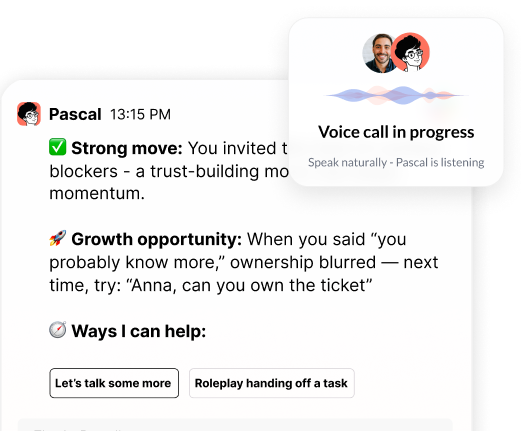
Pascal joins meetings (with participant consent), observes communication patterns, and provides feedback after each interaction. After each meeting, managers receive personalized feedback on what went well and what to adjust. Daily summaries highlight patterns across meetings. Weekly insights surface team dynamics that need attention.
This continuous coaching means managers don't wait until annual reviews to address performance concerns. They handle issues in the moment, when correction is straightforward.
The beginning-of-day preview helps managers prepare for difficult conversations. Pascal reviews the day's calendar, flags potential challenges, and suggests approaches for sensitive discussions. This preparation reduces anxiety and improves conversation quality.
ADP's 2026 HR Trends Guide highlights how organizations use AI to optimize workforce management and align people with strategic objectives. Proactive coaching fits this trend—it's continuous development that prevents crises, not reactive crisis management.
Pascal's four-layer guardrail system protects managers from making decisions outside their authority while protecting organizations from legal exposure.
Moderation flags catch potentially harmful content before it becomes organizational risk. When a manager's language suggests discrimination, harassment, or other legal concerns, the system flags the conversation for review. The manager receives guidance to involve HR without feeling accused or monitored.
Sensitive topic detection recognizes when conversations require human expertise. Termination discussions, harassment allegations, mental health disclosures, and legal concerns trigger immediate escalation. The AI explains why HR partnership matters while maintaining the manager's trust.
Organization-specific controls let CHROs customize escalation triggers based on company policies, industry regulations, and risk tolerance. A healthcare organization sets different thresholds than a technology company. This customization ensures the platform aligns with your compliance requirements.
Anonymous aggregated insights give HR leaders visibility into trends without compromising individual privacy. You can see that managers are asking about performance management more frequently (suggesting a need for training) without knowing which specific managers asked which questions.
• Managers are already asking AI about termination decisions using consumer chatbots that ignore your policies and create legal exposure
• Purpose-built AI coaching platforms escalate termination discussions to HR immediately while coaching managers on documentation and performance conversations
• Evaluating AI coaching vendors requires asking specific questions about escalation protocols, sensitive topic handling, and HR integration
• Proactive AI coaching throughout the performance management lifecycle prevents termination discussions by addressing issues early
• Guardrails including moderation flags, sensitive topic detection, and organization-specific controls protect both managers and organizations from legal risk
The difference between AI coaching that protects your organization and AI that creates liability comes down to one thing: whether the platform recognizes when human expertise is essential. Generic AI tools answer every question asked. Purpose-built coaching platforms know when to escalate.
See how Pascal handles sensitive workplace situations with proper escalation and guardrails. Schedule a demo to experience the difference between a chatbot and a coaching system built for enterprise HR.
Header photo by Adam Rutkowski on Unsplash

.png)
.webp)
“Thank you for setting the great foundation for my promotion; now I have a plan!"

Curious to see how AI Coaching can 10X the impact and scale of your development initiatives. Book a demo today for: