

Slack, Teams, Zoom, and Google Meet integrations determine whether your AI coach becomes a daily habit or unused software. These connections deliver guidance in the flow of work rather than requiring managers to visit another portal.
Integration means connecting the platform to systems where work happens and where employee data lives. The AI coach observes behavior, understands organizational context, and delivers guidance without requiring managers to adopt new tools.
Surface-level integrations pull static data (job titles, org charts, performance ratings) but require managers to visit a separate portal and manually explain situations. Deep integrations embed the coach in communication platforms, join meetings, and build understanding of relationships, communication patterns, and team dynamics.
The integration architecture determines adoption rates. Platforms requiring separate logins see engagement drop within months. Embedded solutions meet managers where they work. Integration determines whether the AI coach has enough context to eliminate the friction of repeatedly explaining your situation, team dynamics, and organizational culture.
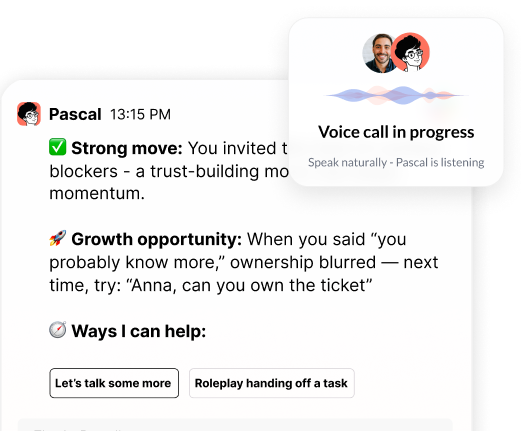
Communication platforms (Slack, Microsoft Teams) and meeting tools (Zoom, Google Meet) drive the highest adoption because they eliminate the barrier of visiting another application. The AI coach delivers feedback immediately after meetings and responds to questions directly in Slack or Teams where managers spend their day.
Communication platforms enable the AI coach to deliver proactive feedback, answer questions in real-time, and become part of daily workflow rather than another tool to remember. These integrations transform coaching from something managers do when they remember to something that happens throughout their day.
Meeting tools allow the coach to observe interactions, provide post-meeting feedback on communication patterns, and help managers prepare for difficult conversations. When the AI coach joins your meetings, it builds understanding of how you communicate, who you work with, and where you need support.
Calendar systems enable meeting preparation, identify patterns in how managers spend time, and trigger proactive coaching before high-stakes conversations. Integration with calendars allows the AI coach to understand your schedule, prepare you for upcoming meetings, and recognize when you're overcommitted.
HRIS and performance management systems (Lattice, Workday, Culture Amp) provide context like job titles, performance history, career goals, and competency frameworks that personalize coaching to your organization's development priorities.
Data Breakdown:
• Integration Type: Slack/Teams | Adoption Impact: Critical | Coaching Quality Impact: High | Implementation Complexity: Low
• Integration Type: Zoom/Meet | Adoption Impact: Critical | Coaching Quality Impact: Very High | Implementation Complexity: Medium
• Integration Type: Calendar | Adoption Impact: High | Coaching Quality Impact: Medium | Implementation Complexity: Low
• Integration Type: HRIS/Performance | Adoption Impact: Medium | Coaching Quality Impact: High | Implementation Complexity: Medium-High
• Integration Type: Learning Management | Adoption Impact: Low | Coaching Quality Impact: Medium | Implementation Complexity: Medium
Prioritize communication platform integration (Slack or Teams) first because it determines whether managers use the AI coach daily. Add HRIS integration second to deepen personalization and organizational context. A coach embedded in Slack with limited HRIS data will see higher adoption than a coach with complete HRIS integration that requires visiting a separate portal.
Managers won't use even the most contextually aware coach if accessing it requires breaking their workflow. Communication platform integration removes this barrier. HRIS integration enhances quality by providing performance history, career goals, competency frameworks, and organizational structure, but it doesn't drive initial adoption.
The optimal implementation sequence: (1) Deploy in communication platforms to establish daily usage habits, (2) Add meeting tool integration to provide real-time coaching value, (3) Connect HRIS systems to personalize guidance based on performance data and career goals, (4) Integrate learning management and other systems as usage patterns emerge.
AI coaching platforms must maintain SOC2 compliance, implement user-level data isolation, never train foundational models on customer data, and provide clear escalation paths for sensitive topics that require human expertise.
SOC2 compliance ensures the platform meets enterprise security standards for handling sensitive employee data. This certification demonstrates the vendor has implemented proper controls for data security, availability, processing integrity, confidentiality, and privacy.
User-level data isolation means each employee's coaching conversations, meeting observations, and development data remain separate and protected. The AI coach can reference organizational knowledge (values, competencies, policies) while keeping individual coaching interactions private.
Model training policies determine whether your employee data becomes training material for the vendor's AI models. Enterprise-grade platforms never use customer data to train foundational models, ensuring your competitive information, employee conversations, and organizational knowledge remain confidential.
Escalation protocols for sensitive topics (harassment, discrimination, mental health crises) ensure appropriate human expertise gets involved when AI coaching reaches its limits. The moderation system should flag sensitive topics and provide clear pathways to HR business partners, employee assistance programs, or other appropriate resources.
Ask vendors whether their AI coach actively participates in meetings or analyzes transcripts afterward, how they handle data privacy across integrated systems, what happens when the coach encounters topics requiring human expertise, and whether they can demonstrate sustained adoption rates beyond the first 90 days.
Meeting participation depth: Does the coach join meetings in real-time to observe interactions, or does it only analyze transcripts hours later? Real-time participation enables immediate post-meeting feedback and builds the contextual understanding that makes coaching relevant.
Data privacy architecture: How is employee data isolated and protected across integrated systems? What happens to your data if you terminate the contract? Can employees delete their coaching history? These questions reveal whether the vendor has built enterprise-grade privacy controls or connected APIs without considering data governance.
Escalation protocols: What happens when an employee discusses harassment, discrimination, or mental health crises with the AI coach? Does the platform have moderation systems and clear pathways to appropriate human resources? The absence of these safeguards creates organizational risk.
Sustained adoption evidence: What percentage of users are still actively engaging after 90 days? Can they show you adoption curves from similar organizations? Vendors with embedded solutions will have data demonstrating sustained usage, while portal-based tools show declining engagement.
Ask vendors to provide customer references in your industry. Talk to three current customers about their experience with integrations, adoption rates, and whether the platform delivered the promised value.
• Communication platform integrations (Slack, Teams) and meeting tool connections (Zoom, Google Meet) are the highest-priority integrations because they determine whether managers use the AI coach daily
• Deep integrations that embed the coach in workflow drive higher retention than portal-only solutions
• Prioritize communication platform integration first to establish usage habits, then add HRIS integration to deepen personalization with performance data and career goals
• Enterprise-grade platforms must maintain SOC2 compliance, implement user-level data isolation, never train models on customer data, and provide escalation protocols for sensitive topics
• Ask vendors for customer references and adoption data beyond 90 days to verify their integration strategy delivers sustained value
Ready to see how the right integration strategy delivers measurable manager effectiveness? See how Pascal works inside Slack and discover why organizations choose embedded coaching solutions.
Header photo by Amy Hirschi on Unsplash

.png)
.webp)
“Thank you for setting the great foundation for my promotion; now I have a plan!"

Curious to see how AI Coaching can 10X the impact and scale of your development initiatives. Book a demo today for: