

AI coaching is a purpose-built system designed specifically for workplace leadership development that integrates organizational context, behavioral data, and proven coaching frameworks to deliver personalized guidance meeting managers where they work. Unlike chatbots that provide generic advice, AI coaches understand your people, your culture, and the specific moments when guidance matters most. TL;DR: AI coaching drives measurable manager effectiveness improvements through contextual awareness and proactive engagement; chatbots provide generic advice that managers abandon within weeks.
Quick Takeaway: AI coaching integrates organizational context, behavioral data, and coaching expertise to deliver personalized guidance that meets managers where they work. The gap between purpose-built coaching platforms and generic chatbots shows up immediately in adoption rates (80%+ versus 10-20%) and measurable behavior change (83% of colleagues report manager improvement versus single-digit impact from generic tools).
AI coaching combines people science, organizational context, and proactive engagement to deliver personalized guidance tailored to specific relationships and situations; chatbots synthesize general knowledge without understanding your organization or team dynamics. Purpose-built systems are trained on coaching methodologies, not internet-scraped content. They integrate with HRIS, performance reviews, meeting transcripts, and company documentation. They proactively surface coaching opportunities after meetings and before critical conversations. They deliver guidance through Slack, Teams, Zoom where managers already work. And they include guardrails and escalation protocols for sensitive workplace topics.
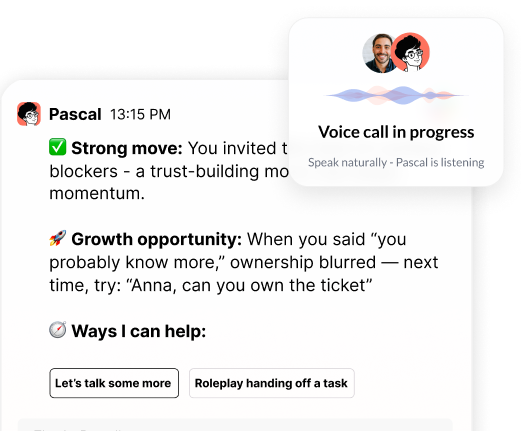
AI coaching is transforming leadership development by making personalized guidance accessible to all employees, not just executives. When Pascal, Pinnacle's AI coach, integrates with your workplace ecosystem, it understands each manager's role, their team composition, recent performance reviews, career aspirations, and even communication patterns from meeting transcripts. This contextual foundation transforms generic advice into personalized guidance that accounts for specific team dynamics and organizational culture.
AI coaching combines contextual awareness, proactive engagement, and coaching expertise to drive measurable behavior change; chatbots provide generic answers without understanding your organization, requiring managers to repeatedly explain situations and translate advice into action. The differences manifest across five critical dimensions that directly predict adoption and impact.
Foundational expertise: AI coaches draw from ICF-certified coaching principles and 50+ leadership frameworks; chatbots synthesize general internet knowledge. This distinction means the guidance you receive is grounded in behavioral science, not statistical patterns from web content. Contextual awareness: AI coaches know team dynamics, performance history, and communication preferences from integrated data; chatbots require managers to explain situations repeatedly. Engagement style: AI coaches proactively deliver feedback after meetings and before difficult conversations; chatbots wait passively for questions. Workflow integration: AI coaches embed in Slack, Teams, Zoom where managers already work; chatbots require separate logins and context-switching. Sensitive topic handling: AI coaches escalate appropriately to HR with guardrails; chatbots provide risky advice on terminations and harassment without safeguards.
Organizations using contextual AI coaching report 83% of colleagues see measurable improvement in their managers, compared to single-digit impact from generic tools. Recent industry research shows 57% of professional coaches believe AI cannot deliver real coaching when divorced from organizational context, validating the distinction between purpose-built systems and repurposed general tools.
Purpose-built AI coaches achieve 80%+ adoption with measurable behavior change; generic chatbots see adoption drop to 10-20% as managers realize advice lacks relevance to their specific situations.
| Factor | Chatbots | AI Coaching |
|---|---|---|
| Training source | General internet content | People science, coaching frameworks, behavioral research |
| Context awareness | None; starts fresh each conversation | Deep integration with HRIS, performance data, team dynamics |
| Proactive engagement | Reactive only | Identifies coaching moments automatically |
| Where it lives | Separate application | Slack, Teams, Zoom, embedded in workflow |
| Sensitive topics | No guardrails; provides risky advice | Clear escalation protocols to HR |
| Adoption rate | 10-20% sustained usage | 80%+ engagement, 2.3 sessions/week average |
| Manager behavior change | Minimal; knowledge without application | Measurable; 20% lift in Manager NPS among engaged users |
Context eliminates friction and enables personalization at the level that drives behavior change. When an AI coach knows your team members' communication styles, recent feedback, and career goals, guidance becomes immediately actionable rather than theoretical. Reduces time wasted re-explaining situations; coaching addresses actual challenges with full understanding of team dynamics. Integrates with your specific values, competency frameworks, and culture so guidance reflects your organization's reality. When Pascal integrates with your HRIS, performance management tools, and communication platforms, it builds comprehensive understanding of each manager and their team, tailoring every coaching moment to reflect your organization's reality rather than generic best practices.
Eliminates the gap between how managers perceive their leadership and how teams actually experience it. Pascal observes actual interactions in meetings, providing feedback grounded in behavior rather than self-reported situations. This objective perspective surfaces blind spots that managers might miss entirely. Creates consistent development habits through real-time feedback tied to specific people and moments.
Choose AI coaching when you need measurable manager effectiveness, faster ramp time for new leaders, or consistent feedback quality across your organization. Choose chatbots only if supplementing existing programs with occasional reference material. The business case for AI coaching justifies investment through ROI: faster manager development, improved team retention, higher engagement scores.
Chatbots cost less initially but deliver minimal business impact; organizations need manager effectiveness at scale. Purpose-built platforms cost 1/20th to 1/100th of human executive coaching while providing more consistent support. Implementation takes days, not months; quick pilots reveal whether coaching becomes a trusted daily resource or another underutilized tool.
"If we can finally democratize coaching, make it specific, timely, and integrated into real workflows, we solve one of the most chronic issues in the modern workplace."
Pascal integrates organizational context, behavioral data, and proactive engagement to provide personalized guidance that managers trust and apply daily, unlike generic tools that provide the same advice to every user regardless of their specific situation. Purpose-built systems designed specifically for coaching journeys deliver the contextual depth, behavioral science foundation, and organizational customization that makes coaching accessible to every manager rather than just senior leaders.
Integrates with performance reviews, 360 feedback, competency frameworks, and meeting transcripts. Joins meetings to observe actual team dynamics rather than relying on manager descriptions. Proactively surfaces coaching after meetings and before critical conversations. Includes sophisticated guardrails and escalation protocols for sensitive employee topics. Customizable to your company's values and leadership frameworks.
Key Insight: The difference between Level 3 and Level 4 AI coaching isn't just better AI. It's AI that knows your organization deeply enough to provide guidance that feels custom rather than generic, proactive enough to create consistent development habits, and integrated enough that using it requires zero extra effort.
Organizations implementing Pascal with these principles consistently report that contextual coaching becomes a retained competitive advantage. Managers develop faster, teams perform better, and the HR function gains capacity for strategic work rather than constant firefighting. The manager problem won't go away without thoughtful support in the moments that matter most, and AI coaching finally makes that support accessible at scale.
"Real learning and value come from in-context coaching in the moment to drive performance and to solve problems in the moment."
The question for CHROs isn't whether AI will transform manager development. It already is. The question is whether your organization will adopt AI coaching that truly understands your people, culture, and challenges, or settle for generic tools that provide the appearance of innovation without the substance of impact. Context makes the difference. Book a demo to see how Pascal's contextual approach drives measurable manager effectiveness improvements, from faster ramp time for new leaders to higher-quality feedback conversations and sustained behavior change that proves training ROI.

.png)
.webp)
“Thank you for setting the great foundation for my promotion; now I have a plan!"

Curious to see how AI Coaching can 10X the impact and scale of your development initiatives. Book a demo today for: