

AI coaching integrates organizational context, behavioral frameworks, and real-time work patterns to deliver personalized leadership development in the flow of work. Chatbots respond to queries with generic advice. The distinction determines whether your managers develop sustainable skills or abandon the tool within weeks.
AI coaching platforms and chatbots serve different purposes. AI coaching platforms are purpose-built for leadership development with coaching methodologies and behavioral change frameworks. Chatbots are conversational interfaces designed to answer questions, not to change behavior over time.
The coaching industry reached $6.25 billion in 2024 and is projected to hit $7.3 billion in 2025. CHROs need to understand what they're buying: a reactive Q&A tool or a development system that changes behavior.
Chatbots wait for users to ask questions and provide generic responses. AI coaches observe communication patterns and deliver personalized feedback without being asked.
The chatbot approach: A manager types "How do I give difficult feedback?" and receives a generic article pulled from public internet data. The manager reads it, closes the tab, and forgets about it by the next meeting.
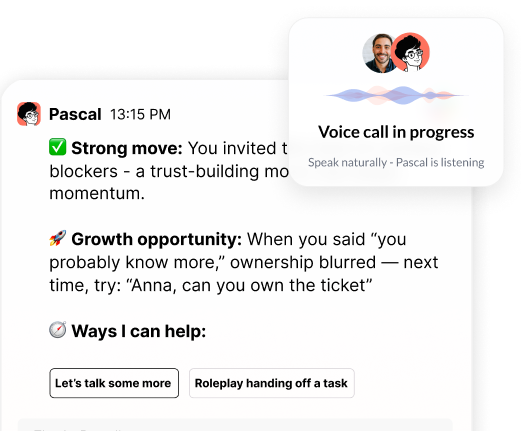
The AI coaching approach: Pascal joins your 1:1, observes the conversation in real-time, and sends post-meeting feedback: "You asked great questions but didn't address the performance gap. Here's how to approach it next time based on your direct report's communication style and your company's feedback framework."
This proactive model meets managers in the moments that matter—during difficult conversations, not days later when the context has faded.
Generic chatbots provide one-size-fits-all advice. AI coaches are trained on your specific competencies, leadership principles, and organizational context to deliver guidance that aligns with how your company works.
Chatbots know general management principles from public internet data. AI coaches know your company's leadership competencies, cultural values, performance review frameworks, individual employee goals, role-specific challenges, and team dynamics.
Pascal builds a knowledge graph of your organization—understanding not just what managers ask but who they're managing, what challenges their teams face, and how your culture defines success. This contextual awareness is why Pascal acts differently for a VP of Sales versus an entry-level HR person.
According to Jeff Diana, former CHRO at Calendly, Atlassian, and SuccessFactors: "Real learning and value come from in-context coaching—solving problems in the moment, not in a classroom." Without organizational context, coaching remains generic and managers don't trust it enough to apply it.
Chatbots provide information. AI coaches apply structured behavioral frameworks—like GROW (Goal, Reality, Options, Will), CLEAR (Contracting, Listening, Exploring, Action, Review), or situational leadership models—to guide managers through real challenges and build habits over time.
AI coaching platforms are trained by ICF-certified coaches (International Coaching Federation, the industry's leading credentialing body) who embed proven coaching methodologies into the system. Pascal doesn't just tell you what to do—it asks questions that help you think clearly, act decisively, and grow through real situations.
Behavioral change requires iteration. AI coaches track progress, reference past conversations, and adjust guidance as managers develop. Traditional eLearning often has low utilization unless required for compliance. AI coaching creates ongoing engagement because it solves problems managers face today, not theoretical scenarios they might encounter someday.
Chatbots require managers to leave their workflow, open a separate platform, and describe their situation. AI coaches embed directly into the tools managers already use—Slack, Teams, Zoom, Google Meet—delivering guidance where work happens.
Pascal integrates with your existing tech stack, appearing as a meeting companion and Slack/Teams assistant. Managers can get help live during a meeting or receive immediate post-meeting feedback without doing anything extra. When tools require going to external environments, engagement drops.
Other solutions force managers to set up role-plays in separate platforms. Pascal delivers value from meetings already happening.
AI coaching occupies a position between expensive human coaching (thousands per person annually), low-engagement eLearning platforms, and basic performance management tools. It delivers personalized development at a fraction of traditional coaching costs.
Traditional coaching is effective but doesn't scale. AI coaching scales what human coaches do best—helping people think clearly about complex situations. Performance management tools track outcomes but don't develop the skills that drive those outcomes. AI coaching fills the gap between knowing what to do and doing it consistently.
The most critical factors are the coach's foundational expertise, its contextual awareness, and how it integrates into daily work. Generic chatbots wrapped in coaching language will fail. Purpose-built systems trained by professional coaches with deep organizational integration will succeed.
Foundational expertise: Is the AI trained by professional coaches using proven methodologies, or is it a large language model with a coaching prompt? Pascal's coaching models are trained by ICF-certified coaches who embed frameworks like GROW and situational leadership into the system's architecture.
Contextual awareness: Does the platform understand your culture, values, and people? Can it reference past conversations, individual goals, and team dynamics? Pascal builds a knowledge graph of your organization, adapting guidance to role, function, and developmental stage.
Workflow integration: Does it require managers to leave their tools and describe situations, or does it observe real work and deliver guidance in context? Pascal joins meetings, lives in Slack and Teams, and provides feedback without managers having to ask.
Privacy and security: Is the platform SOC2 compliant? Does it train models on your data? Pascal is SOC2 compliant and never uses customer data to train models. Your conversations remain private and protected.
Organizations rushing to adopt AI coaching without understanding these distinctions face three major risks: wasted investment in tools managers don't use, privacy concerns from uncontrolled AI usage, and missed opportunities to scale effective development.
Wasted investment: When managers try a tool once and never return, you've paid for shelf-ware. The difference between success and failure is whether the tool solves real problems in the flow of work.
Privacy concerns: Employees are already using ChatGPT to discuss workplace challenges, including sensitive topics like layoffs and terminations. Without a controlled, privacy-first environment, you have no visibility into what's being shared or how it's being used.
Missed development opportunities: When coaching remains generic, managers don't trust it enough to change behavior. You miss the chance to scale effective development across your organization, leaving first-time managers without support.
Success metrics for AI coaching differ from traditional learning platforms. Focus on behavioral change indicators, manager confidence scores, and direct report feedback rather than completion rates or time spent in the platform.
Behavioral change indicators: Are managers applying guidance in real situations? Pascal tracks whether managers implement feedback from coaching sessions, measuring actual behavior change rather than content consumption.
Manager confidence scores: Do managers feel more prepared for difficult conversations? Organizations using Pascal report increased confidence and satisfaction.
Direct report feedback: Are teams noticing improvements? Direct reports provide the clearest signal that coaching translates into better manager effectiveness.
Time savings: Are managers getting answers faster? Companies using Pascal report time saved by eliminating searches for guidance or waiting for scheduled coaching sessions.
Traditional metrics like completion rates and time-on-platform don't predict whether managers will change behavior. Focus on outcomes that matter: better conversations, stronger teams, and managers who feel supported.
• AI coaching platforms use organizational context, behavioral frameworks, and proactive delivery to change manager behavior—chatbots provide generic, reactive responses that managers quickly abandon
• Purpose-built AI coaches integrate into daily workflow (Slack, Teams, meetings) and deliver guidance in the moments that matter, eliminating the friction that kills adoption
• Effective AI coaching costs a fraction of traditional coaching while democratizing development across all managers, not just executives
• When evaluating vendors, prioritize foundational coaching expertise (ICF-certified training), contextual awareness (knowledge graphs of your organization), and privacy protections (SOC2 compliance, no model training on customer data)
• Success metrics should focus on behavioral change, manager confidence, and direct report feedback rather than traditional learning platform metrics like completion rates
Pascal delivers AI coaching where your managers already work—in Slack, Teams, and meetings. No separate platforms. No extra steps. Just personalized guidance when it matters most.

.png)
.webp)
“Thank you for setting the great foundation for my promotion; now I have a plan!"

Curious to see how AI Coaching can 10X the impact and scale of your development initiatives. Book a demo today for: