

Embedding your AI coach directly into the tools managers already use—Slack, Teams, Zoom—drives 3-5x higher adoption and measurable behavior change compared to standalone portals. Where your coach lives determines whether it becomes a daily habit or another underutilized tool.
Quick Takeaway: Embedding your AI coach into collaboration platforms eliminates friction that kills adoption. Organizations embedding AI coaching into Slack, Teams, and Zoom see adoption rates of 65-85% compared to 10-20% for standalone portals. The difference comes down to meeting managers where they already work rather than asking them to adopt another tool.
The strategic question for CHROs isn't whether to implement AI coaching. It's where that coaching should live in your organizational architecture. This decision determines adoption rates, engagement patterns, and whether your investment transforms manager effectiveness or becomes expensive shelfware that gathers dust after the initial pilot phase.
Embedding means your AI coach lives inside the communication and meeting platforms managers already use daily, rather than requiring them to log into a separate application. This integration eliminates friction that kills adoption. Standalone portals require deliberate action: remembering the tool exists, logging in, re-explaining context. Workflow embedding meets managers where they already work dozens of times daily.
Meeting integration enables real-time observation of actual leadership behavior and immediate feedback. Full ecosystem integration connects to HRIS and performance systems for personalized guidance. Organizations embedding AI coaching throughout the employee lifecycle see adoption rates above 80% and measurable improvements in manager effectiveness. The placement decision determines whether coaching becomes a consistent daily habit or another tool managers tried once and abandoned.
Managers using embedded AI coaches average 2.3 coaching sessions per week with 94% monthly retention, compared to less than one session monthly for standalone platforms that see engagement drop after initial novelty. The distinction isn't incremental. It's exponential.
Embedded coaching drives adoption rates above 80%, while standalone tools plateau at 10-20% within six months. The friction compounds: each additional step between recognizing a coaching need and receiving guidance reduces follow-through exponentially. Proactive coaching drives 40% faster skill development than reactive tools because guidance arrives at teachable moments when learning sticks best. 83% of direct reports see measurable improvement in their managers when coaching is deeply embedded, versus minimal sustained impact from portal-based tools.
Organizations embedding AI coaching see faster manager ramp time, higher quality feedback, improved performance review consistency, and measurable behavior change—outcomes that don't materialize with standalone tools. The business case for embedding extends beyond adoption metrics to tangible performance improvements.
AI-coached sales representatives achieved 19.7% higher conversion rates compared to human-only coaching, with results concentrated in high-velocity environments where real-time pattern recognition provides advantages. Time savings compound: a tech company using embedded AI coaching for 50 employees estimated saving 150 hours in the initial rollout through reduced HR escalations and faster meeting follow-up. Manager Net Promoter Score increases average 20% among highly engaged embedded users, with improvement concentrated among managers who needed development most. 58% of L&D professionals believe AI enhances leadership training when embedded into daily workflows, compared to skepticism about standalone platforms.
Purpose-built AI coaches combine specialized coaching expertise with embedded delivery, while generic tools integrate general-purpose AI into workflows without coaching methodology. This distinction determines sustained engagement and behavior change. Purpose-built platforms like Pascal maintain 94% monthly retention through relevance and proactivity; generic embedded tools see engagement decline once managers realize guidance lacks organizational context.
Contextual awareness—integrating performance data, team dynamics, and cultural values—eliminates friction and drives 2.3 sessions per week versus sporadic usage. Generic embedded tools operate reactively, waiting for questions; purpose-built coaches proactively surface coaching moments after meetings and before difficult conversations. Organizations with multi-platform integration see 80-95% adoption; single-layer integrations achieve 30-50%; standalone tools plateau at 10-20%.
The strongest implementations combine meeting integration, workflow embedding, and HRIS connection, with clear escalation protocols for sensitive topics. This multi-layered approach drives the highest adoption and measurable behavior change.
Meeting integration allows AI to observe actual team dynamics and deliver specific feedback immediately after interactions, when learning sticks best. Workflow embedding into Slack, Teams, or Google Meet eliminates context-switching friction and makes coaching part of daily work. HRIS connection enables personalization without requiring managers to re-explain situations. Sensitive topic guardrails protect both employees and the organization while maintaining coaching support for appropriate situations. Organizations embedding AI throughout the employee lifecycle see adoption rates above 80% and measurable improvements in manager effectiveness.
| Integration Level | Adoption Rate | Sustained Engagement |
|---|---|---|
| Standalone portal | 10-20% | Declines rapidly |
| Meeting integration only | 45-60% | Moderate |
| Workflow embedding | 65-80% | High (2.3x/week) |
| Full ecosystem integration | 80-95% | Very high (94% retention) |
Usage concentrated in small groups, generic questions lacking context, sharp engagement drops after week two, and shadow AI usage all signal integration isn't embedded deeply enough into daily workflow. These patterns don't indicate vendor failure; they indicate integration depth doesn't match adoption goals.
Most can be fixed by deepening integration, improving change management, or adjusting which features you've enabled. Effective change management includes executive visibility where leaders reference coaching insights, concrete use cases showing specific scenarios, and clear guardrails explaining when AI escalates to humans. Managers rarely need help in a workshop—they need it when preparing for a tough 1:1 or in the middle of a team conflict, which is why embedding matters more than feature sophistication.
"If we can finally democratize coaching, make it specific, timely, and integrated into real workflows, we solve one of the most chronic issues in the modern workplace."
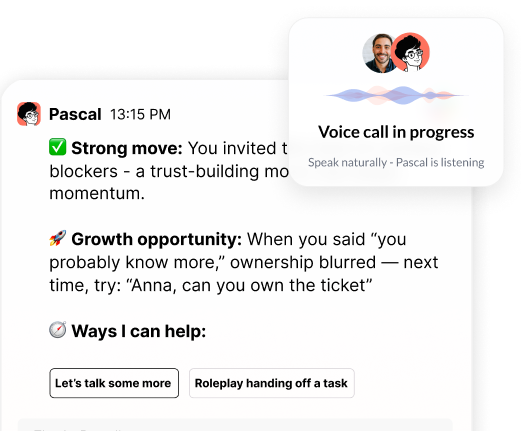
Pascal lives inside Slack, Teams, Zoom, and Google Meet—meeting managers exactly where they already work. The platform's contextual awareness means coaching adapts to each manager's situation, their team's dynamics, and your organization's culture. Meeting integration enables real-time observation of actual leadership behavior. Workflow embedding eliminates the friction that kills adoption. Organizations embedding AI throughout the employee lifecycle see adoption rates above 80% and measurable improvements in manager effectiveness.

.png)
.webp)
“Thank you for setting the great foundation for my promotion; now I have a plan!"

Curious to see how AI Coaching can 10X the impact and scale of your development initiatives. Book a demo today for: