
Embedding an AI coach directly into the tools managers already use—Slack, Teams, Zoom—drives adoption rates 3-5 times higher than standalone portals and creates sustained engagement that transforms manager effectiveness. When coaching lives where work happens, adoption becomes automatic rather than aspirational.
Quick Takeaway: The placement of your AI coach determines whether managers use it consistently or abandon it within weeks. Organizations embedding AI coaching directly into collaboration platforms see 65-80% adoption rates compared to 10-20% for standalone portals, with managers averaging 2.3 coaching sessions weekly versus less than one monthly for portal-based approaches.
The question of where your AI coach should live isn't technical. It's strategic. In our work implementing AI coaching across organizations, we've observed a consistent pattern: the most impactful deployments aren't determined by AI sophistication or feature breadth. They're determined by integration depth. When Pascal, Pinnacle's AI coach, lives inside the communication and meeting platforms where managers already spend their time, coaching becomes part of daily work rather than another tool competing for attention.
Embedded AI coaching means the system lives inside collaboration platforms and meeting tools rather than requiring managers to log into a separate application. This eliminates friction, enables proactive guidance, and integrates coaching into daily workflow.
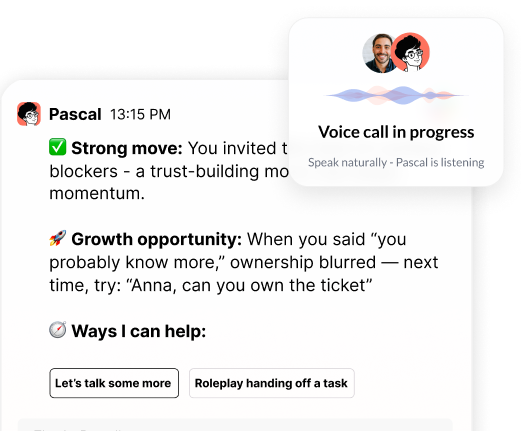
Pascal joins Slack conversations, Teams channels, and Zoom meetings where managers already spend their time. Managers access coaching through voice or chat without context-switching to another platform. The AI coach observes real team interactions and surfaces feedback immediately after meetings. Proactive nudges arrive in existing communication tools, not via separate notifications.
The technical architecture matters less than the practical outcome: managers maintain 94% monthly retention with an average of 2.3 coaching sessions per week when coaching is embedded. This sustained engagement reflects how adults actually learn—through doing, immediate feedback, and integration with real work rather than separated learning activities.
Organizations embedding AI coaches into collaboration platforms see adoption rates 3-5 times higher than those deploying standalone solutions. The distinction reflects how friction compounds across decision points.
Standalone portals require deliberate action: remembering the tool exists, logging in, navigating to the right section, and re-explaining context. Each step creates exponential drop-off. Research from HubSpot, Zapier, and Marriott shows that embedded approaches drive adoption rates above 80%, compared to 15-25% for portal-based deployments.
Workflow embedding eliminates the remembering problem that defeats most learning tools. Pascal maintains high engagement because coaching appears where managers already work. Engagement patterns show sustained usage over months rather than novelty-driven spikes that fade. 65-80% adoption rates for embedded platforms versus 10-20% for standalone portals represent the difference between transformation and experiment.
When AI coaches join virtual meetings, they observe actual leadership behavior in real time and deliver specific, contextual feedback immediately after interactions. This creates learning moments tied directly to real situations rather than hypothetical scenarios.
Pascal analyzes meeting dynamics and provides immediate post-meeting feedback grounded in specific moments. Example feedback: "Strong move inviting the team to surface blockers. Growth opportunity: when you said 'you probably know more,' ownership blurred. Next time, try: 'Anna, can you own the ticket?'"
Proactive coaching creates consistent development habits that drive sustained behavior change. Managers receive guidance when learning sticks best—immediately after the triggering event. This contextual awareness enables personalization at scale, with 83% of colleagues reporting measurable improvement in their managers when coaching is deeply embedded.
Integration depth determines adoption success. Five models exist, ranging from standalone portals (10-15% adoption) to full ecosystem integration connecting HRIS, performance systems, and communication platforms (80-95% adoption).
Standalone portals create the highest friction and lowest adoption. Email-based coaching improves slightly but remains reactive and context-limited. Meeting integration through Zoom or Google Meet provides observational feedback but requires separate access. Workflow platform embedding into Slack or Teams eliminates friction while enabling proactive coaching. Full ecosystem integration connects all systems for truly personalized, pervasive support.
| Integration Level | Typical Adoption Rate | User Friction | Context Awareness |
|---|---|---|---|
| Standalone portal | 10-15% | High | Limited |
| Email-based | 30-40% | Medium | Moderate |
| Meeting integration | 45-60% | Low | High |
| Workflow embedding | 65-80% | Very low | High |
| Full ecosystem | 80-95% | Very low | Very high |
Embedding eliminates friction that kills engagement. When coaching requires no tool-switching, login delays, or context re-explanation, managers use it consistently as part of daily routines rather than treating it as a separate learning activity.
Friction compounds exponentially. Each additional step before getting coaching reduces follow-through. Voice-based coaching in Slack or Teams lets managers talk through challenges naturally, like speaking with a colleague. Proactive notifications appear in familiar tools, making coaching feel like a helpful message rather than a task.
Integration into existing workflows transforms coaching from aspirational to habitual. When managers can access coaching without context-switching, engagement increases dramatically. The difference between remembering to log into a portal and having coaching appear in your Slack thread determines whether development becomes consistent or episodic.
Deep workflow integration allows AI coaches to access performance data, team structures, meeting transcripts, and organizational documentation, enabling truly personalized guidance that generic tools cannot provide.
Contextual awareness requires data access that only embedded systems can obtain safely. Pascal synthesizes performance reviews, 360 feedback, career goals, and real-time interactions to personalize every coaching moment. 83% of colleagues see measurable improvement in their managers when coaching is deeply embedded because personalization builds trust that sustains adoption over time.
Organizations report that embedded coaching with company-specific data delivers 57% higher course completion rates, 60% shorter completion times, and 68% higher satisfaction scores compared to generic tools. Personalization drives the engagement that creates lasting behavior change.
Implementation success depends on clear communication about data usage, executive sponsorship that models engagement, integration with existing L&D programs, and metrics focused on leading indicators like session frequency and behavior change.
Start with specific use cases—feedback preparation, delegation, 1:1 facilitation—rather than vague "become a better manager" messaging. Executive visibility matters: when leaders reference insights from their AI coach, managers feel permission to use it. Measure engagement frequency and behavioral application in real situations, not just satisfaction scores.
Treat embedding as ongoing conversation with the organization, not one-time announcement. Organizations that communicate transparently about what data the AI coach accesses and how privacy is protected see faster adoption across all demographics.
Watch for usage concentrated in small groups, generic questions lacking context, sharp engagement drops after week two, and shadow AI usage where managers use ChatGPT instead of your official coach.
These patterns signal integration isn't embedded deeply enough into daily workflow. Most can be fixed by deepening integration, improving change management, or adjusting enabled features. Rapid iteration based on early signals prevents failed pilots from becoming abandoned tools.
"Managers rarely need help in a workshop—they need it when preparing for a tough 1:1 or in the middle of a team conflict."
The question "where should your AI coach live?" has a clear answer: everywhere your managers work. That means deep integration into Slack, Teams, and meeting platforms where coaching happens proactively without friction.
Pascal demonstrates this principle by living inside your existing workflow tools, joining meetings to observe real team dynamics, and delivering personalized feedback based on your company's actual data and culture. The result is coaching that managers use 2.3 times weekly with 94% monthly retention because it meets them where they already work.
Book a demo to see how Pascal's embedded approach transforms adoption and drives measurable improvements in manager effectiveness across your organization.

.png)
.webp)
“Thank you for setting the great foundation for my promotion; now I have a plan!"

Curious to see how AI Coaching can 10X the impact and scale of your development initiatives. Book a demo today for: