

AI coaching outperforms traditional training because it delivers guidance in the flow of work, provides continuous reinforcement through spaced repetition, and adapts to individual context, creating sustained behavior change instead of forgotten content. Traditional LMS platforms see 5-15% engagement within six months; AI coaching maintains 94% monthly retention with 2.3 sessions per week. The difference comes down to fundamentals: where learning happens, how often it reinforces, and whether guidance reflects organizational reality.
Quick Takeaway: AI coaching outperforms traditional training and LMS content by delivering personalized guidance at the moment managers actually need it, using spaced repetition to combat the forgetting curve, and adapting to individual context and organizational culture. Purpose-built AI coaching platforms achieve effect sizes nearly identical to human coaching while democratizing access to every manager rather than just executives.
Traditional training separates learning from application through scheduled events; AI coaching embeds guidance into daily work where managers actually need it, enabling immediate practice and habit formation. Employees forget 90% of training content within a week according to the Ebbinghaus forgetting curve, yet AI coaching achieves effect sizes nearly identical to human coaching (AI: ηρ² = .269; human: ηρ² = .265) for goal attainment, with 96% of users reporting customized guidance.
The gap shows up in how learning happens. Training happens in isolation; AI coaching happens in Slack, Teams, and meetings where work occurs. One-time learning events fail to drive behavior change; continuous reinforcement creates lasting habits. Managers must remember to apply training weeks later; AI surfaces coaching at the moment of need.
The future of leadership development is embedded in daily workflows, not separated from work. When a manager faces a difficult one-on-one conversation, they need help in that moment, not in a workshop three months prior. This immediacy is what transforms coaching from theoretical knowledge into practical skill.
Generic advice applies nowhere specifically; contextual coaching integrates performance data, team dynamics, and organizational values to deliver guidance managers can implement immediately. ChatGPT provides frameworks any manager anywhere could use; Pascal knows your team member's communication style, career goals, and performance history to deliver specific guidance grounded in reality.
LMS modules treat all managers identically; contextual AI personalizes based on role, level, and development focus. Generic training ignores organizational culture; purpose-built coaching reinforces your specific values and competencies. Managers waste time explaining situations before receiving help; contextual systems already understand the dynamics. One-size-fits-all advice creates low adoption; personalized guidance drives sustained engagement.
The business impact of this distinction is measurable. Organizations using contextual AI coaching report 57% higher course completion rates and 60% faster time to completion compared to traditional methods. The difference stems from relevance. When a manager asks for help preparing feedback for a specific employee, contextual AI knows that person's communication preferences, recent projects, and career goals. The guidance becomes immediately actionable rather than requiring translation.
AI coaching provides 24/7 availability, consistent framework application, proactive identification of coaching moments, and scalability to every manager while complementing rather than replacing human coaches for complex situations. Human coaches operate reactively; AI coaches proactively surface development opportunities after meetings and interactions. Human coaching costs $1,500-3,000 per person annually; AI coaching costs $150 per person, enabling democratization across the organization.
Coaches see clients every two weeks; AI coaches engage multiple times weekly through integration into daily workflows. Human coaches have limited availability; AI provides immediate support when managers face real decisions. Research shows AI coaching achieves effect sizes nearly identical to human coaching for goal attainment, with 96% of users reporting customized guidance.
"AI coaching presents a pivotal opportunity for organizations to extend development to every worker. When used thoughtfully, it can democratize growth, magnify human coaches' impact, and transform how companies build leadership capability."
Organizations see measurable improvements in manager effectiveness, team engagement, and time savings within 90 days—outcomes traditional training rarely delivers. 83% of direct reports report measurable improvement in their managers after sustained AI coaching use. Manager Net Promoter Score increases 20% among highly engaged users. Organizations save 150+ hours in manager development time per 50-person rollout.
Course completion rates reach 57% higher with AI-powered reinforcement versus traditional methods. 79% of employees receiving 5+ hours of AI training become regular users, compared to 67% with less exposure. These aren't vanity metrics. They reflect actual behavior change that shows up in team performance and engagement scores.
The time savings compound across organizations. A technology company with 50 managers using Pascal estimated saving 150 hours in their initial rollout. These hours come from eliminated redundant training, reduced HR escalations for routine coaching questions, and more efficient performance review preparation. When managers get guidance in the flow of work, they spend less time searching for resources or waiting for HR availability.
Continuous reinforcement in the flow of work builds muscle memory that one-time training events cannot match, with proactive engagement creating consistent touchpoints that transform development from episodic to habitual. Spaced repetition—AI coaching's natural rhythm—scientifically combats the forgetting curve that defeats traditional training. Proactive nudges after meetings create coaching moments managers wouldn't recognize independently.
Integration into Slack, Teams, and Zoom eliminates friction that kills adoption of standalone platforms. Weekly check-ins and goal tracking maintain momentum between major development milestones. Real-time feedback on actual interactions (not hypothetical scenarios) accelerates skill application. When managers receive proactive guidance after meetings and interactions, they develop skills 2-3 times faster than those relying on reactive support.
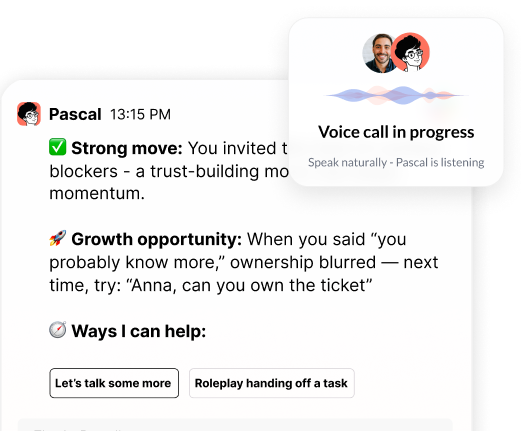
Pascal demonstrates this through post-meeting feedback and daily check-ins. After a team standup, managers receive specific observations about delegation patterns or communication dynamics. The feedback arrives when context is fresh, implementation is straightforward, and the manager can immediately apply insights to subsequent interactions. This consistent reinforcement builds new habits faster than annual training programs ever could.
AI coaching excels for foundational skills every manager needs (feedback, delegation, goal-setting); human coaches remain essential for complex organizational dynamics and sensitive HR topics. AI handles routine coaching; humans handle nuanced judgment and ethical complexity. Hybrid models combining AI for daily guidance and human coaches for strategic situations deliver highest satisfaction (8.4/10).
Purpose-built platforms like Pascal include guardrails that escalate harassment, termination, and medical issues to HR. AI coaching democratizes access; human coaching focuses on high-stakes situations requiring deep expertise. Organizations implementing hybrid models see balanced performance gains while maintaining sustainable workloads.
| Coaching Need | Best Approach | Why |
|---|---|---|
| Feedback, delegation, 1:1 skills | AI coaching | High-frequency, benefit from continuous practice |
| Performance management, goal-setting | AI coaching | Structured frameworks, benefit from real-time application |
| Terminations, harassment, legal issues | Human expertise | Require compliance, legal awareness, HR oversight |
| Complex organizational politics | Human coaches | Require contextual knowledge, strategic judgment |
Purpose-built coaching expertise, deep contextual integration, proactive engagement, workflow integration, and robust escalation protocols distinguish effective solutions from generic chatbots. Assess whether the platform is trained on coaching methodologies or repurposed from general AI. Evaluate contextual depth: Does it access HRIS, performance data, communication patterns, and company culture?
Confirm proactive engagement: Does it surface coaching opportunities or only respond when asked? Verify workflow integration: Does it live in Slack/Teams or require separate logins? Check guardrails: How does it handle sensitive topics like terminations or harassment concerns? Leading CHROs from Atlassian, Calendly, and Peloton advise evaluating vendors on foundational coaching expertise, contextual depth, and escalation protocols rather than feature lists alone.
The vendors that survive long-term will be those combining deep coaching expertise with proper privacy safeguards and appropriate escalation to human judgment. Ask for specific examples of how the system handles termination discussions, harassment concerns, and mental health issues. Demand evidence of business outcomes beyond adoption metrics. Request case studies showing manager effectiveness improvements, team engagement changes, and time savings.
Key Insight: The gap between effective AI coaching and overpromised solutions comes down to whether the platform combines purpose-built coaching expertise with deep contextual awareness, proactive engagement, seamless workflow integration, and appropriate guardrails for sensitive topics.

.png)
.webp)
“Thank you for setting the great foundation for my promotion; now I have a plan!"

Curious to see how AI Coaching can 10X the impact and scale of your development initiatives. Book a demo today for: