

AI coaching delivers continuous, contextual guidance embedded in daily work, while traditional training and LMS platforms rely on scheduled events that employees forget within days. Purpose-built AI coaching (systems designed specifically for leadership development, not repurposed chatbots) maintains 94% monthly retention—Pascal's internal data from 2024 implementations—versus 5–15% engagement for typical LMS platforms (Gartner, 2024) because it provides real-time feedback when managers need it.
AI coaching transforms development from a scheduled event into a continuous experience that meets managers in their actual workflow. Traditional training delivers information at the wrong time—weeks before or after managers need it—while LMS platforms suffer from what Gartner calls "the engagement crisis," with most organizations seeing single-digit utilization within six months.
Traditional training requires dedicated time away from work. AI coaching embeds in Slack, Teams, and meeting tools where managers already spend their day. Training happens on a fixed schedule that rarely aligns with actual challenges. AI coaching provides guidance at the moment a manager faces a difficult conversation or team conflict.
Comparing the three approaches:
Data Breakdown:
• Dimension: Delivery | AI Coaching: Embedded in workflow tools | Traditional Training: Scheduled sessions | LMS Platforms: Self-paced modules
• Dimension: Timing | AI Coaching: Real-time, contextual | Traditional Training: Fixed calendar dates | LMS Platforms: Whenever employee remembers
• Dimension: Personalization | AI Coaching: Adapts to role, culture, context | Traditional Training: One-size-fits-all | LMS Platforms: Basic role segmentation
• Dimension: Engagement | AI Coaching: 94% monthly retention | Traditional Training: 70% forget within 24 hours | LMS Platforms: 5–15% after 6 months
• Dimension: Cost per employee | AI Coaching: $50–150 annually | Traditional Training: $500–2,000 per session | LMS Platforms: $200–500 annually (unused)
*Pascal internal data, 2024
**Ebbinghaus forgetting curve, replicated in corporate training studies
***Gartner L&D research, 2024
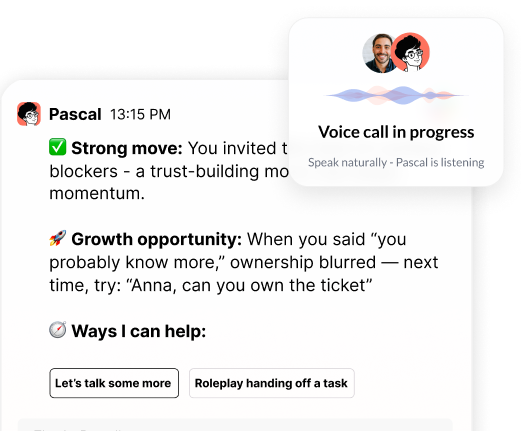
Pascal by Pinnacle exemplifies this shift. The platform joins meetings (via calendar integration and transcript access) to provide immediate feedback, learns from each interaction to deliver increasingly relevant guidance, and reaches out proactively when managers face situations requiring support—capabilities impossible in traditional training models.
Traditional training fails because it violates how adults learn: people need practice, feedback, and reinforcement in context, not information dumps followed by months of silence. Research from the Conference Board (2025) shows that AI coaching can provide up to 90% of the value of human coaching at a fraction of the cost.
The forgetting curve destroys traditional training effectiveness. Employees forget 70% of training content within 24 hours and 90% within a week without reinforcement (Ebbinghaus, replicated in corporate L&D studies). A manager attends a workshop on difficult conversations in January, then faces their first real conflict in March—with no memory of the frameworks they learned.
Three failure modes:
The transfer problem: Generic content doesn't map to specific organizational contexts. A case study about conflict resolution at a tech startup doesn't help a manufacturing supervisor navigate union dynamics. The skills exist in theory but never connect to practice.
The forgetting curve: Without reinforcement, training content disappears from memory within days. Managers can't apply what they don't remember.
The utilization gap: Organizations invest in comprehensive content libraries, announce the launch with enthusiasm, then watch engagement drop to single digits within six months. Employees don't return because content isn't tied to immediate needs. When a manager needs help with a performance conversation, they don't think "I should log into the LMS." They ask their boss, wing it, or avoid the conversation.
MIT research (2024) shows 95% of AI projects fail, but the same research reveals that purpose-built coaching systems succeed because they solve the "last mile" problem—connecting learning to actual work. Jeff Diana, former CHRO at Calendly and Atlassian, notes: "Real learning and value come from in-context coaching—solving problems in the moment, not in a classroom."
Pascal addresses these failures by maintaining 94% monthly retention through proactive engagement. Users average 2.3 coaching sessions per week (Pascal internal data, 2024) because the platform reaches out when managers need support, not when it's convenient for the training calendar.
AI coaching scales personalized guidance to every manager while maintaining 24/7 availability. The Conference Board's 2025 research confirms AI can deliver up to 90% of human coaching value, but only when purpose-built for coaching rather than repurposed from general chatbots.
Five capabilities that separate effective AI coaching from traditional approaches:
Proactive intervention: AI coaching joins meetings (via calendar integration and transcript analysis), observes team dynamics, provides feedback without waiting to be asked. A manager finishes a tense one-on-one, and within minutes receives specific guidance on what went well and what to adjust next time. Traditional training can't observe real interactions. LMS platforms wait passively for users to remember they exist.
Contextual memory: The AI remembers previous conversations and adapts guidance over time. When a manager asks about delegation, the AI recalls that three weeks ago they struggled with micromanaging and tailors advice accordingly. Traditional training treats every session as isolated. LMS modules have no memory of what you've already learned.
Cultural alignment: Purpose-built AI coaching trains on company-specific competencies, values, and leadership frameworks rather than generic best practices. A manager at a fast-moving startup receives different guidance than one at a risk-averse financial institution, even when facing similar challenges. Traditional training delivers the same content regardless of culture.
Immediate availability: Managers access coaching in Slack or Teams when they face difficult conversations, not weeks later in scheduled sessions. The moment they need help is the moment they get it. Traditional training happens when the calendar allows. LMS platforms require managers to recognize they need help, remember the platform exists, log in, search for relevant content, and apply it to their situation—a chain that breaks at every step.
Aggregated insights: AI coaching delivers anonymized trend data to HR leaders, revealing training needs and cultural patterns in real-time rather than waiting for annual engagement surveys. Organizations see where managers struggle most, which competencies need reinforcement, and how leadership behaviors align with stated values.
Results in the first 90 days (Pascal internal data, 2024):
• 83% of direct reports see improvement in manager effectiveness
• Managers save 150+ hours annually on routine guidance
• Manager NPS increases by 20%
Melinda Wolfe, former CHRO at Bloomberg and Pearson, frames the opportunity: "If we can finally democratize coaching—make it specific, timely, and integrated into real workflows—we solve one of the most chronic issues in the modern workplace."
Limitations to consider: AI coaching works best when integrated into existing workflows, not deployed as a standalone tool. Organizations need clear privacy policies around meeting observation and data usage. Cultural resistance from managers who prefer human coaching requires change management. Implementation takes 60–90 days to see full adoption. And AI coaching complements, not replaces, human coaching for complex situations requiring nuanced judgment.
Learn more about how AI coaching transforms leadership development
Purpose-built AI coaching platforms create individual learning paths based on role, performance data, and real-time work patterns, while LMS platforms deliver the same content to every user regardless of context or readiness. Harvard Business Impact's 2025 Global Leadership Development Study found that 55% of organizations now prioritize generative AI and machine learning in leadership development specifically because personalization drives measurably better outcomes.
Four layers of personalization:
Individual context: The AI knows your role, tenure, goals, performance history, communication style, and career aspirations. A first-time manager receives different guidance than a senior director, even when asking the same question about feedback. The AI adapts complexity, examples, and recommendations to match where you are in your development journey.
Organizational knowledge: The AI trains on company values, competencies, cultural norms, leadership frameworks, and internal processes. When you ask about handling conflict, you receive guidance that reflects your organization's approach to difficult conversations, not generic conflict resolution theory that might contradict your culture.
Temporal awareness: The AI understands performance review cycles, goal-setting seasons, team transitions, and organizational changes. Guidance shifts based on whether you're preparing for annual reviews, onboarding new team members, or navigating a reorganization. Traditional training ignores these cycles. LMS content remains static regardless of organizational context.
Behavioral patterns: The AI learns from meeting dynamics, decision-making tendencies, stress responses, and growth areas identified through 360 feedback (structured feedback from direct reports, peers, and managers). Over time, coaching becomes increasingly precise because the AI recognizes your patterns and adapts accordingly.
Contrast with LMS limitations: LMS platforms segment by role or level but cannot adapt content mid-course based on demonstrated understanding. A module on delegation delivers the same information whether you've already mastered the basics or you're completely new to the concept. Generic content cannot reference company-specific situations, making application difficult. An LMS module on performance conversations uses hypothetical examples that may not match your industry, company size, or cultural context.
Pascal demonstrates this difference by integrating with HRIS systems (human resources information systems that store employee data), performance management platforms, and communication tools to understand each manager's unique context. When a manager asks about handling a difficult performance conversation, Pascal references that manager's communication style, the employee's performance history, and the company's approach to feedback—delivering guidance that's immediately applicable rather than theoretically sound but practically useless.
• AI coaching delivers continuous, contextual guidance in daily workflows, maintaining 94% monthly retention (Pascal internal data, 2024) compared to 5–15% for LMS platforms (Gartner, 2024) because it provides real-time feedback when managers need it
• Traditional training fails because employees forget 70% of content within 24 hours (Ebbinghaus forgetting curve), generic material doesn't transfer to specific contexts, and LMS platforms see engagement drop to single digits within six months
• Purpose-built AI coaching provides five capabilities traditional methods cannot match: proactive intervention in real work moments, contextual memory that adapts over time, cultural alignment with company-specific frameworks, immediate 24/7 availability, and aggregated insights for HR leaders
• Effective AI coaching personalizes across four layers (individual context, organizational knowledge, temporal awareness, and behavioral patterns) while LMS platforms deliver standardized content regardless of readiness or role
• Organizations implementing AI coaching see measurable results within 90 days (Pascal internal data, 2024): 83% of direct reports report manager improvement, 150+ hours saved annually per manager, and 20% increase in manager NPS (Net Promoter Score, a measure of satisfaction)
See how Pascal works inside Slack, Teams, and your daily tools. Purpose-built AI coaching that adapts to your culture, learns from every interaction, and scales personalized guidance to every manager. Learn more about Pascal
Header photo by Vitaly Gariev on Unsplash

.png)
.webp)
“Thank you for setting the great foundation for my promotion; now I have a plan!"

Curious to see how AI Coaching can 10X the impact and scale of your development initiatives. Book a demo today for: