
Organizations should prioritize AI coaching when scaling personalized development across 50+ managers, accelerating skill acquisition for first-time leaders, reducing per-person training costs, or supporting distributed teams; traditional training remains better for foundational culture-building and complex emotional work. The decision hinges on specific organizational needs, constraints, and readiness rather than treating AI coaching and traditional training as either/or choices.
Quick Takeaway: Organizations should prioritize AI coaching when they need to scale personalized development to all managers, accelerate skill acquisition, reduce costs dramatically, or support distributed teams. The most effective approach combines AI coaching for foundational skill development with human expertise for complex situations, delivering measurable ROI and reaching 85% of employees versus human-only coaching that reaches only 15%.
The gap between manager capability and organizational need has never been wider. 70% of team engagement variance is determined by the manager, yet 60% of new managers receive zero formal training before stepping into their roles. Traditional training programs can't close this gap because they separate learning from application by weeks or months. By contrast, AI coaching meets managers in the flow of work where they face real challenges, delivering guidance when it matters most.
AI coaching delivers personalized guidance in the moment managers face real challenges; traditional training separates learning from application through isolated events weeks or months removed from actual need. The difference shows up immediately in how people learn and retain information. Managers forget 90% of training content within a week, yet AI coaching achieves effect sizes nearly identical to human coaching, with 94% monthly retention when integrated into daily workflows.
The research is unambiguous. Only 12% of learners apply training skills on the job, meaning organizations waste $90,000 per $100,000 training program to forgetting. Meanwhile, 75% of organizations rate traditional leadership programs as "not very effective". The pattern repeats across industries: companies invest heavily in training, see temporary engagement spikes, then watch behavior revert to old patterns when managers return to overwhelming inboxes.
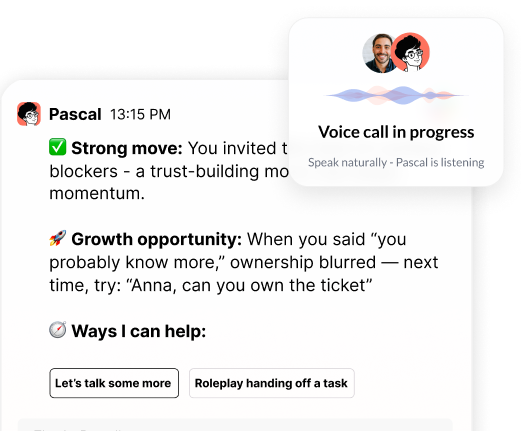
AI coaching solves this through continuous reinforcement in context. Rather than attending a workshop on delegation and then facing a delegation decision weeks later without support, managers using AI coaching receive guidance embedded in daily workflows, making new skills immediately applicable. Pascal demonstrates this by joining meetings, observing team dynamics, and delivering specific feedback within minutes of interactions when learning is most likely to stick.
Choose AI coaching when you need to scale coaching to all managers, accelerate skill development, reduce per-person costs dramatically, or support geographically distributed teams. Stick with or blend in traditional training for culture-building moments and complex emotional work requiring human judgment. The decision framework depends on five factors: organizational size, manager population needs, geographic distribution, budget constraints, and strategic priorities.
Scale beyond executives: Traditional coaching costs $3,000-$15,000 per manager annually; AI coaching costs $120-$150, enabling organizations to serve 20-100x more employees. This economics shift transforms the conversation from "Can we afford coaching for our top 5% of leaders?" to "How do we extend coaching to every manager?"
First-time managers need consistent practice: Foundational skills like delegation, feedback, and goal-setting benefit from continuous reinforcement that AI coaching provides through daily engagement. When managers receive proactive guidance after meetings and interactions, they develop skills 2-3 times faster than those relying on reactive support or annual training programs.
Distributed teams: Workflow-integrated AI coaching eliminates friction of in-person programs and scheduling constraints. Pascal lives inside Slack, Teams, and Zoom, making coaching accessible regardless of time zone or location. This integration is critical for organizations with remote or hybrid workforces where traditional classroom training creates logistical barriers.
Feedback quality varies dramatically: AI coaching levels capability across your management population by providing every manager with frameworks and practice opportunities. When direct reports report low manager quality or feedback inconsistency, AI coaching addresses the root cause through real-time guidance rather than hoping annual training sticks.
AI coaching excels at personalization, availability, and continuous reinforcement; traditional training excels at creating shared language and culture-building moments. Most organizations benefit from blended approaches that leverage the strengths of each. Hybrid models combining AI for routine coaching and human expertise for complex situations yield 450% ROI and reach 85% of employees, versus human-only coaching at 529% ROI but only 15% reach.
| Factor | Traditional Training | AI Coaching |
|---|---|---|
| Personalization | Generic for all | Tailored to individual context |
| Availability | Scheduled sessions | 24/7, in the moment |
| Cost per manager | $3,000-$15,000 | $120-$150 |
| Behavior change | Episodic, requires follow-up | Continuous reinforcement |
| Culture alignment | Explicit, shared learning | Requires customization |
| Measurement | Completion rates | Behavioral change, business outcomes |
You're ready when you have 50+ managers, high turnover among new leaders, or struggle with management consistency; you're not ready if you have fewer than 20 managers or prioritize culture-building as your primary lever. Readiness assessment requires honest evaluation of current state and organizational appetite for change.
You've invested heavily in training but see minimal behavior change in actual management moments. If your managers can articulate frameworks from last year's training but still avoid difficult conversations, that's a signal that training isn't translating to behavior change. AI coaching addresses this by reinforcing concepts at the moment they matter.
Manager effectiveness varies dramatically across your population, indicating inconsistent coaching quality. When some teams have engaged managers who develop people effectively while others struggle, AI coaching establishes a consistently high floor by providing every manager with frameworks and practice opportunities.
New managers struggle during their first 90 days without real-time support. This is the highest-impact intervention point for AI coaching. Organizations like HubSpot, Zapier, and Marriott are succeeding with AI coaching because they embed it into the early manager experience, providing consistent guidance when managers need it most.
Start with a 30-60 day focused pilot targeting your highest-pain management challenge, moving quickly rather than planning indefinitely; identify early adopters and measure both adoption frequency and direct report feedback. Organizations that pilot quickly, gather feedback, iterate, and expand see measurable ROI within 90 days.
Link AI coaching to existing organizational rituals like performance reviews and goal-setting cycles to drive sustained usage. Rather than treating AI coaching as a separate initiative, embed it into processes managers already engage with regularly. This integration approach dramatically improves adoption compared to asking managers to remember to use another tool.
Combine AI coaching with existing training rather than treating it as a replacement. The most effective organizations use AI to reinforce training concepts in the flow of work, bridging the gap between learning and application that traditional programs struggle to close.
"If we can finally democratize coaching, make it specific, timely, and integrated into real workflows, we solve one of the most chronic issues in the modern workplace."
Partner HR and IT early to address data integration and privacy concerns. IT needs to understand that AI coaching requires connections to HRIS, performance systems, and communication tools. HR needs to ensure the platform aligns with organizational values and includes appropriate guardrails for sensitive topics.
Organizations see faster manager ramp time, higher quality feedback conversations, improved performance review consistency, and measurable behavior change, outcomes traditional training rarely delivers. 83% of colleagues report measurable improvement in their manager when using contextual AI coaching. Among highly engaged users, 20% average lift in Manager Net Promoter Score appears within 90 days.
Time savings compound quickly at scale. One tech company with 50 employees using Pascal estimated saving 150 hours in their initial rollout. These time savings stem from eliminated redundant coaching requests, reduced need for managers to search for resources, and decreased escalations to HR for routine management questions.
57% course completion rates with AI-powered reinforcement versus traditional methods reflects the engagement advantage that workflow integration and personalization create. When learning happens in context and feels relevant, managers engage consistently rather than abandoning the platform after initial novelty.
Key Insight: The most compelling ROI story combines hard efficiency metrics (time saved, faster ramp) with soft outcome metrics (improved manager NPS, better feedback quality). CHROs need both to justify continued investment and expansion.
The most sophisticated organizations don't choose between AI and human coaching. They design hybrid models where AI handles high-frequency, skill-building interactions while human coaches focus on complex, high-stakes situations requiring nuanced judgment. This division of labor is economically powerful and strategically sound.
Human coaches can serve 3-4 times more managers effectively because AI handles routine interactions and administrative tasks. Pascal manages daily coaching on feedback, delegation, and goal-setting while human coaches focus on career transitions, complex organizational dynamics, and transformational work.
"Managers rarely need help in a workshop. They need it when preparing for a tough 1:1 or in the middle of a team conflict."
AI coaching achieves effect sizes nearly identical to human coaching at goal attainment, with the statistical difference negligible. This parity, combined with dramatic cost advantages, makes hybrid models the optimal approach for organizations seeking to maximize reach and impact while managing budget constraints.
Pascal exemplifies this hybrid approach by handling foundational skill development, providing safe practice environments for difficult conversations, and offering consistent engagement that builds habits. This frees human coaches to focus on the 10% of coaching situations that require deep emotional intelligence, complex judgment, and transformational work.
The choice between AI coaching and traditional training investments isn't binary. The organizations winning are those that understand when each approach delivers maximum value and design integrated systems that leverage both. Start with a clear assessment of your highest-pain management challenges, pilot with your most engaged managers, and expand based on measurable outcomes. Book a demo to see how Pascal's contextual awareness, proactive coaching, and workflow integration can accelerate your manager effectiveness and deliver measurable ROI without the cost or friction of traditional training approaches.

.png)
.webp)
“Thank you for setting the great foundation for my promotion; now I have a plan!"

Curious to see how AI Coaching can 10X the impact and scale of your development initiatives. Book a demo today for: